RP08 - Boyle's Law and Charles's Law
Plan and analyse the two gas-law investigations in required practical 8. Control the gas sample, connect force balance to pressure, test proportionality with graphs, and judge offsets and uncertainty before interpreting an extrapolation.
What each experiment must test
Boyle's and Charles's laws describe a fixed amount of gas under different controls. Boyle's law is at constant temperature. Charles's law is at constant pressure, with in kelvins. Sealing the sample keeps its amount fixed; the other control needs a separate method.
For Boyle's law, changing the load on a syringe plunger changes pressure and volume. Wait for the gas to return to room temperature after each change. For Charles's law, a short movable liquid thread traps air in a uniform capillary tube. Heating changes the air-column length while the movable thread keeps its pressure approximately constant.
In a uniform bore of area , air-column volume is . Therefore length can replace volume in the Charles's-law test, provided includes the whole trapped column and the cross-sectional area stays constant. A bulb or a large unmeasured sealed-end volume would invalidate simple .
Use absolute pressure, not just a gauge's pressure difference from the atmosphere. Also distinguish from a temperature difference: adding the offset is essential for ratios, but and have the same numerical value.
Syringe and capillary methods
The two methods need a stable gas sample and paired measurements after equilibrium. Choose an apparatus range that gives resolvable changes without exceeding pressure, temperature or travel limits. Record original readings and repeats in tables with units before calculating derived quantities. Read between analogue scale marks where justified, while retaining an uncertainty consistent with resolution and repeat scatter.
Boyle's law with hanging loads
Clamp a syringe barrel vertically with its nozzle upwards and plunger downwards. Seal the nozzle with short tubing and a secure clip close to the nozzle. A hanging load pulls the plunger out, so gas pressure is below atmospheric pressure. Use a stable stand, secure masses and a catch below the load; do not allow the plunger to leave the barrel.
[DIAGRAM: asset_slug: RP 08 - Investigation of Boyle's Law and Charles's Law for a Gas - Diagram 1; caption: Boyle’s-law syringe with an outward hanging load; description: Hanging-load syringe with sealed nozzle and supported stand.]
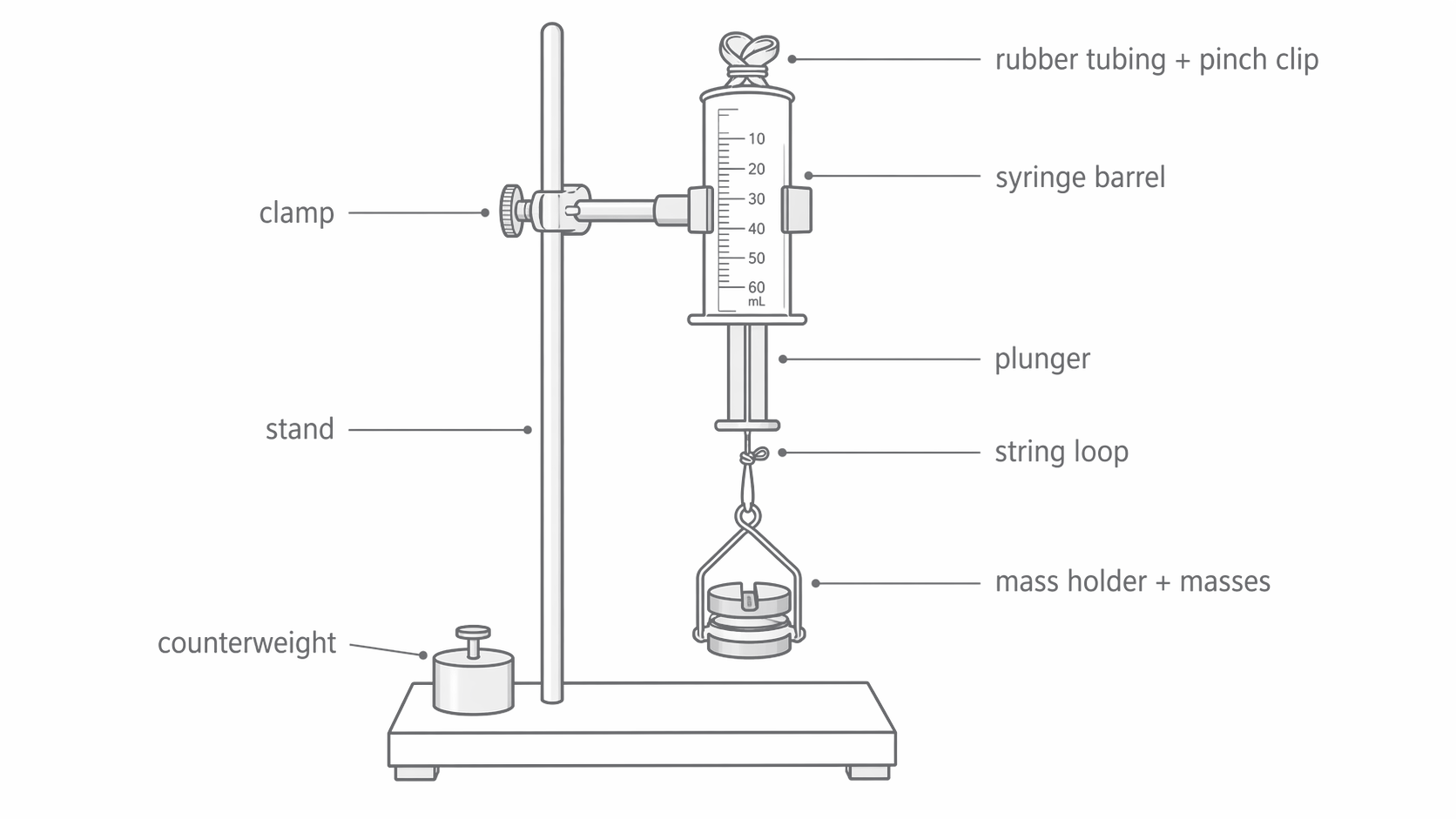
Hanging masses pull the downward-facing plunger outwards. The drawing shows a generic syringe scale; select the syringe size and load range for the actual apparatus.
Measure the effective seal diameter in several orientations with a suitable micrometer or calliper and find . Do not substitute the outside barrel diameter. Measure local atmospheric pressure with a barometer. Include the holder and plunger weight in the outward force where significant; alternatively tare or account for them explicitly.
Set a load, gently free the plunger from stiction without opening the seal, then let it settle. Wait for temperature and volume to stabilise before reading volume at eye level. Take at least several well-spaced load settings over a safe range, recording the total outward force and volume. Repeat while increasing and decreasing the load: differences between directions reveal friction or slow equilibration that a mean alone could hide. A pressure-sensor method is also valid, but establish whether the sensor reports absolute or gauge pressure.
Charles's law with a trapped air column
Use a prepared uniform-bore capillary sealed at its lower end, with a short liquid thread trapping dry air below it. The AQA handbook method uses a concentrated sulfuric-acid thread: the tube must be prepared/handled under the school's risk assessment, with eye protection and no mouth pipetting. A suitable approved low-volatility trapping liquid can be used in an equivalent method, with its effects assessed. Secure the glass and protect against hot-water spills.
[DIAGRAM: asset_slug: RP 08 - Investigation of Boyle's Law and Charles's Law for a Gas - Diagram 2; caption: Charles’s-law capillary with the entire trapped air column immersed; description: Capillary apparatus with complete air-column length and liquid thread submerged.]
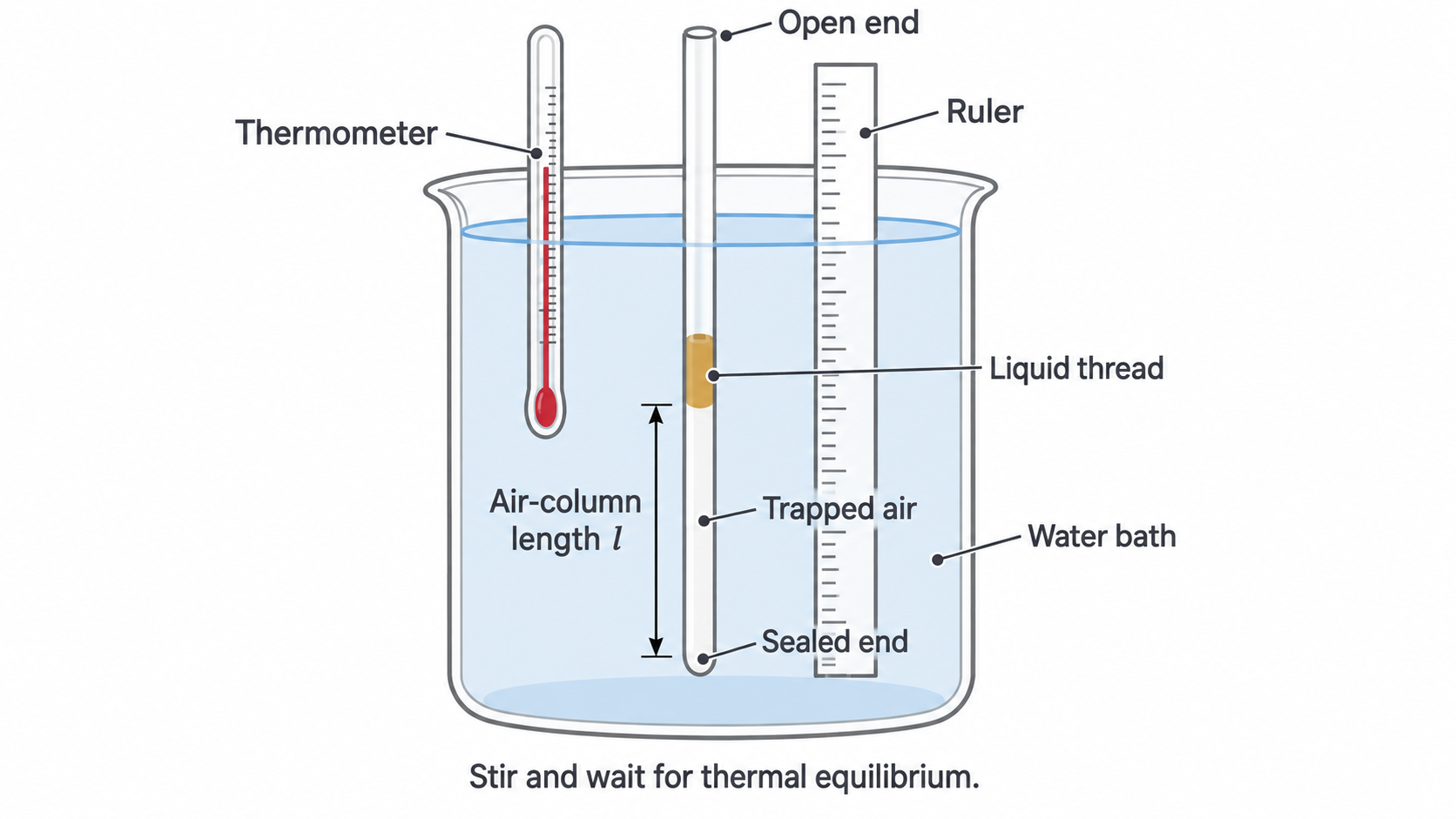
Measure from the sealed end to the lower meniscus of the thread. Keep that whole air column immersed while the open end stays above water.
Fix the capillary beside a ruler in a stirred water bath, with a thermometer or calibrated probe nearby. Keep the open end above water. At each of several temperatures over a wide safe range, stir, wait until length and temperature stabilise, and record both. Measure the sealed-end and meniscus positions and subtract; do not rely on an assumed zero alignment. Repeat at the same temperatures and compare warming with cooling where possible. The uniform bore makes the length proportional to trapped gas volume.
Controls, pressure balance and offsets
A law can only be tested if a changing variable is not accidentally confounded with another. For Boyle's law, keep the gas amount fixed with leak-tight connections and temperature fixed by slow adjustments followed by waiting. Handling the barrel or rapid compression changes temperature. A steadily drifting volume at fixed load can indicate leakage or thermal relaxation; investigate it before taking more readings.
For a frictionless downward-facing plunger at rest, atmospheric pressure provides an upward force . Gas pressure and the outward load provide downward forces . Hence
The minus sign belongs to this pulling-out arrangement. A load pushing a piston inwards instead increases gas pressure. Always establish the force directions instead of memorising a sign. Friction supplies another force, so the ideal force balance is only an approximation when the plunger sticks.
A dead volume in the nozzle and tubing also contains trapped gas:
Minimise it or measure and add it. A fixed volume offset becomes a nonlinear distortion after taking ; repeating readings does not remove it.
For Charles's law the thread can move while its upper surface is exposed to atmospheric pressure. In a vertical tube the trapped gas pressure is approximately , where is the vertical height of the thread. Thus pressure is approximately constant, not exactly atmospheric. Keep the same short thread, orientation and bore, and check that it remains intact; changes in its head, friction or surface effects can alter pressure. An immersed open end would introduce a changing water-pressure head.
Immerse the full trapped column, stir to reduce bath temperature gradients, and wait for thermal equilibrium. During heating the gas can lag cooler than the bath; during cooling it can lag warmer. The sign depends on the process. A ruler zero offset changes the inferred length; measuring both endpoints addresses alignment, while the true sealed-end volume and meniscus need consistent treatment.
The pressure-law adaptation illustrates the control choice: use a sealed rigid bulb connected to a pressure sensor, vary bath temperature, wait for equilibrium and plot absolute pressure against kelvin temperature. It tests constant volume, whereas the moving capillary thread tests constant pressure.
Testing proportionality with graphs
A graph must test the predicted relationship, not merely show that two quantities change together. For Boyle's law , where is constant for the sample at its chosen temperature:
Plotting vertically against horizontally should give a straight line with an intercept consistent with zero. Its gradient is . Plotting against is equally valid but gives gradient . A -versus- curve can show an inverse trend, but linearisation makes slope and intercept tests easier.
The following illustrative data use absolute pressure and corrected gas volume; they are not an instruction to copy results in a laboratory.
| 69.8 | 5.1 | 0.1961 |
| 76.0 | 4.7 | 0.2128 |
| 82.3 | 4.3 | 0.2326 |
| 88.5 | 4.0 | 0.2500 |
[DIAGRAM: asset_slug: RP 08 - Investigation of Boyle's Law and Charles's Law for a Gas - Diagram 3; caption: Measured Boyle’s-law data on reciprocal-volume axes; description: Boyle's-law reciprocal-volume plot using the tabulated points and stated illustrative uncertainties.]
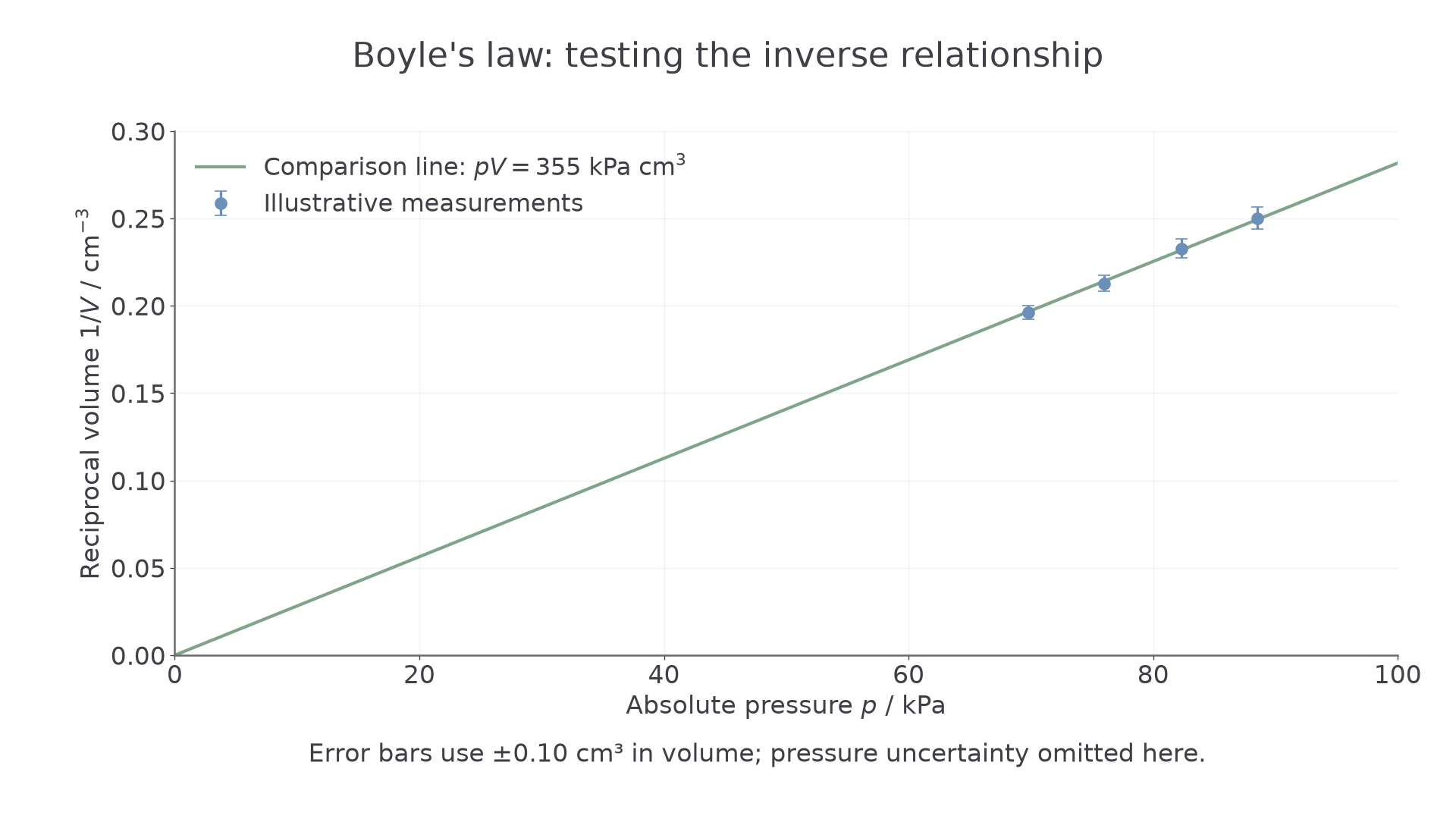
The points match the table. A line with passes within the illustrative volume-error bars, supporting an inverse relationship over the measured range.
Continue this lesson.
You’re previewing NovaLearn without an account. Create a free account to read the rest.
Create free account