3.7.5.5 - Alternating Currents
Distinguish the period, peak and rms values of a sinusoidal signal, use rms to calculate resistor heating, and read voltage and time scales on an oscilloscope.
Cycles, period and frequency
An alternating current repeatedly reverses direction. In this topic, voltages and currents are sinusoidal and centred on zero. Their sign specifies a chosen polarity or current direction; a negative current is flow in the opposite direction, not a negative amount of charge.
A sinusoidal voltage can be written . The period is the time between points at the same stage of successive cycles: for example, one rising zero crossing and the next rising zero crossing. A rising zero crossing followed by a falling one spans only half a cycle.
[DIAGRAM: asset_name: 7.5.5 - Alternating Currents - Diagram 1; asset_slug: 7.5.5 - Alternating Currents - Diagram 1; recommended_method: local_png; caption: One complete sinusoidal voltage cycle: the period spans identical rising zero crossings, and peak and peak-to-peak measure different vertical distances.; description: One complete sinusoidal voltage cycle: the period spans identical rising zero crossings, and peak and peak-to-peak measure different vertical distances.]
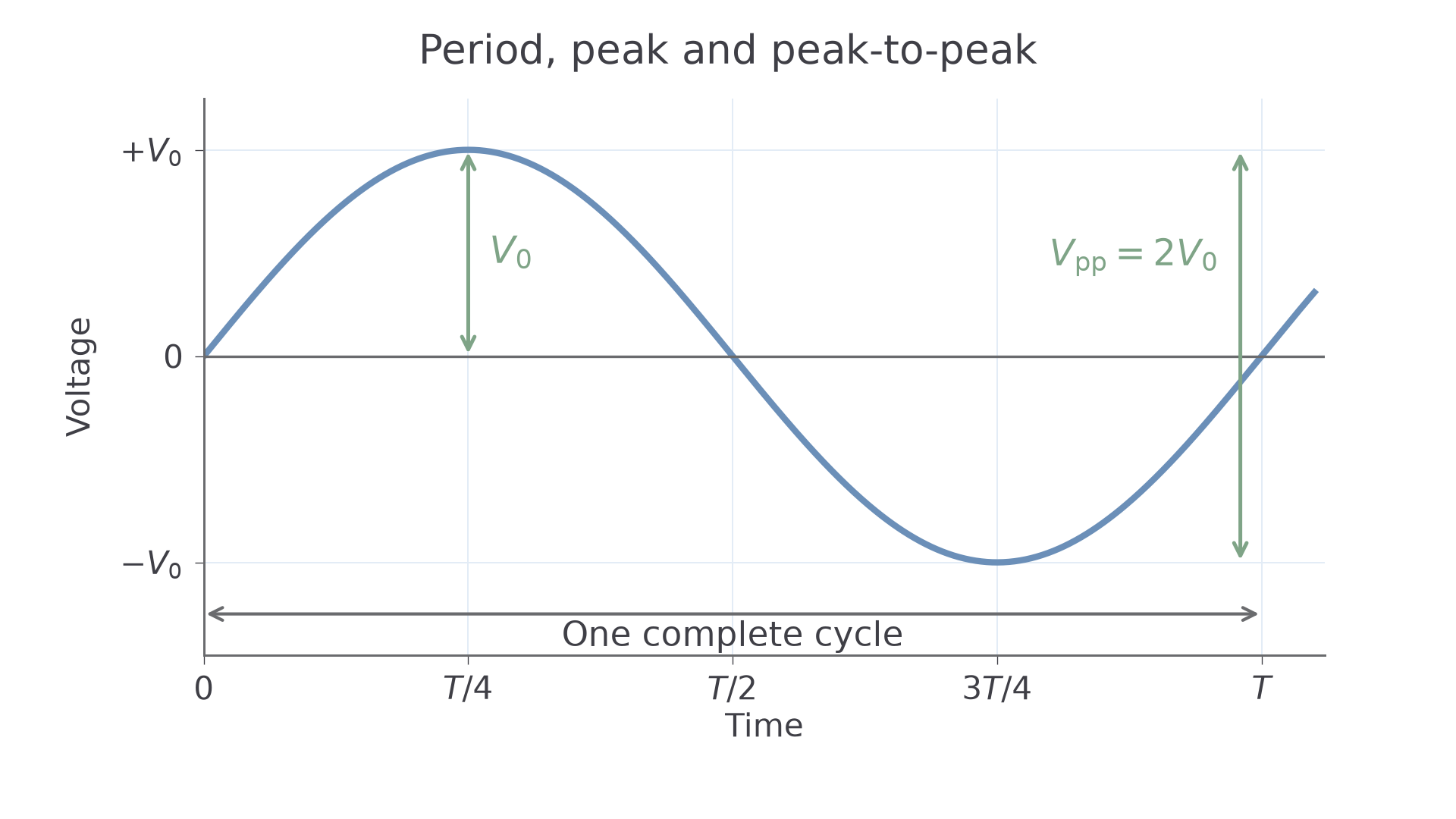
There are two direction reversals per cycle, so a sinusoidal current has period and reverses times per second. A generator's sinusoidal voltage produces a sinusoidal current in a fixed resistor, with current and voltage in phase.
Peak values and the heating meaning of rms
The peak value is the maximum magnitude from zero to a crest, or . For a sinusoid centred on zero, the peak-to-peak value spans trough to crest: . Neither quantity is the arithmetic mean, which is zero over a complete cycle.
The root mean square (rms) value is the steady dc value producing the same mean power in the same fixed resistor. The resistor heats in both half-cycles because instantaneous power is , which is never negative.
To understand the factor, square . The mean of over a complete cycle is , so . Taking its square root gives:
Sinusoidal rms values
For a fixed resistor, mean power is . The last product assumes voltage and current are in phase. Do not extend it without that assumption to an arbitrary ac circuit. The peak-to-rms factor here is specifically for a sinusoid; the specification does not require other waveform shapes.
For example, through gives , mean power , and peak instantaneous power . Zero mean current does not imply zero energy transfer.
Mains rms, peak and component ratings
The nominal UK mains values used in calculations are rms and . For a sinusoid,
to three significant figures. Keeping unrounded intermediate values avoids a final rounding discrepancy; about is sufficient to two significant figures.
Continue this lesson.
You’re previewing NovaLearn without an account. Create a free account to read the rest.
Create free account