3.2.2.4 - Wave-Particle Duality
Photoemission reveals the particle-like energy transfer of light, while electron diffraction reveals wave behaviour in matter. The de Broglie relation connects a particle’s momentum to its wavelength and makes a testable prediction about diffraction.
The dual nature of light
Light produces diffraction and interference patterns, which require a wave description. Yet a classical continuous-wave account does not explain the photoelectric threshold: radiation below a metal’s threshold frequency causes no emission, even when its intensity is increased. The photon account explains this by discrete energy transfer, , in a single photon–electron interaction.
Wave-particle duality means that electromagnetic radiation and matter show both wave-like and particle-like properties. Which evidence is observed depends on the experiment. The idea does not mean that light literally switches between a classical ball and a classical water wave. Each simple model captures some observations and has limits.
| Observation | What it supports |
|---|---|
| Light diffraction and interference | Wave properties of electromagnetic radiation |
| Threshold and prompt photoemission | Particle-like energy transfer by photons |
| Electron diffraction | Wave properties of matter |
Momentum and de Broglie wavelength
De Broglie proposed that matter particles also have an associated wavelength. The relation is
de Broglie wavelength
Here is wavelength in metres, is momentum magnitude in , and . The form assumes non-relativistic motion, with speed small compared with the speed of light.
Momentum, rather than mass or speed alone, determines the wavelength. Doubling momentum halves wavelength. Two different particles with equal momentum have equal de Broglie wavelengths. At equal speed, the more massive particle has shorter wavelength. At equal non-relativistic kinetic energy, , so the more massive particle again has shorter wavelength, but the dependence is on , not on .
The equation applies to all matter. Ordinary macroscopic objects have enormously greater momenta than slow electrons, so their wavelengths are too small to reveal diffraction in ordinary experiments. It is incorrect to say only electrons possess wave properties. Observability also depends on the experimental arrangement and whether the wave remains coherent.
Electron diffraction and momentum changes
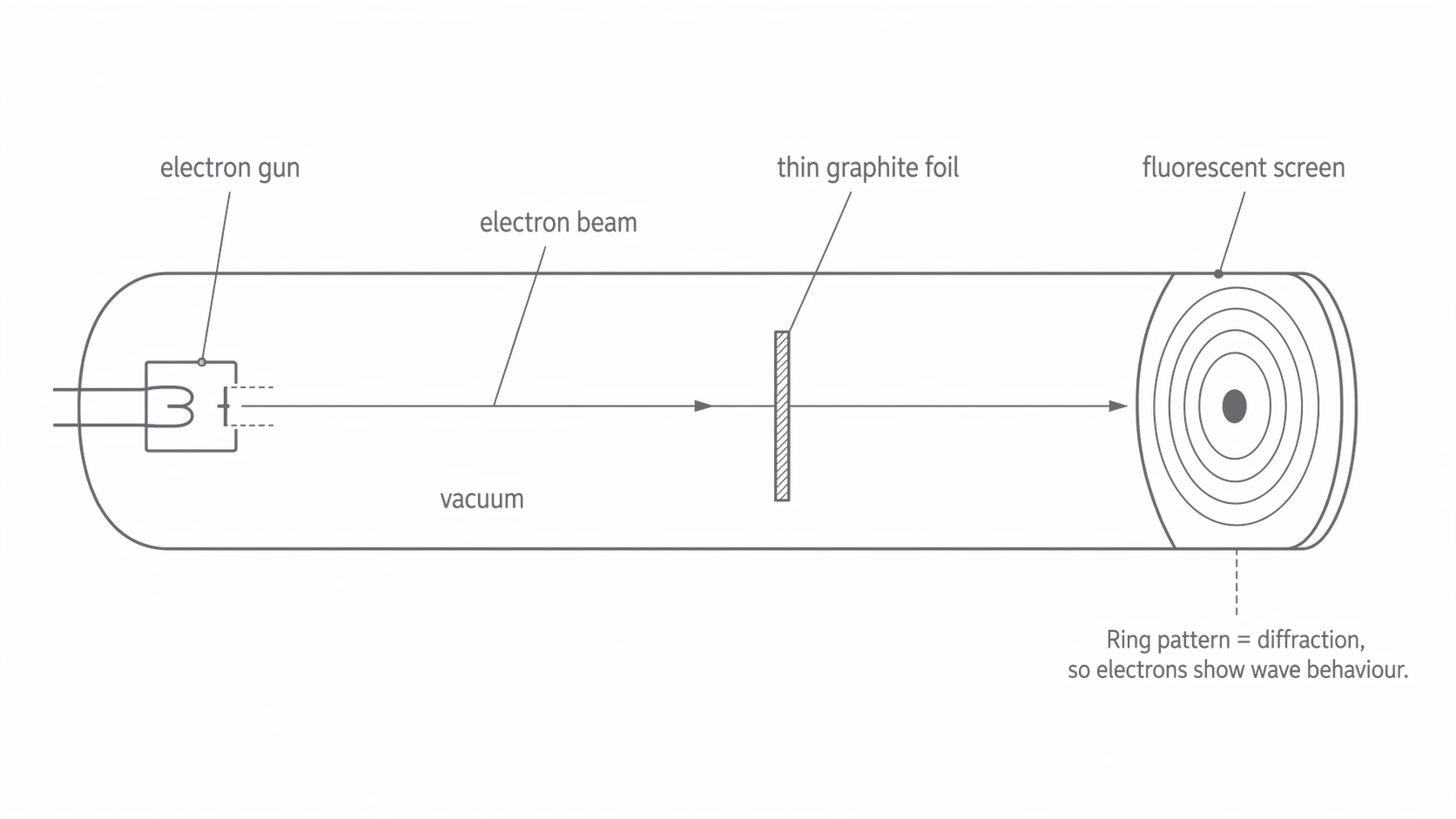
A beam of electrons passing through thin crystalline material can form a diffraction pattern on a fluorescent screen. In a polycrystalline specimen, many crystallite orientations give rings. The pattern is an interference effect associated with a wavelength, so it demonstrates wave properties of the electrons. The exact apparatus method and detailed crystal-diffraction equations are not required here.
[DIAGRAM: asset_name: 2.2.4 - Wave-Particle Duality - Diagram 1; asset_slug: 2.2.4 - Wave-Particle Duality - Diagram 1; recommended_method: retained_png; caption: A schematic electron diffraction tube. Thin polycrystalline material produces a ring pattern on the screen, demonstrating wave properties of electrons.; description: A schematic electron diffraction tube. Thin polycrystalline material produces a ring pattern on the screen, demonstrating wave properties of electrons.]
Keep the crystal and the screen distance fixed when comparing patterns. Greater electron momentum gives a smaller de Broglie wavelength. For the same family of crystal planes, smaller wavelength gives a smaller diffraction angle, so the corresponding ring moves closer to the centre. A smaller momentum gives larger wavelength and larger ring radius.
[DIAGRAM: asset_name: 2.2.4 - Wave-Particle Duality - Diagram 2; asset_slug: 2.2.4 - Wave-Particle Duality - Diagram 2; recommended_method: retained_png; caption: Qualitative comparison for unchanged crystal and screen geometry: higher momentum gives smaller wavelength and smaller diffraction-ring radii. The sketch is not a scale measurement.; description: Qualitative comparison for unchanged crystal and screen geometry: higher momentum gives smaller wavelength and smaller diffraction-ring radii. The sketch is not a scale measurement.]
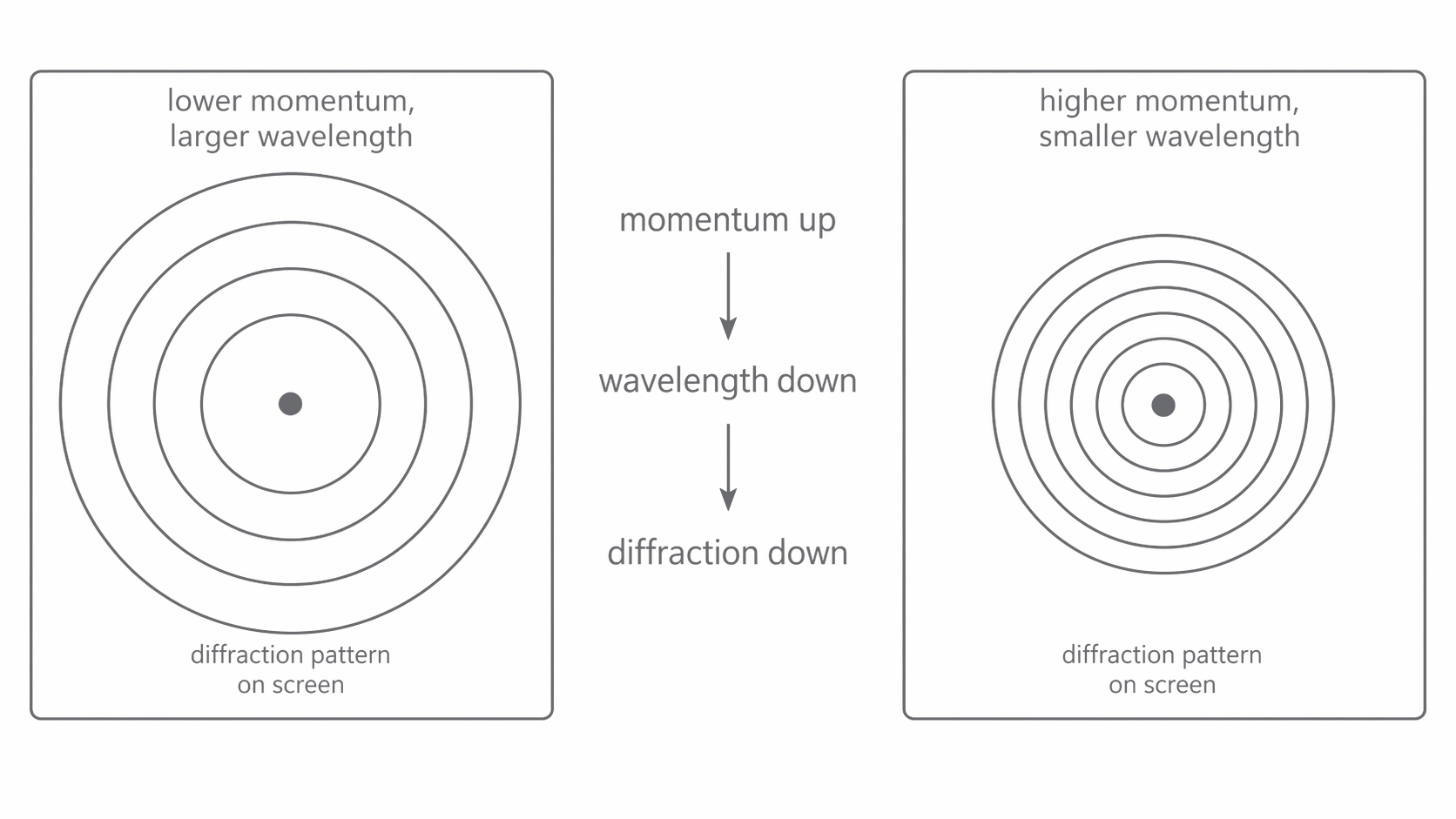
At small diffraction angles, ring radius is approximately proportional to wavelength for a fixed crystal and geometry. Consequently is approximately constant: doubling momentum approximately halves each corresponding ring radius. This scaling assumption must be stated when making a numerical radius prediction; the general direction of the change does not require it.
Calculating and comparing matter wavelengths
Use when momentum is supplied, and first use if mass and non-relativistic speed are supplied. Convert masses, speeds and prefixes consistently before substitution.
A direct calculation
For an electron moving at ,
The speed is about , so the non-relativistic approximation is appropriate at this precision. The wavelength is small enough for diffraction from atomic-scale structures; it is much shorter than visible-light wavelengths.
Combining acceleration with wavelength
An electron accelerated from rest through a potential difference , without collisions or other energy losses, gains kinetic energy . Combining this with gives
This is a useful derived relation, not an additional formula to memorise. It assumes non-relativistic motion. Quadrupling doubles momentum and halves wavelength; doubling does not halve wavelength.
Why matter waves matter
Matter-wave effects are easiest to reveal when the wavelength and experimental structure allow measurable interference. This explains why atomic spacings can diffract electron beams while everyday objects travelling at everyday speeds show no observable diffraction in ordinary arrangements.
A ball moving at has momentum and wavelength . Comparing this with an electron wavelength of order shows why the practical observations differ, although both obey the same relation. A high mass alone does not invalidate de Broglie’s hypothesis.
Electron microscopes use electron wavelengths much smaller than visible-light wavelengths, allowing finer spatial detail in suitable instruments. Actual resolution also depends on the lenses and instrument, not wavelength alone. At sufficiently high accelerating voltages, relativistic momentum is needed for an accurate wavelength, so the simple calculation must not be applied indiscriminately to every microscope.
How evidence changes scientific models
Wave-particle duality changed the separation between classical waves and classical particles. Light’s interference supported a wave model; photoemission required discrete photon energy transfer. De Broglie’s matter-wave hypothesis then made a quantitative prediction, , that electron diffraction could test. The established wave and particle models remained useful within their successful domains, while their limitations became clear.
Peer review is scrutiny by relevant experts of methods, analysis and conclusions. Reviewers can question calibration, uncontrolled variables, uncertainty, whether a claimed pattern has another explanation, and whether the conclusions follow from the data. This normally forms part of evaluating research for publication, but it does not prove a claim correct.
Independent replication tests whether other researchers obtain compatible results. It is distinct from peer review: reading a paper does not reproduce its experiment. Confidence grows when several reliable observations agree with the prediction, survive criticism and can be repeated. Scientific acceptance depends on this body of evidence, not a vote, a famous scientist’s authority or one persuasive diagram.
For electron diffraction, a stronger test than seeing one ring pattern is checking that changing momentum changes its scale in the way predicted by de Broglie’s relation. Reviewers assess how momentum and ring radii were determined and whether the crystal and geometry were controlled; other groups can then test the relationship independently.