3.11.2.5 - Second Law and Engines
Use the Second Law to set an engine’s best possible work efficiency, then distinguish unavoidable heat rejection from additional real losses and useful heat recovery.
Why conservation alone is insufficient
The first law limits the energy total; it does not by itself decide whether a proposed process is physically possible. A cyclic engine has , so for net transfers. A proposal taking from one reservoir and producing of work would satisfy that arithmetic.
The Second Law rules out a device whose only overall effects in a complete cycle are taking heat from a single reservoir and converting it entirely into work. A continuously operating heat engine needs a hot source and a colder sink, rejecting some energy to the sink.
This is a restriction on a complete cycle. A single isothermal expansion of ideal gas can have , but returning the gas to its original state requires additional processes. It cannot simply repeat the expansion indefinitely in the same cylinder. Nor does the engine’s internal energy have to increase on each cycle: it returns to its initial value.
The source–engine–sink balance
A heat engine absorbs energy from a source at , gives work to its surroundings, and rejects energy to a sink at . Here and are positive magnitudes of opposite heat transfers, not signed values of the same .
[DIAGRAM: asset_name: C.2.5 - Second Law and Engines - Diagram 1; asset_slug: C.2.5 - Second Law and Engines - Diagram 1; caption: Heat enters the engine from the hot source, work leaves sideways and rejected heat flows to the colder sink.; description: Heat enters the engine from the hot source, work leaves sideways and rejected heat flows to the colder sink.]
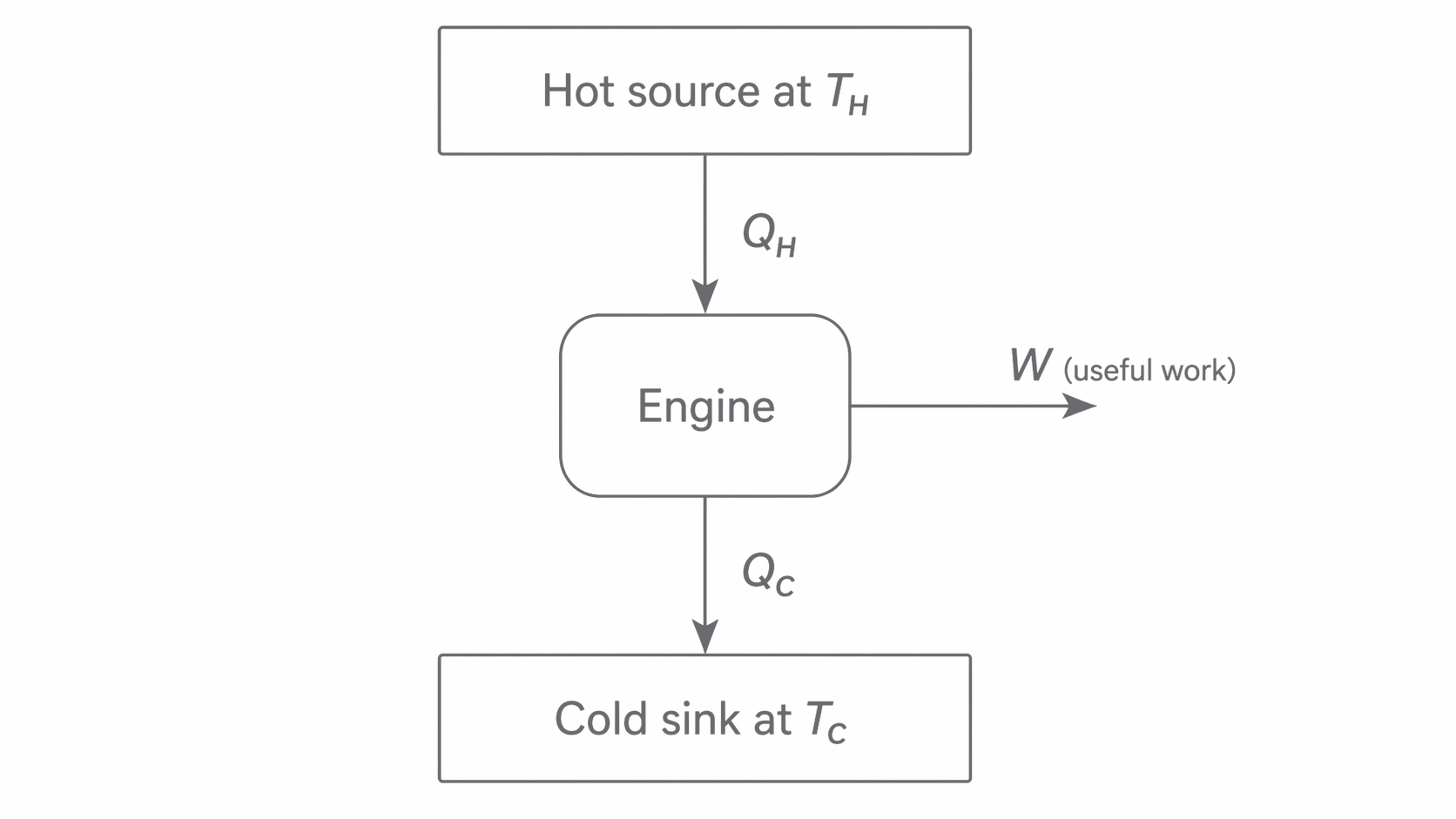
Over a complete cycle,
The same balance holds for transfer rates if all quantities are powers. For example, absorbed and work output require rejected. The work efficiency is
Use the gross heat input in the denominator. Dividing work by net heat would give one for every cyclic engine and would not measure how much of the supplied heat becomes work.
The maximum efficiency between two temperatures
A reversible engine between reservoirs at fixed absolute temperatures has the greatest possible work efficiency:
This Carnot limit depends on reservoir temperatures, not on using an ideal gas as the working substance. It is not automatically the efficiency of every idealised engine cycle. A theoretical Otto or Diesel cycle may already lie below it because it does not exchange all its heat reversibly at the two reservoir temperatures.
Temperatures must be in kelvin. A source at and sink at give approximately and , hence . Using Celsius in the denominator would give the wrong absolute-temperature ratio.
To increase the limit, raise at fixed , or lower at fixed . For a finite source temperature, unit efficiency would require a sink, which cannot be realised.
Testing a claim: with reservoirs at and , at most half the input heat becomes work. An engine claiming output from input violates this limit even though its claimed efficiency is below . For reversible transfer, the working substance must remain at essentially the source temperature while receiving heat and the sink temperature while rejecting heat; a finite temperature difference makes transfer irreversible.
Continue this lesson.
You’re previewing NovaLearn without an account. Create a free account to read the rest.
Create free account