3.2.2.1 - The Photoelectric Effect
Light can release electrons from a metal surface, but only when each photon has enough energy. The observations distinguish the energy of one photon from the rate at which photons arrive, and lead to a measurable energy balance.
Observations and threshold frequency
The photoelectric effect is the emission of electrons from a metal surface when electromagnetic radiation supplies enough energy to release them. The emitted electrons are photoelectrons.
An initially negatively charged electroscope has excess electrons. Its leaf is raised because like charges on the stem and leaf repel. Place a clean zinc plate on top and illuminate it with suitable ultraviolet radiation: electrons leave the plate, the negative charge decreases, and the leaf falls. Visible light below zinc's threshold does not produce this discharge. The initial negative charge matters: this explanation is loss of excess electrons, not UV making any charged object neutral.
[DIAGRAM: asset_name: 2.2.1 - The Photoelectric Effect - Diagram 1; asset_slug: 2.2.1 - The Photoelectric Effect - Diagram 1; recommended_method: retained_png; caption: An initially negatively charged zinc electroscope loses electrons under above-threshold UV. Below-threshold visible radiation leaves the leaf raised.; description: An initially negatively charged zinc electroscope loses electrons under above-threshold UV. Below-threshold visible radiation leaves the leaf raised.]
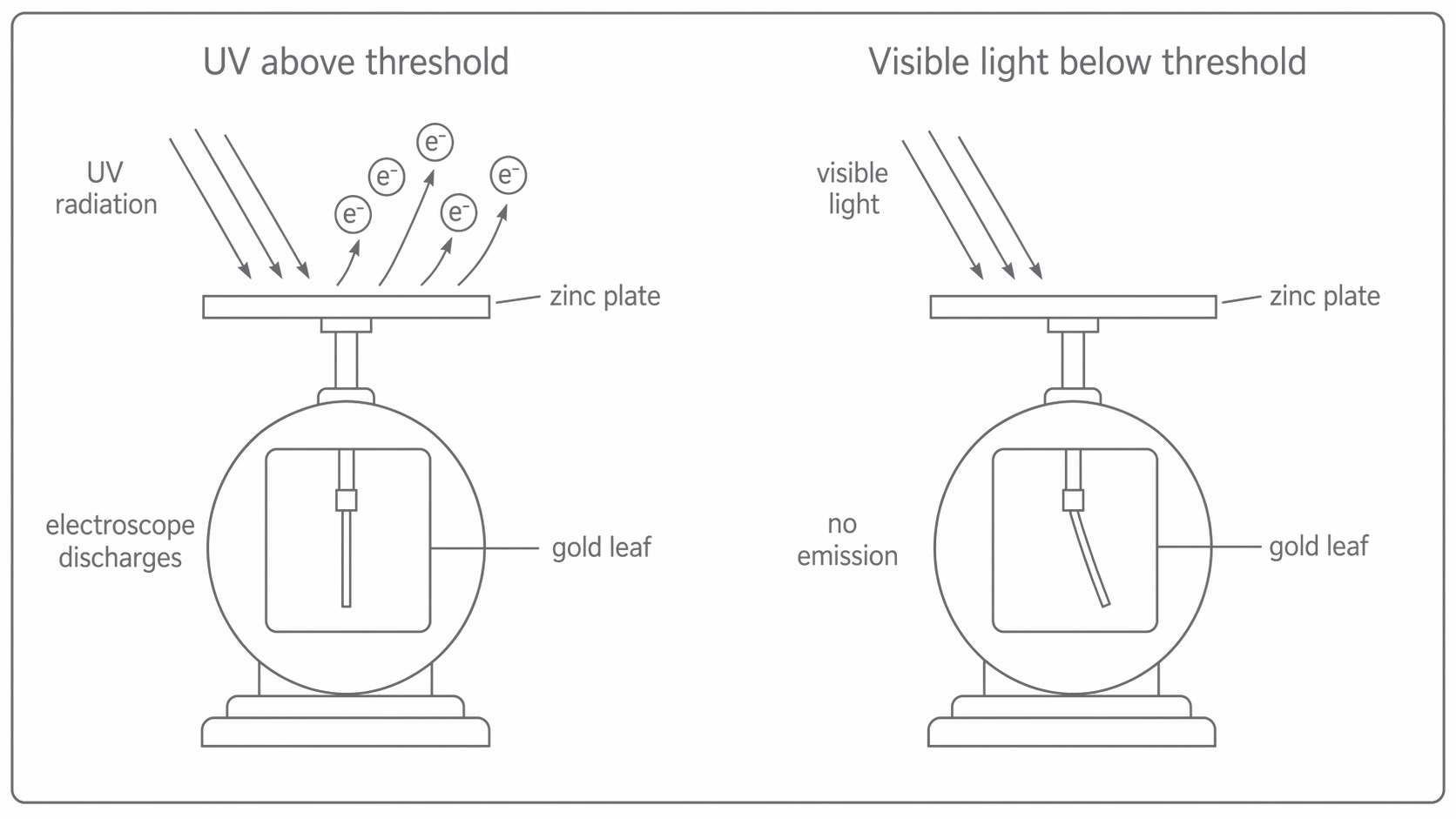
The experiment illustrates a threshold frequency, : the minimum incident frequency that can cause photoelectric emission from that surface. Below , increasing intensity or waiting longer does not cause emission in the ordinary single-photon experiments considered here. With suitable radiation, emission begins without a measurable delay, even at low intensity.
The current in a photocell provides another observation. Above threshold, increasing intensity at fixed frequency increases the emission rate. It does not increase the maximum kinetic energy of the emitted electrons; that energy increases when frequency increases.
Einstein's photon explanation
A photon transfers a discrete amount of energy in a single interaction. For electromagnetic radiation,
Energy of one photon
Here , is frequency, is the speed of light in vacuum and is the vacuum wavelength.
In the photon explanation of photoemission, one electron absorbs one photon's energy. The work function, , is the minimum energy needed to release an electron from the surface. If , one absorption supplies too little energy. More photons of the same frequency still supply the same insufficient energy per interaction. If , an electron can escape in one interaction; it need not gradually accumulate energy, explaining the absence of a measurable delay.
[DIAGRAM: asset_name: 2.2.1 - The Photoelectric Effect - Diagram 2; asset_slug: 2.2.1 - The Photoelectric Effect - Diagram 2; recommended_method: retained_png; caption: One photon transfers energy to one electron. The crossed-out continuous-energy picture cannot account for the observed threshold and prompt emission.; description: One photon transfers energy to one electron. The crossed-out continuous-energy picture cannot account for the observed threshold and prompt emission.]
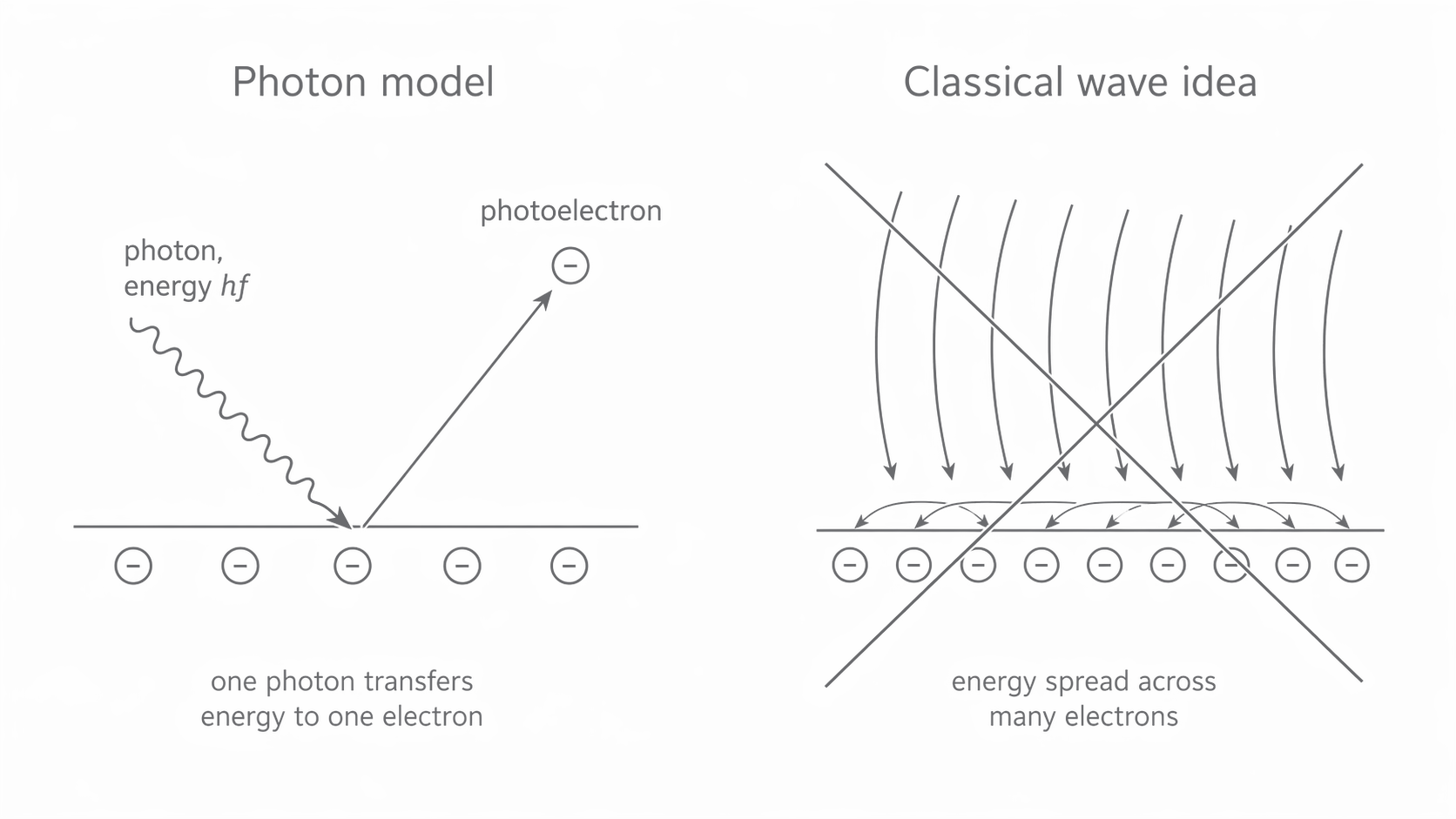
A classical continuous-wave explanation makes different predictions. Energy delivered across the wavefront should gradually build up at an electron, so sufficiently long illumination should eventually release it at any frequency. Greater intensity should supply energy faster and reduce the delay. The observed frequency threshold and prompt emission at low intensity contradict that account. This does not remove the evidence that light also diffracts and interferes.
Work function and the photoelectric equation
Conservation of energy links the incoming photon to the fastest possible emitted electron. The work function is the minimum escape energy, so the maximum remaining kinetic energy is
Photoelectric energy balance
At threshold, , so .
Photoelectrons have a range of kinetic energies: electrons can lose energy before reaching the surface. The equation uses the maximum, not the mean. A negative value from means that this radiation cannot produce photoemission; it is not a negative kinetic energy.
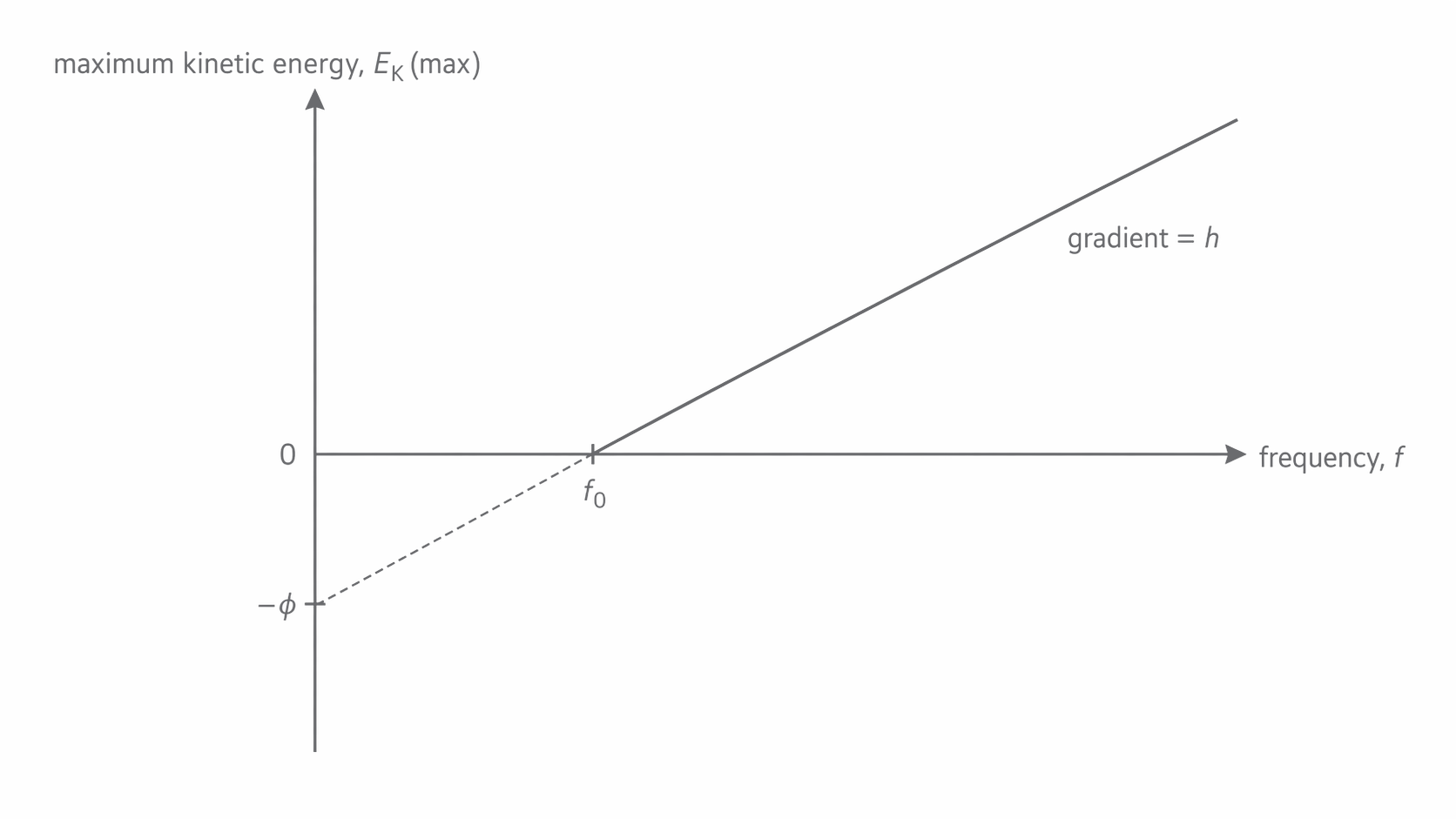
For a graph of in joules against in hertz, comparison with gives gradient and frequency-axis intercept . Extrapolating the line back to zero frequency gives an energy-axis intercept . Only the above-threshold portion describes emitted electrons.
[DIAGRAM: asset_name: 2.2.1 - The Photoelectric Effect - Diagram 3; asset_slug: 2.2.1 - The Photoelectric Effect - Diagram 3; recommended_method: retained_png; caption: The solid line describes emitted photoelectrons. The dashed continuation gives the intercept −φ mathematically. No photoelectrons exist below the threshold.; description: The solid line describes emitted photoelectrons. The dashed continuation gives the intercept −φ mathematically. No photoelectrons exist below the threshold.]
Deciding whether emission occurs
Suppose . The threshold is
At , the photon energy is , leaving . At there is no emission, because the photon energy is below .
Energy may also be quoted in electronvolts: . Multiply an eV value by this factor before using in . If the graph's energy axis is in eV instead, its numerical gradient is , not in SI units.
Stopping potential
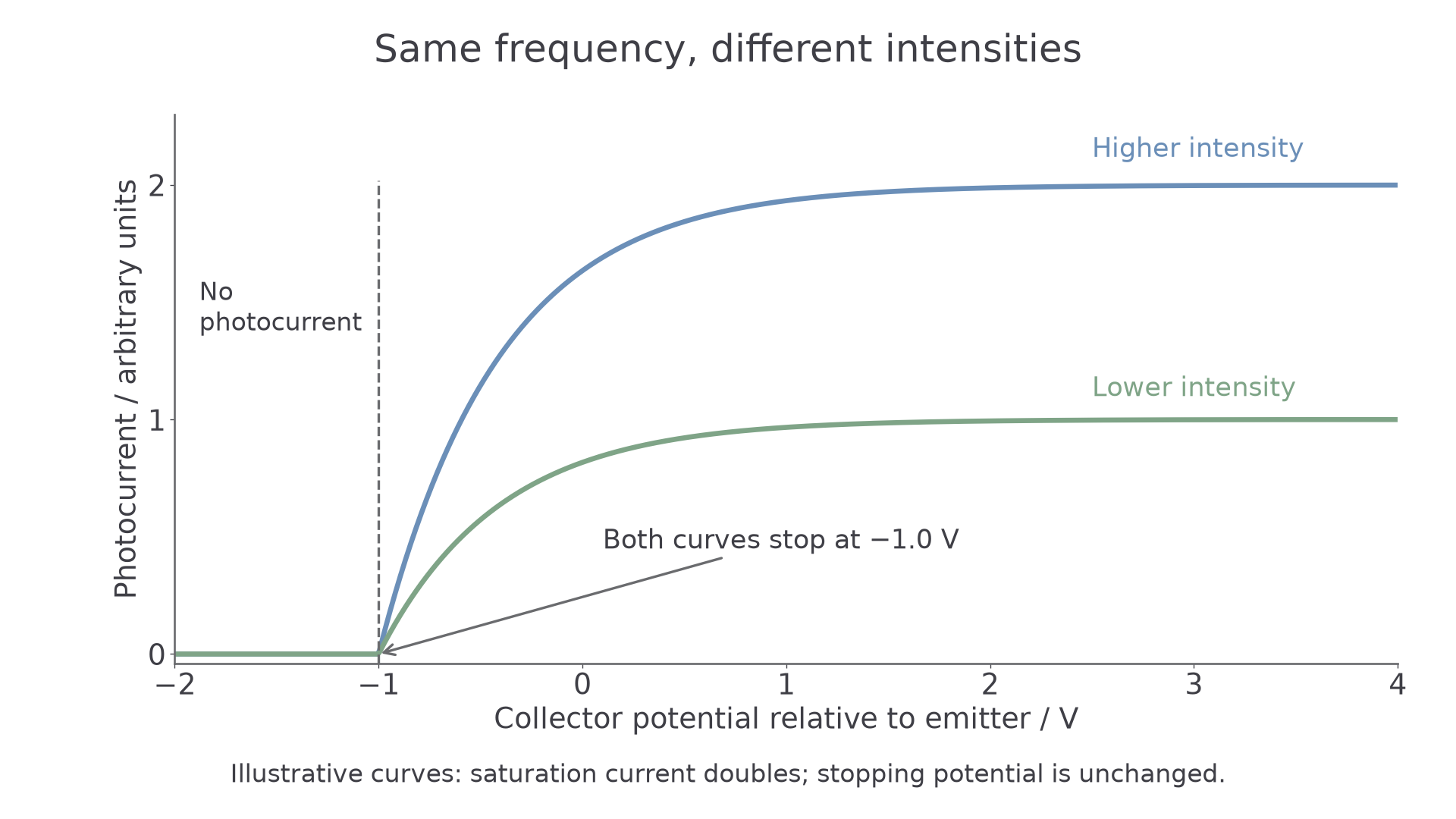
An opposing electric field can prevent photoelectrons reaching a collector. The stopping potential, , is the minimum magnitude of opposing potential difference that stops even the most energetic photoelectrons, reducing the photocurrent to zero.
Electrical energy needed to stop the fastest electron
where is the magnitude of electron charge and is positive.
The collector must be negative relative to the emitting surface to repel electrons. A graph using the signed collector potential therefore reaches zero current at . Below that collector potential the current remains zero. Above it, some electrons reach the collector; a sufficiently positive collector collects essentially all emitted electrons, giving the saturation current. The detailed experimental determination of stopping potential is not required.
[DIAGRAM: asset_name: 2.2.1 - The Photoelectric Effect - Diagram 4; asset_slug: 2.2.1 - The Photoelectric Effect - Diagram 4; recommended_method: retained_png; caption: Illustrative photocurrent curves for the same metal and frequency. Doubling intensity doubles saturation current but leaves the stopping potential at 1.0 V. Signed collector potential at cutoff is −1.0 V.; description: Illustrative photocurrent curves for the same metal and frequency. Doubling intensity doubles saturation current but leaves the stopping potential at 1.0 V. Signed collector potential at cutoff is −1.0 V.]
Combining two energy measurements
For incident frequency and ,
Keep unrounded values until the final answer. Since is the energy of one electron, a stopping potential of corresponds to maximum kinetic energy.
Frequency, intensity and emission rate
Frequency fixes the energy of each photon; intensity is power per unit area. For monochromatic light of fixed frequency, doubling intensity doubles the number of photons arriving each second per unit area. Above threshold, this increases the photoelectron emission rate, provided the same fraction of incident photons ejects electrons.
| Change for the same metal | Emission rate | Maximum kinetic energy and stopping potential |
|---|---|---|
| Higher intensity, fixed frequency above threshold | Increases | Unchanged |
| Higher intensity, fixed frequency below threshold | Still zero | No photoelectrons to stop |
| Higher frequency, already above threshold | Not determined by frequency alone | Both increase |
At fixed incident power , the photon arrival rate is . Higher frequency then means fewer incident photons each second. The emission rate also depends on how efficiently the surface absorbs photons and ejects electrons; frequency alone does not determine current. In comparisons that keep frequency fixed, this complication does not change the usual intensity result.
For the same surface, . A rise in frequency raises . A greater work function at the same frequency lowers if emission still occurs, and moves the threshold to a higher frequency. These are energy changes, unlike raising intensity.