3.5.1.6 - Electromotive Force and Internal Resistance
A real cell transfers energy both to the external circuit and within itself. Use emf, terminal pd and internal resistance to calculate that division and interpret the change in voltage when the load changes.
Emf is energy supplied per coulomb
The electromotive force, or emf, of a source is the energy it supplies per unit charge. Despite the name it is not a mechanical force. It is measured in volts, equivalent to joules per coulomb:
A source with emf supplies per coulomb; transferring corresponds to supplied. In a chemical cell this comes from chemical energy.
Terminal pd is the potential difference between the external terminals. It is defined even when the circuit is open. When a cell is supplying current, terminal pd gives the energy delivered to the external circuit per coulomb; emf gives the total supplied per coulomb, including energy transferred inside the cell.
With an ideal voltmeter as the only connection, no current is drawn and its reading equals emf. A real high-resistance voltmeter draws a small current, so its reading only approximates emf. A nominal battery label also need not be an exact measurement of its present emf.
Internal resistance divides the supplied energy
A real source can be modelled as an ideal emf source in series with an internal resistance, . This is an equivalent circuit: a chemical cell’s internal processes include ionic conduction and electrochemical effects, so they should not all be described as electrons colliding with a metal lattice.
[DIAGRAM: asset_name: 5.1.6 - Electromotive Force and Internal Resistance - Diagram 1; asset_slug: 5.1.6 - Electromotive Force and Internal Resistance - Diagram 1; caption: The ideal emf source and internal resistance lie inside the real-cell boundary. The same current passes through internal r and external R. The terminals span the complete source model.; description: The ideal emf source and internal resistance lie inside the real-cell boundary. The same current passes through internal r and external R. The terminals span the complete source model.]
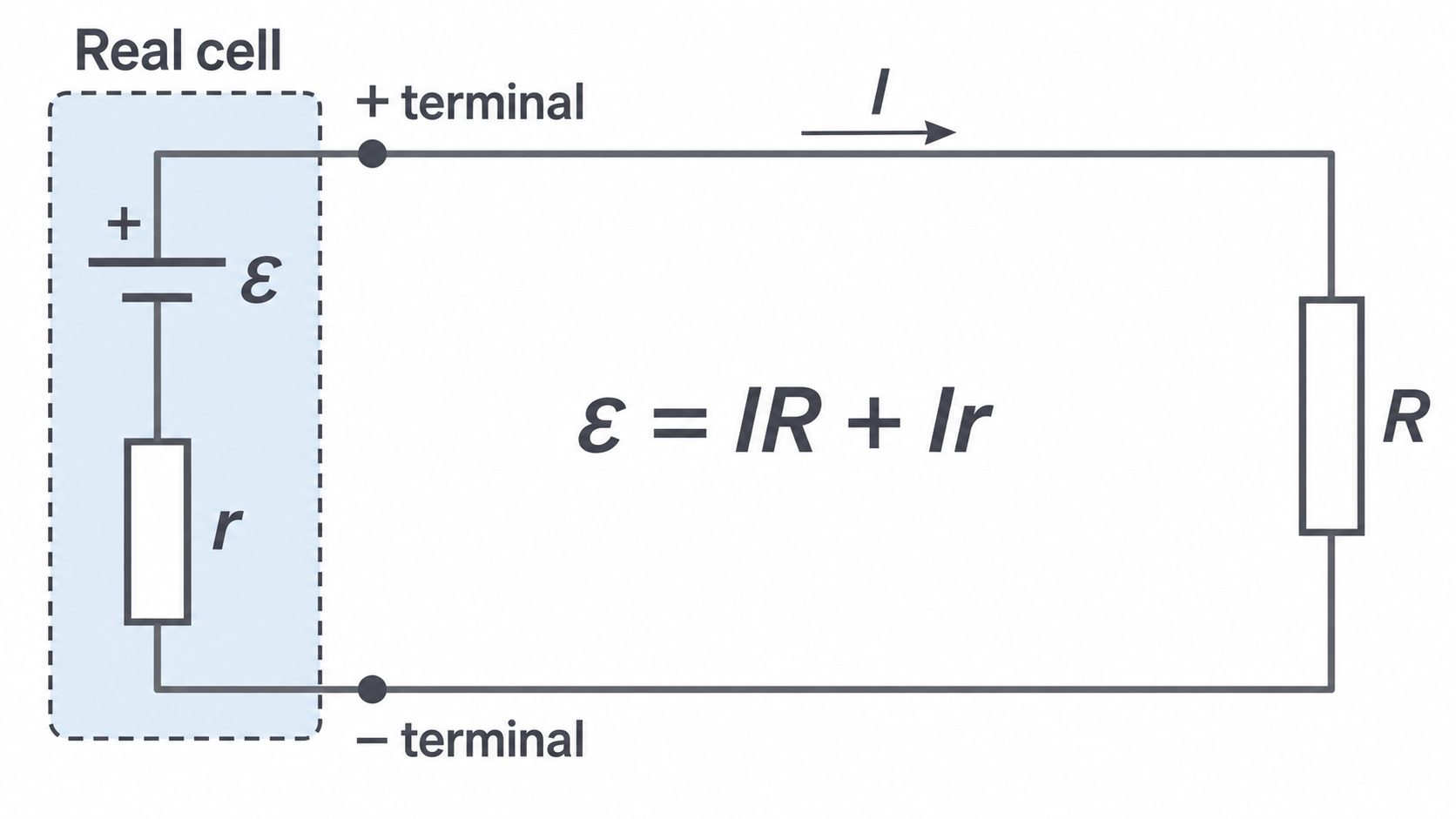
For a discharging cell supplying an external resistance , conservation of energy per charge gives
The internal pd , sometimes called lost volts, represents energy transferred inside the cell per coulomb. Energy is transferred, not destroyed. For and , terminal pd is below emf. These signs describe a cell delivering current; they must not be applied unchanged to charging a cell.
If the current doubles while stays constant, lost volts double. Internal heating power instead increases fourfold. Multiplying the energy-per-charge balance by current gives a power balance:
This separates the source’s total power from its external output power.
Solving for a load or an unknown cell
The whole-circuit current is . Terminal pd can then be found from either or ; agreement checks the calculation. Do not put emf across alone when internal resistance matters.
For , and , total resistance is , so . Lost volts are and terminal pd is . External power is ; internal power is , totaling .
For a resistor network, first find the equivalent external resistance, then add . Return to the external network using terminal pd to find its branch currents; internal resistance carries the total cell current.
Continue this lesson.
You’re previewing NovaLearn without an account. Create a free account to read the rest.
Create free account