3.9.1.4 - Telescope Diameter and Detectors
A telescope must collect enough photons and separate the detail of interest; its detector must then record the available information. Use area ratios and the diffraction limit to distinguish these requirements, and compare the eye with a CCD.
Collecting power and photon counts
Collecting power describes how much incident radiation a telescope can intercept from a source, rather than how large it makes the source appear.
For a circular unobstructed objective of diameter ,
At the same incident intensity, exposure time and optical efficiency, doubling collects four times as much energy and approximately four times as many photons in a fixed wavelength band. This helps detect faint sources. Real obstruction, transmission losses and detector efficiency reduce the registered signal, so use the area ratio only under comparable conditions or with those factors accounted for.
For two telescopes under the same conditions,
A objective has nine times the collecting area of a objective. If the smaller instrument receives 1200 source photons per second at its detector, equal throughput gives the larger instrument 10800 per second. To collect the same number, its exposure can be one ninth as long. A larger diameter does not by itself determine the source's emitted luminosity or guarantee nine times the brightness per retinal area for every extended-image viewing arrangement.
Diffraction and the minimum resolvable angle
Even a perfectly focused point source forms a diffraction pattern rather than an infinitely small point, because the telescope aperture is finite.
For a circular aperture the pattern has a bright central Airy disc, followed by dark minima and weaker bright rings. Images of nearby point sources overlap. Under the Rayleigh criterion, equal point sources are just resolved when the central maximum of one pattern lies at the first minimum of the other.
[DIAGRAM: asset_name: A.1.4 - Advantages of Large Diameter Telescopes - Diagram 1; asset_slug: A.1.4 - Advantages of Large Diameter Telescopes - Diagram 1; recommended_method: retained_png; caption: Exact Airy intensity profiles for just-resolved and unresolved equal sources; maximum aligns with the other first minimum only in the just-resolved panel.; description: Exact Airy intensity profiles for just-resolved and unresolved equal sources; maximum aligns with the other first minimum only in the just-resolved panel.]
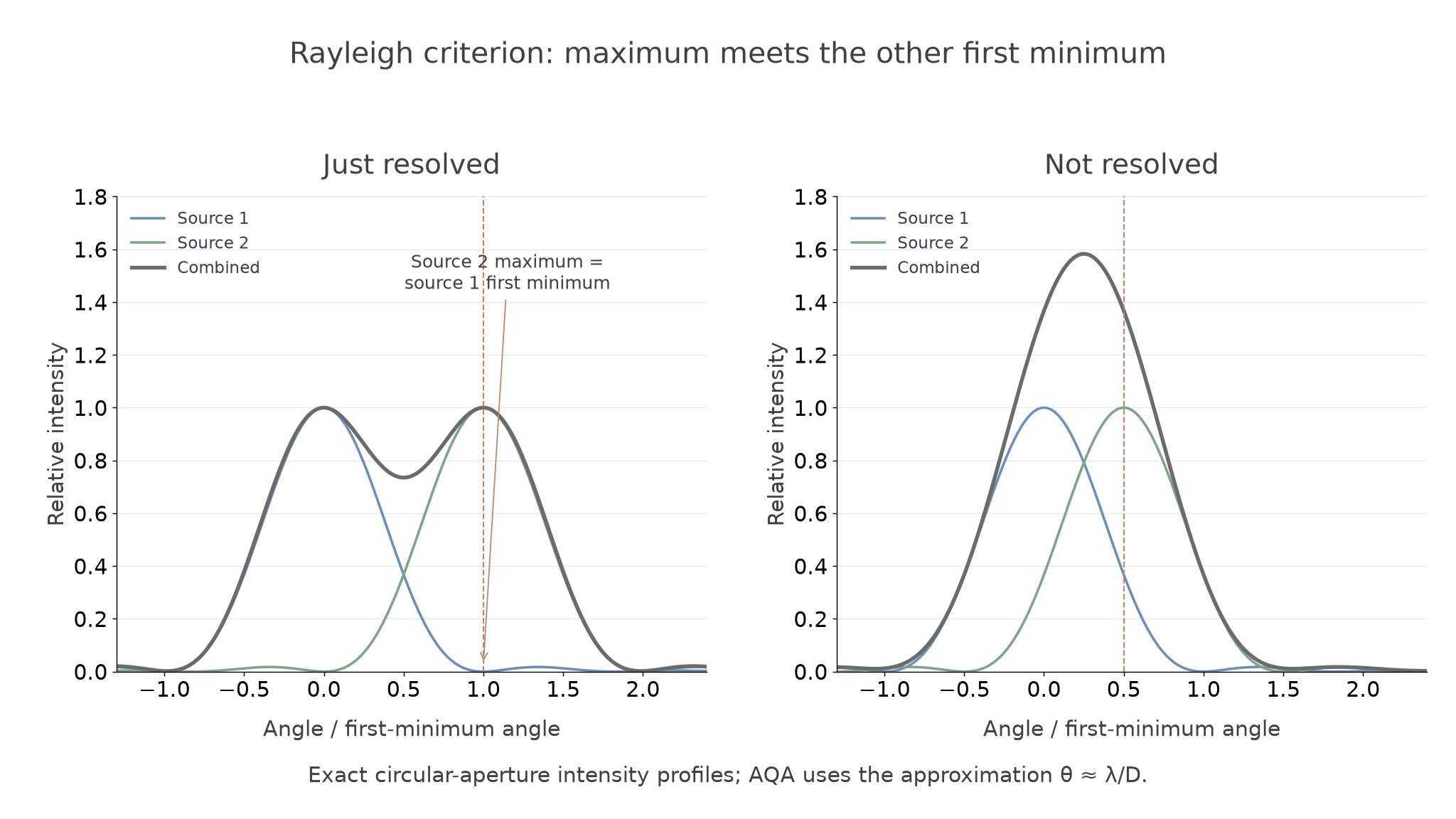
The plotted intensities add for two independent sources. At the just-resolved separation, the second maximum is at the first pattern's first minimum. At a smaller separation, the combined profile has one central peak.
AQA diffraction approximation
Use wavelength and diameter in consistent length units; the answer is in radians. A radian is the angle subtended at a circle's centre by an arc equal to the radius: and a full turn is . For an ideal uniformly illuminated circular aperture, a more exact first-minimum factor is 1.22; use AQA's stated approximation unless a question supplies a different relation.
Smaller means better resolving power. Compare an actual angular separation with the threshold: is resolved under this model; is not. Doubling diameter halves the minimum angle at a fixed wavelength. A shorter wavelength also reduces it. Changing an eyepiece increases apparent angle but does not recover detail already lost to diffraction.
From angular separation to a design decision
For and ,
At a distance , the corresponding small transverse separation is . Use radians in this small-angle relation. A feature separation at that distance would be below the diffraction threshold.
Continue this lesson.
You’re previewing NovaLearn without an account. Create a free account to read the rest.
Create free account