3.11.1.5 - Angular Momentum
Angular momentum changes only when a resultant external torque acts. Use that principle to explain sports movements, solve clutch problems and calculate the effect of a torque acting over time.
Angular momentum and its sign
For rotation about a fixed axis, angular momentum combines moment of inertia with angular velocity.
Angular momentum
Its SI unit is , equivalent to .
This is analogous to linear momentum . Choose one rotational sense as positive: is non-negative, while and carry the direction sign. For a rotor with at , . Its momentum magnitude is 5.4.
The system boundary matters. Angular momenta of coaxial bodies add algebraically. Two equal and opposite angular momenta give zero total angular momentum, even though both bodies move and their kinetic energies are positive.
Conservation when shape changes
Total angular momentum remains constant when the resultant external torque about the chosen axis is zero.
Internal forces can move mass or transfer angular momentum between parts, but cannot change the total. A motor inside a freely floating spacecraft can spin an internal wheel one way and turn the spacecraft body the other way. The motor exerts an internal torque on the combined spacecraft–wheel system, so its total angular momentum is unchanged if external torques are negligible. For a body changing shape with negligible external torque,
[DIAGRAM: asset_name: C.1.5 - Angular Momentum - Diagram 1; asset_slug: C.1.5 - Angular Momentum - Diagram 1; caption: A skater reduces moment of inertia by pulling in her arms and spins faster; description: A skater reduces moment of inertia by pulling in her arms and spins faster.]
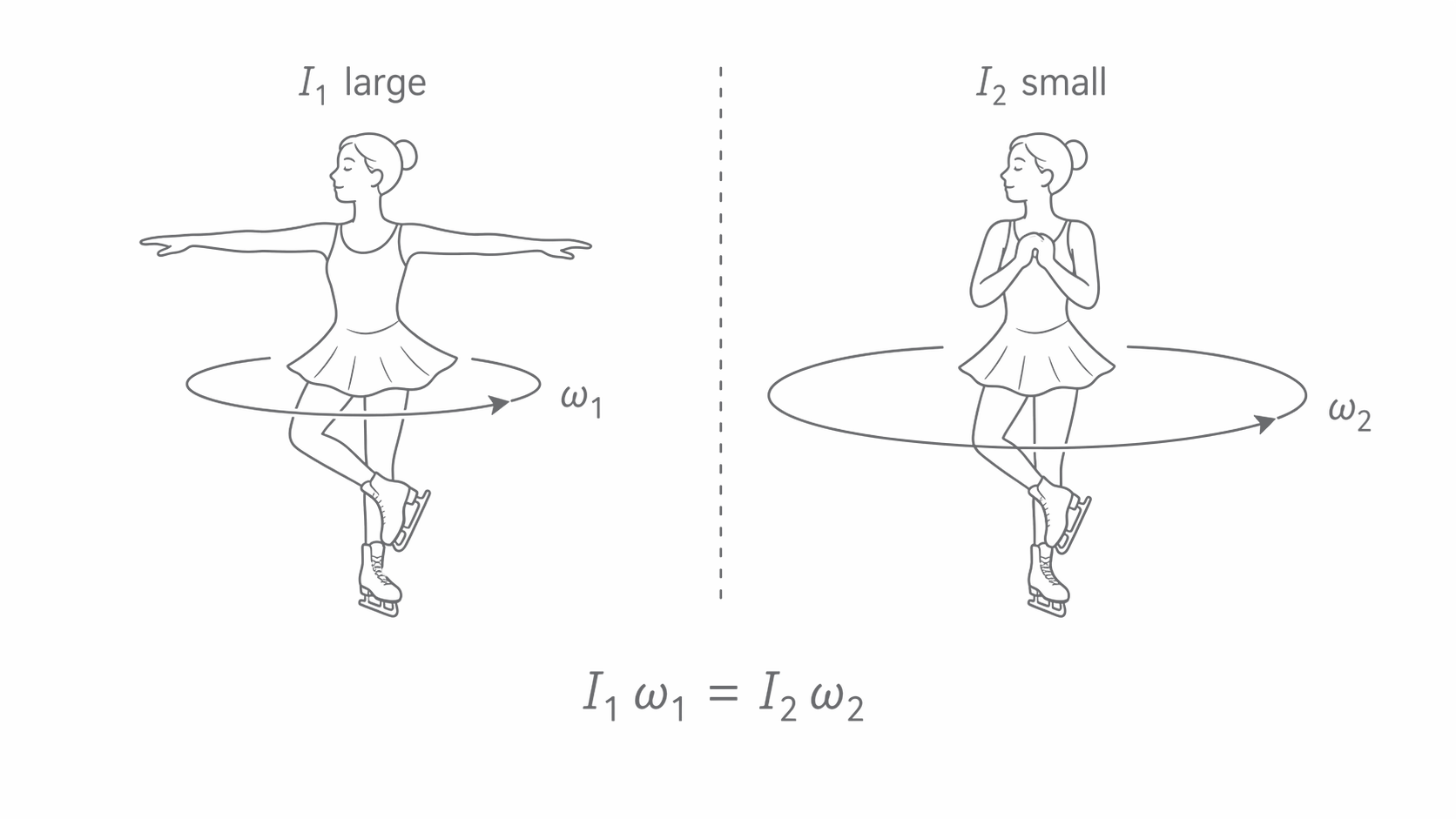
A skater pulls her arms towards the spin axis. Her moment of inertia decreases because the same mass moves closer to the axis. Conservation requires angular speed to rise. This is an approximation over an interval when the angular impulse from ice friction and air resistance is negligible.
For a diver in flight, gravity acts through the centre of mass and therefore exerts no torque about it in a uniform gravitational field. Ignoring air resistance, tucking reduces and increases the somersault rate; extending increases and slows rotation to control the entry orientation. Extending does not make angular momentum vanish.
Conservation of angular momentum does not imply constant kinetic energy. Since , reducing at fixed increases rotational kinetic energy. The skater does internal work when pulling in the arms, transferring energy from chemical stores. If halves, doubles and doubles.
Coupling two rotating discs
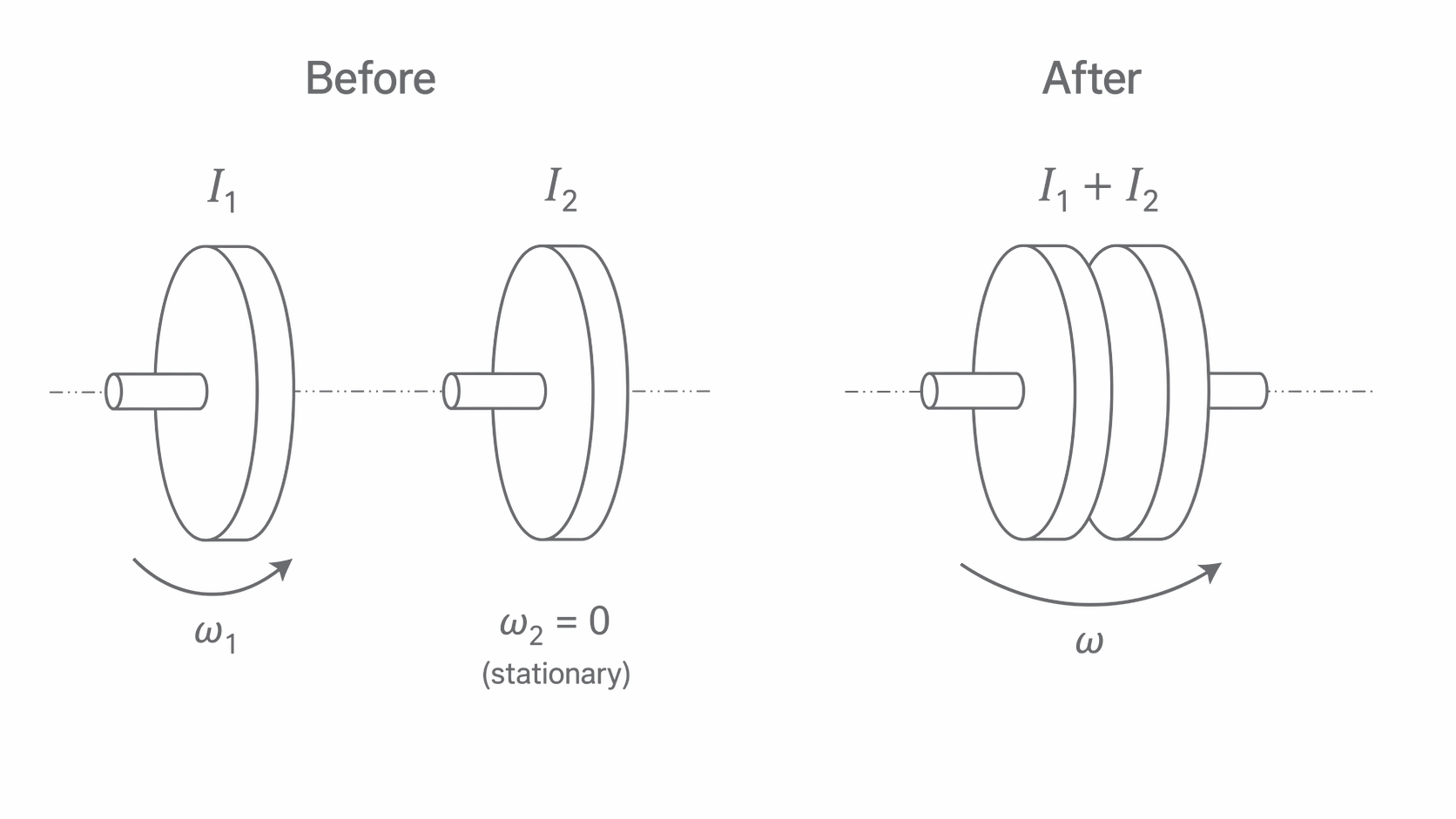
A clutch uses friction between coaxial discs to bring them to a common angular velocity.
Treat both discs as one system. During brief engagement, assume angular impulse from external driving and resisting torques is negligible. Contact friction is internal to this system: it transfers angular momentum from one disc to the other.
[DIAGRAM: asset_name: C.1.5 - Angular Momentum - Diagram 2; asset_slug: C.1.5 - Angular Momentum - Diagram 2; caption: A rotating disc couples to a stationary coaxial disc and they share a final angular velocity; description: A rotating disc couples to a stationary coaxial disc and they share a final angular velocity.]
Continue this lesson.
You’re previewing NovaLearn without an account. Create a free account to read the rest.
Create free account