3.7.1 - Fields
A field describes how a source affects objects without contact. Use field direction, line spacing and potential to compare gravitational and electrostatic interactions, then combine individual fields as vectors.
The concept of a force field
A force field is a region in which a body experiences a non-contact force. The field exists whether or not a test object is present: a test object reveals the field by experiencing a force.
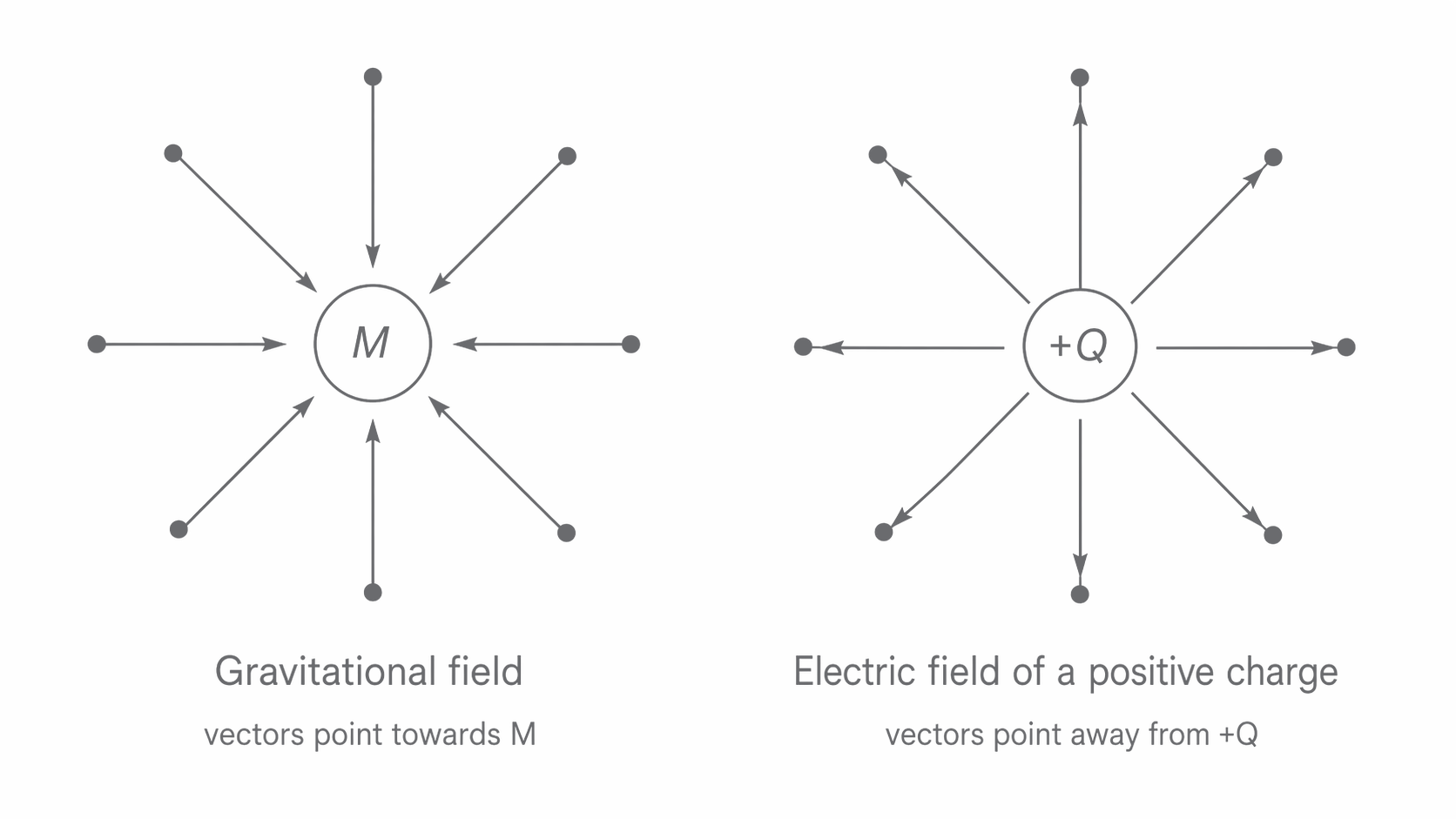
A gravitational field acts on mass. Its vector at a point points in the direction of the force on a small test mass. An electric field acts on charge, but its direction is defined using a positive test charge. A negative charge experiences an electric force opposite to the electric field direction.
The word vector matters: a field has both magnitude and direction. Around an isolated mass, gravitational field vectors point inward. Around a positive point charge, electric field vectors point outward; around a negative point charge, they point inward. Determine the force direction from the source and test object before doing arithmetic.
[DIAGRAM: asset_name: 7.1 - Fields - Diagram 1; asset_slug: 7.1 - Fields - Diagram 1; recommended_method: retained_png; caption: Field directions around a mass and a positive charge. Arrow lengths do not represent strength.; description: Direction sketches for an isolated mass and a positive charge. Arrow lengths are schematic, not a scale of field strength.]
Sources of gravitational, electric and magnetic fields
The relevant property of the source determines which interaction a field describes.
| Interaction | Source and response |
|---|---|
| Gravitational | Mass produces a gravitational field; another mass experiences a gravitational force. |
| Electrostatic | Static charge produces an electric field; another charge experiences an electric force. |
| Magnetic | Moving charges, including currents, produce magnetic fields; moving charges or currents can experience magnetic forces. |
These are three types of force field, not three distinct fundamental interactions: electrostatic and magnetic phenomena are aspects of electromagnetism. A stationary charge does not experience a magnetic force solely because it is charged. The magnetic force on a moving charge also depends on its direction of motion; magnetic field arrows are therefore not generally force arrows.
Fields can coexist. A charged particle near Earth may experience gravitational and electric forces at the same time. Calculate or reason about each interaction separately and then add the forces to find the resultant force.
Reading direction and strength from field lines
Field lines represent a field throughout a region; they are not physical threads or compulsory particle paths. The tangent to a gravitational or electric field line gives the field direction, and its arrow gives the sense along that line. A moving particle need not follow a line because it may already have velocity in another direction.
Closer line spacing indicates greater field strength, using a consistent convention within one diagram. The number of drawn lines is an illustrative choice; do not compare the numerical strength of unrelated sketches merely by counting their lines. Field lines cannot cross at a point with nonzero field, because the resultant field has only one direction there.
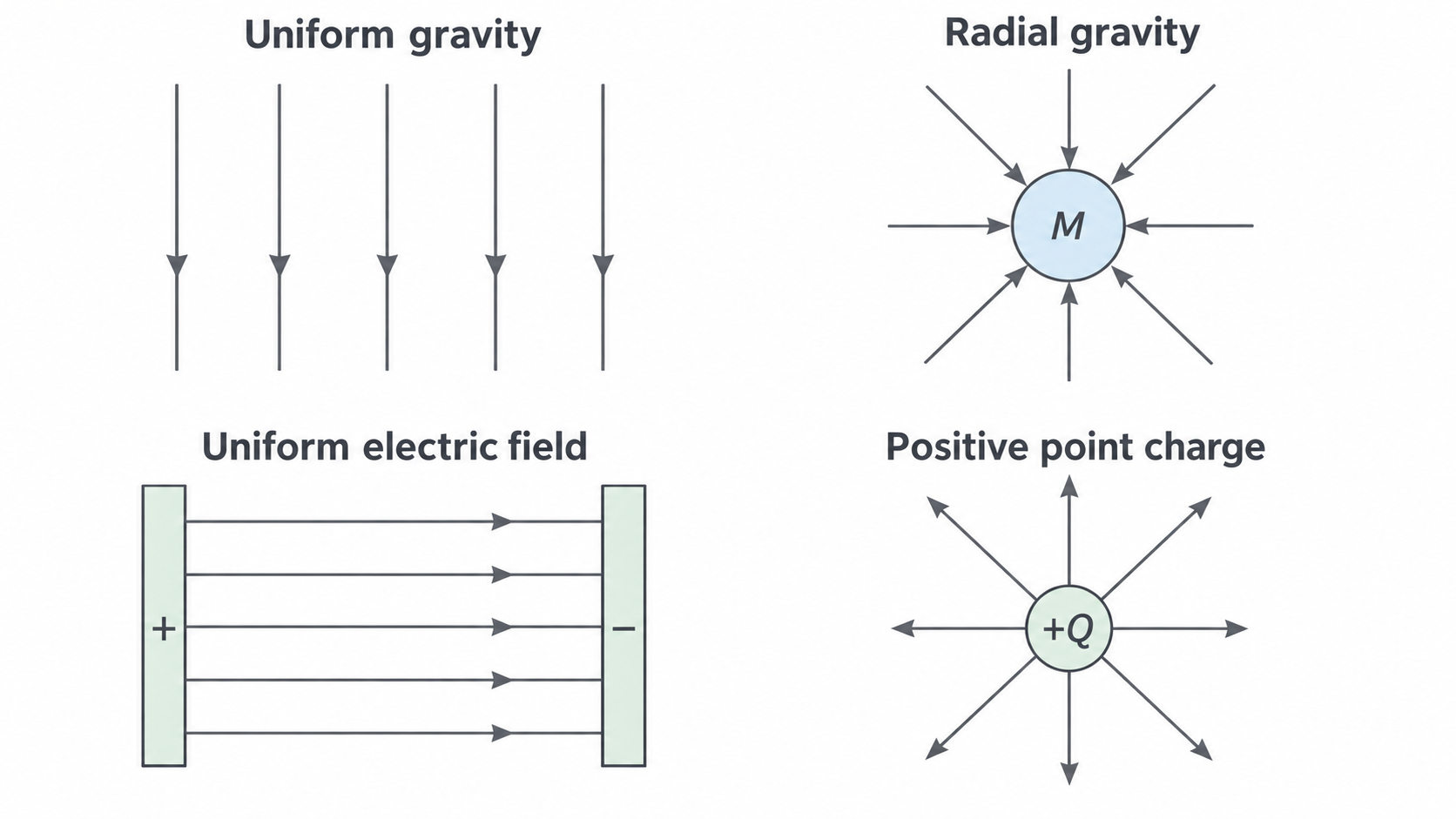
In a uniform field, magnitude and direction are constant: lines are parallel and equally spaced. A small region near Earth's surface is approximately uniform. Between large parallel charged plates, the central region is approximately uniform when edge effects are negligible.
In a radial field, lines follow radii towards or away from a point source. Their separation increases with distance. In three dimensions the same set of lines is distributed over spherical areas proportional to , consistent with inverse-square weakening. The two-dimensional sketch shows the geometry; its line count alone is not a numerical derivation.
[DIAGRAM: asset_name: 7.1 - Fields - Diagram 2; asset_slug: 7.1 - Fields - Diagram 2; recommended_method: retained_png; caption: Uniform and radial fields: inward gravity, outward positive-charge field, and plate field from positive to negative.; description: Uniform fields have parallel equally spaced lines. Radial gravity points inward; a positive electric source has outward field lines. The plate field points from positive to negative.]
Inverse-square laws and potential
The gravitational and electrostatic force magnitudes between point sources have the same inverse-square structure:
Continue this lesson.
You’re previewing NovaLearn without an account. Create a free account to read the rest.
Create free account