3.13.4.3 - Summing and Difference Amplifiers
A summing amplifier forms a weighted inverted total, while a difference amplifier responds to the separation between two voltages. Use the correct signed relationship, understand the resistor matching, and distinguish independent input contributions from cancellation of shared interference.
Weighted Sums of Input Voltages
A summing amplifier connects several sources to an inverting-input junction through separate resistors. The non-inverting input is grounded and provides negative feedback.
[DIAGRAM: asset_name: E.4.3 - Summing Amplifier Configuration - Diagram 1; asset_slug: E.4.3 - Summing Amplifier Configuration - Diagram 1; caption: Three input resistors join one virtual-earth summing junction and share the feedback resistor; description: Three input resistors join one virtual-earth summing junction and share the feedback resistor.]
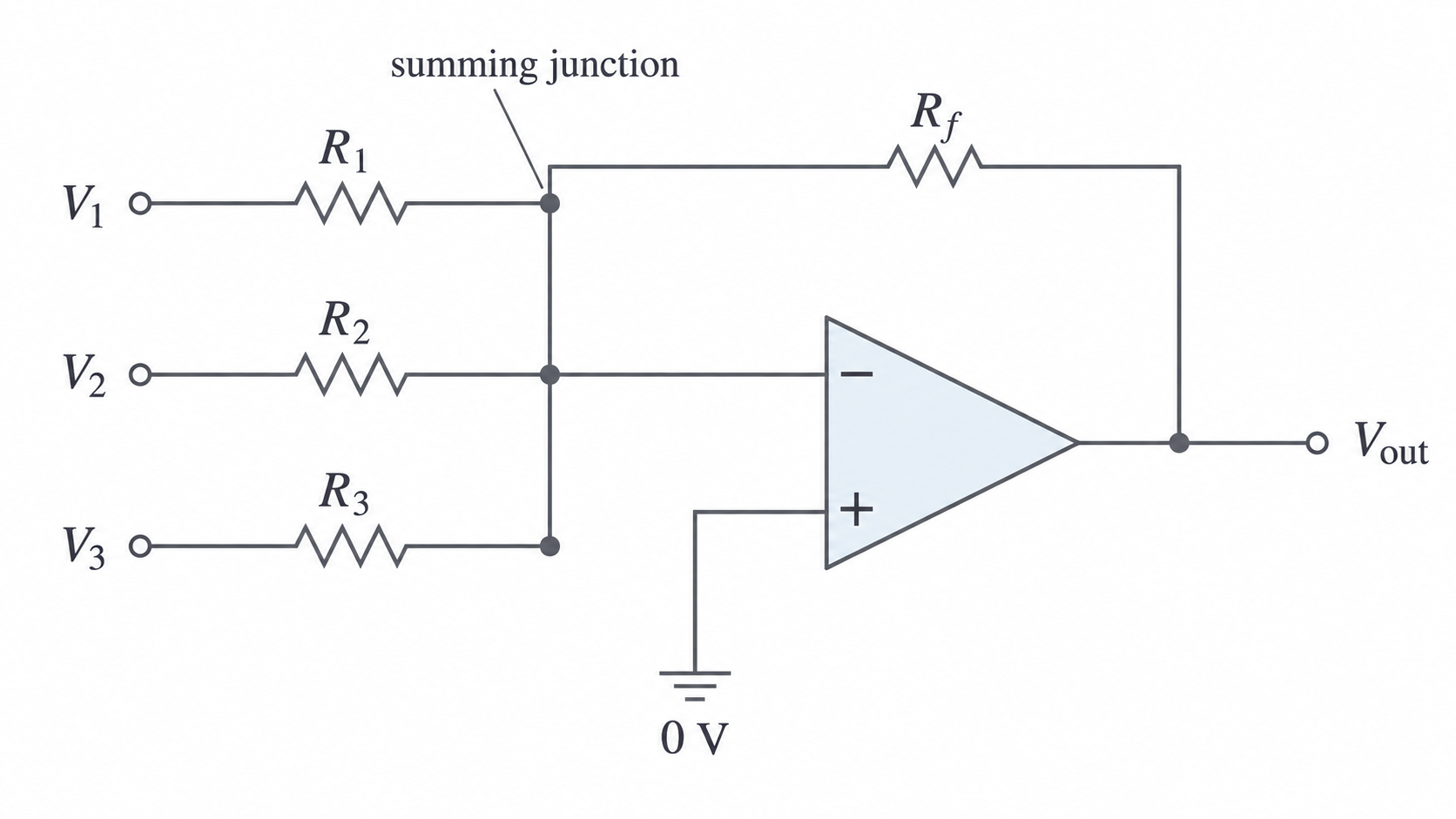
While the op-amp is linear, the junction is approximately zero and its input takes negligible current. Thus the signed source currents combine in the feedback path. The output is a weighted, inverted sum:
AQA does not require a derivation. To apply the equation safely, calculate each signed contribution and add them. Each channel has gain , so increasing one input resistance reduces that channel's weighting. Equal input resistors give equal weighting; an average requires a suitable feedback ratio, not just equal inputs.
For , and , the output is . Inputs and therefore contribute and , giving overall. Check the sum against the stated output limits even when each individual contribution is allowed.
Why Input Contributions Are Independent
A fixed summing-junction potential makes each channel current depend on its own source voltage and resistor: . Changing changes , but does not change the voltage across if and the virtual earth stay fixed. The op-amp adjusts its output and feedback current to accommodate the new total.
This is useful in an audio mixer, where altering one channel's weighting should leave the other channels' contributions unchanged. The statement assumes stiff sources and an unsaturated op-amp at an appropriate frequency. Once the junction moves away from virtual earth, the currents need not remain independent.
Do not interpret independence as a claim that every current always flows towards the junction. A negative input produces a current away from it under that sign convention. The important result is that one channel's voltage does not shift the common junction and change the other channel currents. Current directions depend on the signed inputs.
Continue this lesson.
You’re previewing NovaLearn without an account. Create a free account to read the rest.
Create free account