3.13.6.4 - AM and FM
Modulation varies a carrier so that it conveys information. Compare the waveforms and bandwidth of AM and FM, read their frequencies from time graphs, and decide whether a channel can carry the signal.
Carrier, information and bandwidth
A microphone's voltage represents sound, but radiating low-frequency audio directly would require impractically large efficient aerials and would make different broadcasts difficult to separate. A higher-frequency carrier provides a suitable radio wave; different carrier frequencies allow receivers to select different transmissions.
The information signal carries the message. Modulation varies a property of the carrier in accordance with the information signal. For a single sinusoidal information signal, its frequency describes how quickly the message variation repeats; the unmodulated carrier frequency is much higher. For speech or music, in the bandwidth equations means the highest information frequency present.
Bandwidth is a frequency width: highest occupied frequency minus lowest occupied frequency, in hertz. It is different from the carrier frequency, which locates the signal in the spectrum, and different from data rate, measured in bits per second. The receiving channel must pass the useful range of frequencies, not just the central carrier. Detailed modulator circuits and the full mathematical theory of modulation are not required.
AM waveforms and sidebands
In amplitude modulation (AM) the carrier amplitude varies with the information signal while the rapid carrier oscillations retain constant frequency. The upper outline, or envelope, has the shape of the information signal displaced above zero. The lower envelope is its negative mirror.
[DIAGRAM: asset_name: E.6.4 - Amplitude (AM) and Frequency Modulation (FM) Techniques - Diagram 1; asset_slug: E.6.4 - Amplitude (AM) and Frequency Modulation (FM) Techniques - Diagram 1; caption: Information, carrier and AM voltage traces on the same time scale; description: Information, carrier and AM voltage traces on the same time scale]
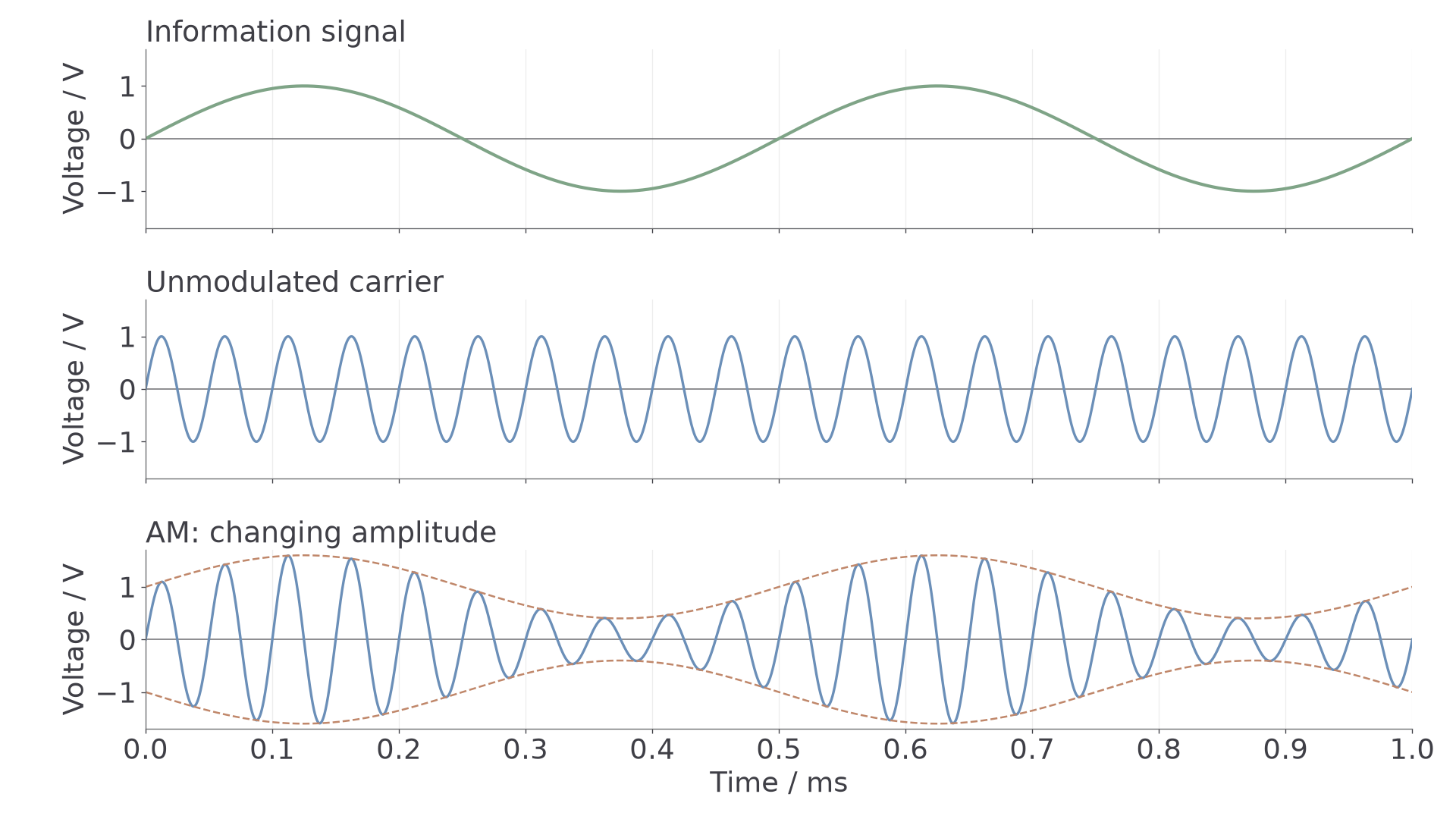
For a sinusoidal message the AM spectrum contains the carrier and side frequencies and . For an information signal with many frequencies, sidebands extend as far as these limits. The separation of the outer limits is therefore
For and audio up to , the band extends from to , a width of . The carrier is in the centre, not at either edge. A receiver that passes only the carrier would lose the information-carrying sidebands.
Noise that changes amplitude also changes the AM envelope, so it can distort the recovered message. This explains a limitation of AM even when the available bandwidth is adequate.
FM deviation, bandwidth and noise
In frequency modulation (FM) the instantaneous frequency varies with the information signal while amplitude stays constant. With the convention shown below, a positive message voltage increases instantaneous frequency, so cycles become closer together; a negative voltage spreads them apart. The frequency varies smoothly, not by changing the wave height.
[DIAGRAM: asset_name: E.6.4 - Amplitude (AM) and Frequency Modulation (FM) Techniques - Diagram 2; asset_slug: E.6.4 - Amplitude (AM) and Frequency Modulation (FM) Techniques - Diagram 2; caption: FM changes cycle spacing while keeping amplitude constant; description: FM changes cycle spacing while keeping amplitude constant]
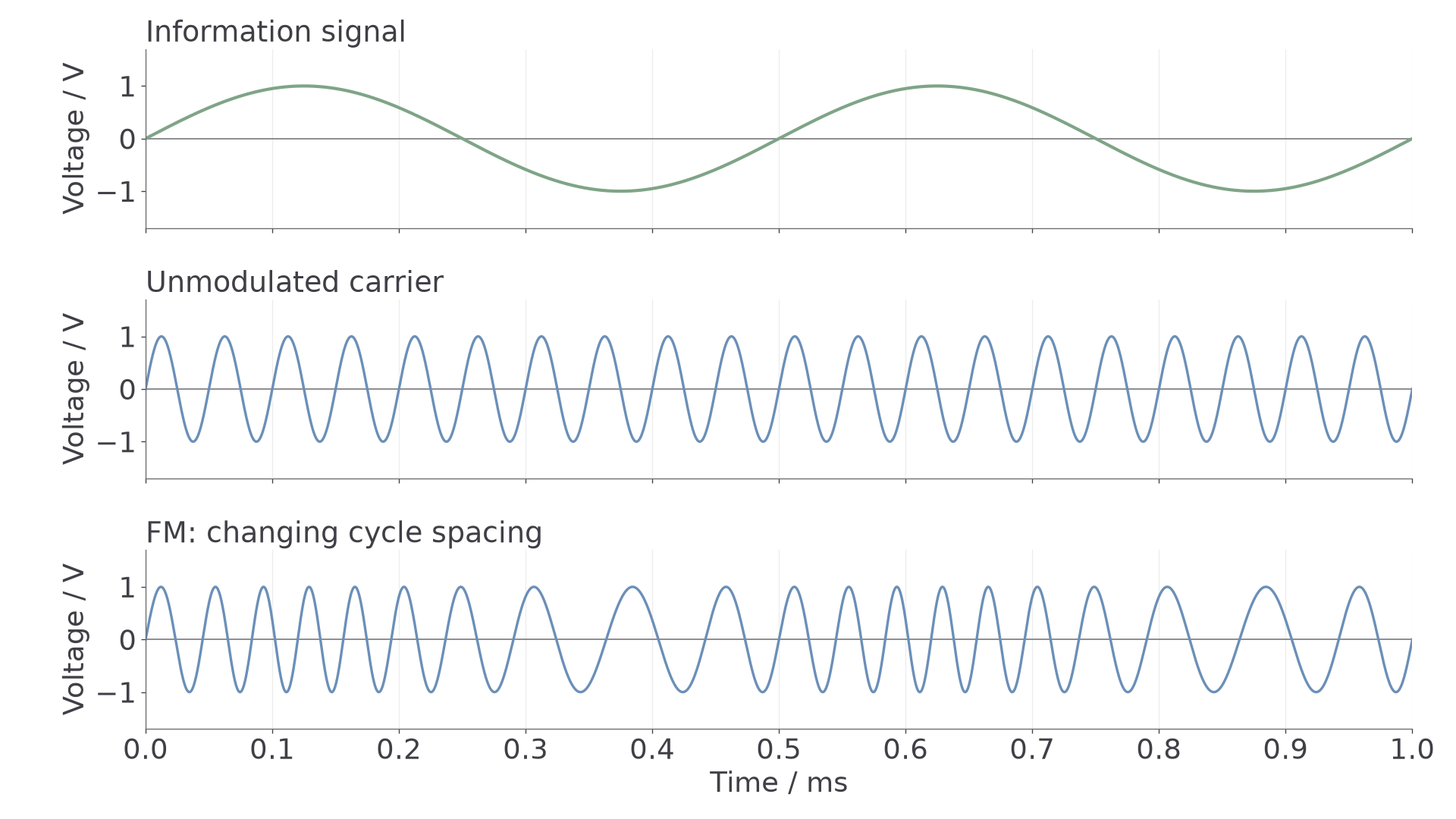
The frequency deviation is the maximum change from the unmodulated carrier frequency. Thus instantaneous frequency ranges from to . These are not the full occupied spectral limits: FM produces side frequencies beyond them. For the required simple estimate, use
This is Carson's bandwidth estimate, rather than a statement that all signal power vanishes outside the band.
For , and , the instantaneous frequency reaches and . The estimated occupied bandwidth is , giving spectral limits about and . Keep these two ranges distinct.
Continue this lesson.
You’re previewing NovaLearn without an account. Create a free account to read the rest.
Create free account