3.7.5.2 - Moving Charges in a Magnetic Field
A magnetic field can change a charged particle's direction without changing its speed. Begin with the force on one moving charge, use its sign to find the direction, then combine magnetic force with circular motion to understand a cyclotron.
Force on one moving charge
A particle of charge magnitude moving at speed perpendicular to a magnetic field of flux density experiences force magnitude
The formula sheet writes ; use the magnitude of charge for a force magnitude, then find direction separately. is in tesla, in coulomb and in . A stationary charge has no magnetic force. Motion parallel or antiparallel to the field also gives zero force.
The connection with the wire equation is useful. Charge moving through a distance in time corresponds to current magnitude and speed . Substituting into gives
This explains why a current-carrying conductor experiences a force: its moving charge carriers interact with the field and transfer force to the conductor. It does not mean the drift speed of electrons equals the speed of an individual particle beam.
For example, a singly charged ion moving at perpendicular to experiences .
Charge sign and three-dimensional directions
Use Fleming's left-hand rule with the first finger along the field. For a positive particle, point the second finger along its velocity, since positive charge moving that way is conventional current. For a negative particle, point the second finger opposite its velocity. The thumb gives the force.
A cross means field into the page; a dot means field out of the page. In the figure, both particles move to the right and the field is into the page. The positive particle's force is up; the negative particle's force is down. The force arrows start at the particles and are perpendicular to the velocity arrows.
[DIAGRAM: asset_name: 7.5.2 - Moving Charges in a Magnetic Field - Diagram 2; asset_slug: 7.5.2 - Moving Charges in a Magnetic Field - Diagram 2; caption: Opposite charges with the same velocity experience opposite magnetic forces; description: Positive charge moving right in an into-page field has upward force. Negative charge with the same velocity has downward force.]
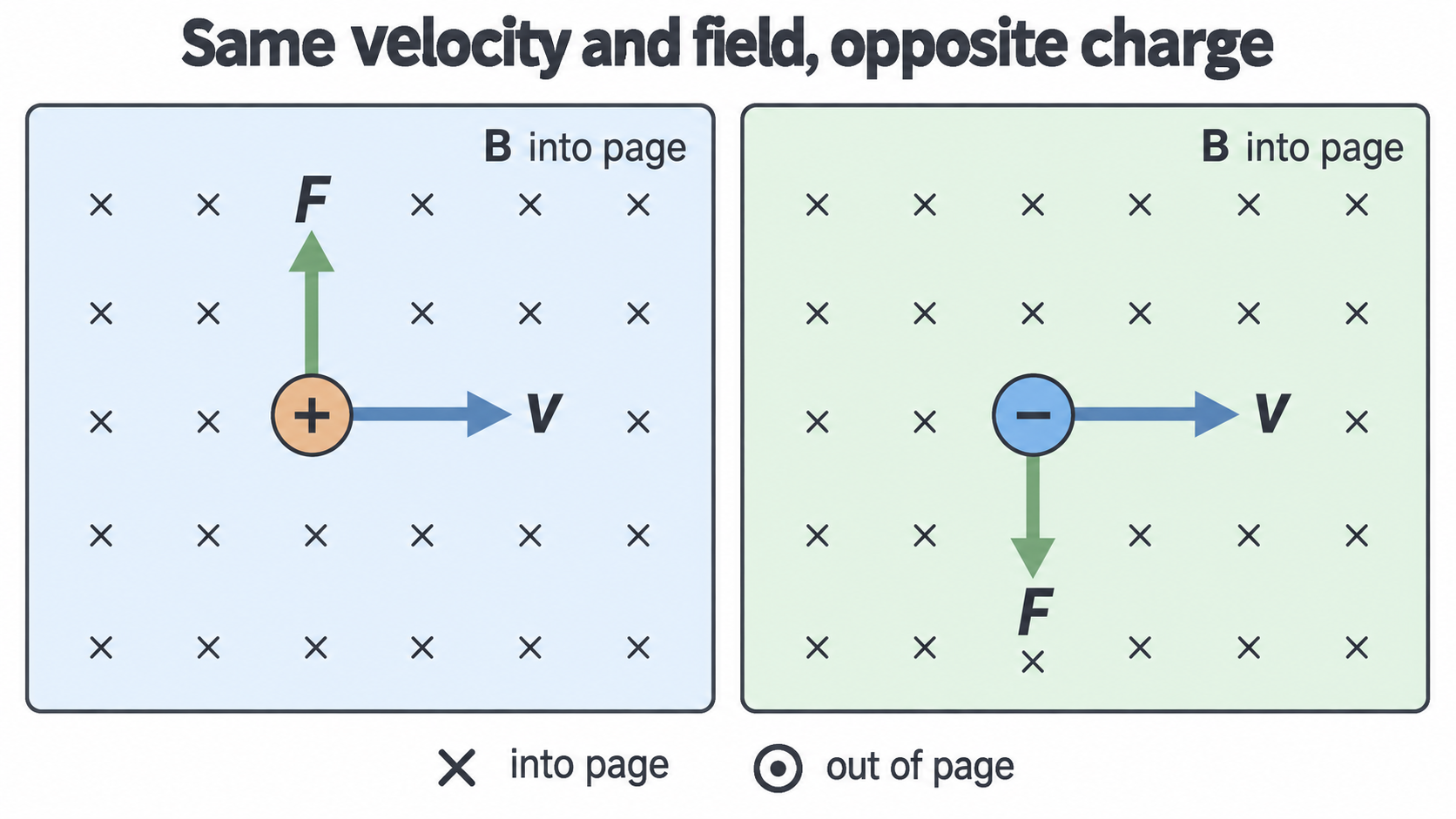
Reversing charge sign, velocity or field alone reverses the force. Reversing any two leaves its direction unchanged. Always state the particle's actual velocity separately from the current-equivalent direction: an electron does not move in the direction of your second finger.
Circular motion without a change in speed
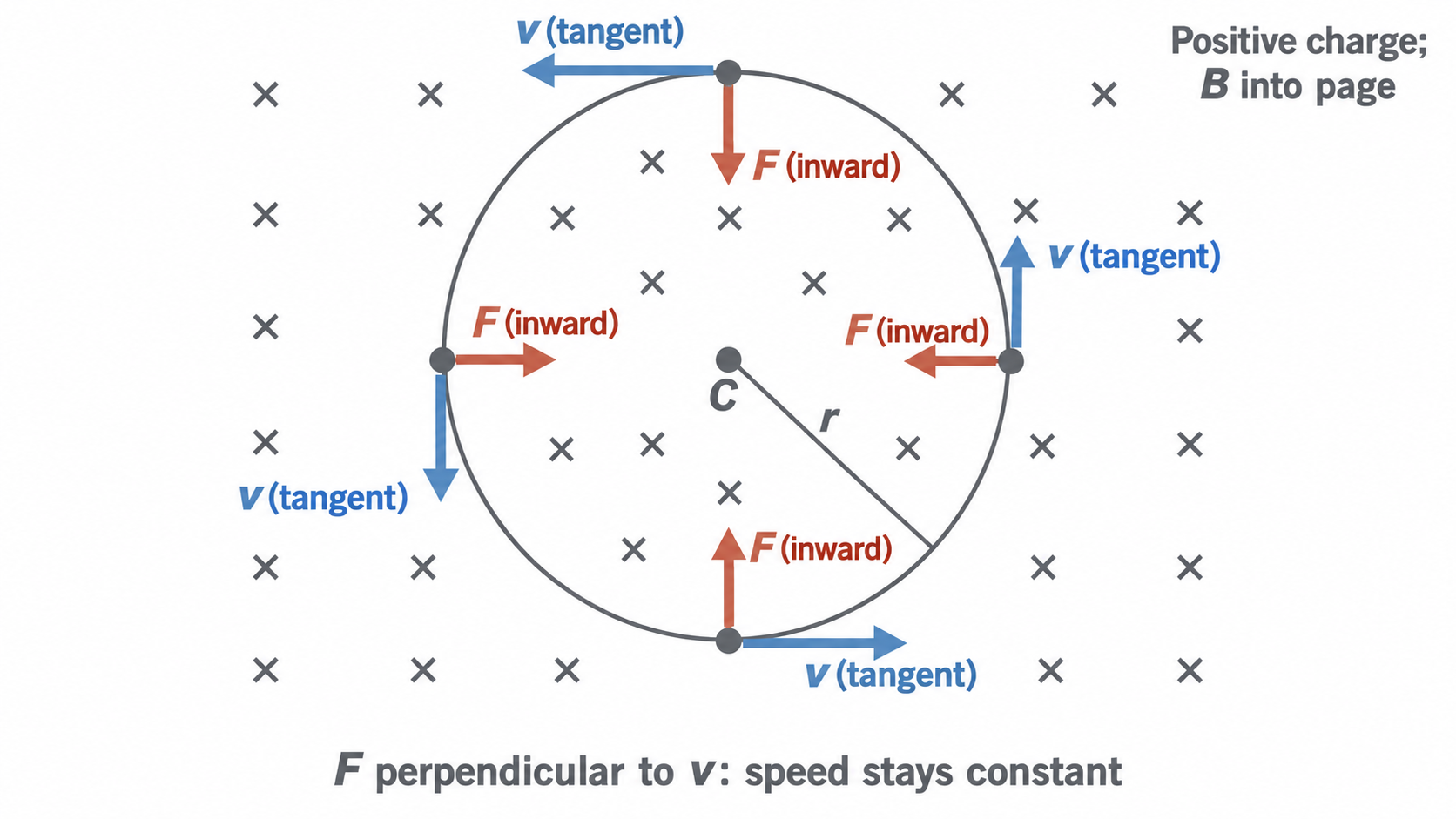
If a charged particle enters a uniform magnetic field perpendicular to its velocity, and magnetic force is the only significant force, its path is circular. The force is always perpendicular to its instantaneous velocity, so it turns the velocity without changing its magnitude. Work done is zero because the force has no component along the displacement; kinetic energy and speed stay constant. The particle still accelerates because its velocity direction changes.
[DIAGRAM: asset_name: 7.5.2 - Moving Charges in a Magnetic Field - Diagram 3; asset_slug: 7.5.2 - Moving Charges in a Magnetic Field - Diagram 3; caption: A positive particle turns anticlockwise in an into-page magnetic field; description: At four points velocity is tangential and magnetic force points to the centre. The speed stays constant.]
Continue this lesson.
You’re previewing NovaLearn without an account. Create a free account to read the rest.
Create free account