3.8.1.8 - Safety Aspects
Reactor safety depends on controlling both the fission chain and the radiation and heat that remain afterwards. Connect fuel handling, shielding, shutdown and waste storage to the hazards they reduce, then weigh those protections against the benefits and remaining risks of nuclear power.
Fuel composition and remote handling
Many thermal reactors use uranium dioxide fuel with an increased proportion of fissile uranium-235. Natural uranium contains about uranium-235; typical conventional light-water-reactor fuel contains about – and is still mainly uranium-238. Enrichment improves the neutron balance in that design. Not all reactors use this fuel or enrichment: other designs can use natural uranium or fuel containing plutonium.
Fuel pellets are enclosed in metal cladding, forming rods or assemblies. The cladding helps contain radioactive material while allowing thermal energy to reach the coolant. Unused uranium fuel emits mainly alpha radiation, which intact cladding contains; contamination and intake into the body are important hazards if material escapes.
Used fuel contains many radioactive fission products and actinides. Beta and penetrating gamma radiation, together with decay heat, make spent fuel much more hazardous to handle than fresh fuel. Some actinides are alpha emitters and especially hazardous internally. Their presence increases risk; exposure does not make illness inevitable.
Remote equipment increases worker distance and avoids close contact. Shielded handling, containment, monitoring and controlled procedures complement distance. The very high external radiation from spent fuel is why remote handling behind shielding is essential.
Shielding, containment and activation
Radiation from the operating core includes penetrating neutrons and gamma rays. Biological shielding reduces the dose to people. Dense material attenuates gamma radiation; hydrogen-containing material slows neutrons through collisions so they can be absorbed more readily. Thick concrete is useful because it combines these properties.
[DIAGRAM: asset_name: 8.1.8 - Safety Aspects - Diagram 1; asset_slug: 8.1.8 - Safety Aspects - Diagram 1; caption: The vessel and surrounding concrete reduce radiation from the reactor core; description: The vessel and surrounding concrete reduce radiation from the reactor core.]
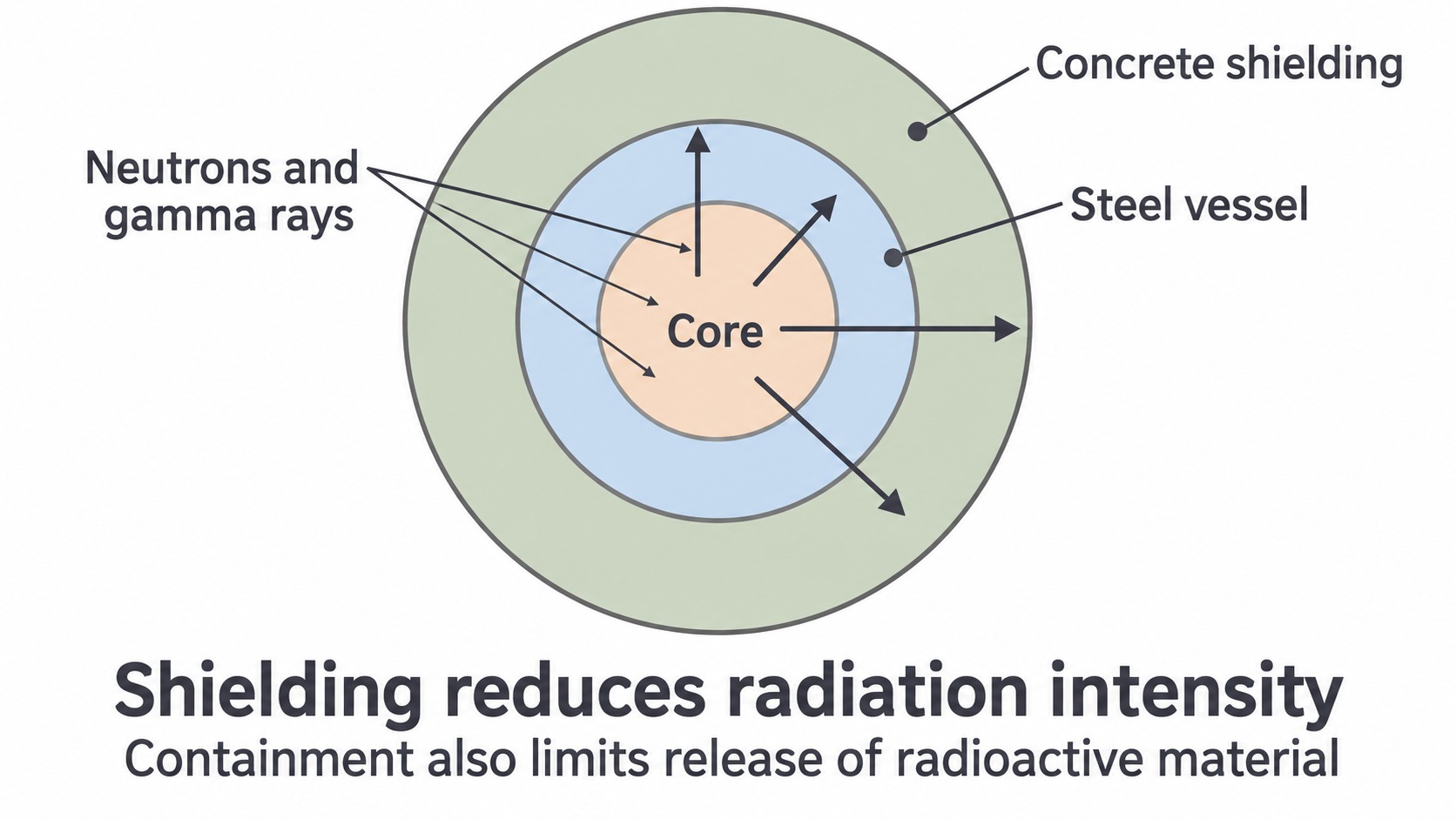
The steel vessel in a pressurised design contains the hot coolant under pressure and also attenuates some radiation. Containment barriers limit the escape of radioactive material, while shielding reduces radiation passing through: these are related but different tasks. No finite shield removes every possible photon, so thickness and monitoring are chosen to reduce dose to an acceptable level.
Neutron capture can convert initially stable nuclei in reactor structures and shielding into radioactive isotopes. This activation means those materials can require controlled handling and disposal during decommissioning. The material does not become radioactive because gamma rays are 'stored' inside it.
Shutdown does not remove decay heat
An emergency shutdown rapidly inserts neutron absorbers into the core. Fewer than one neutron from each fission then induces another fission on average, so the reactor becomes subcritical and the sustained chain dies away. Some designs use gravity-driven insertion on loss of power; other designs use different fail-safe mechanisms.
The existing radioactive fission products still decay. Their radiation deposits energy in the fuel and surroundings, producing decay heat even after successful shutdown. Cooling must continue: if the rate of thermal energy removal falls below the heating rate, the core's internal energy and temperature rise. Backup cooling and reliable power or passive heat-removal paths therefore address a different hazard from shutdown rods.
For example, a shut-down core producing of decay heat while cooling removes only gains thermal energy at . The chain can be subcritical while the core still heats up.
Continue this lesson.
You’re previewing NovaLearn without an account. Create a free account to read the rest.
Create free account