3.4.1.2 - Moments
Use perpendicular distances to calculate turning effects, locate weight at the centre of mass, and distinguish balanced forces from balanced moments.
Moment and perpendicular distance
A force can turn a body about a point when its line of action misses that point. The moment is
where is the shortest, perpendicular distance from the point to the force's line of action. The unit is . State clockwise or anticlockwise when direction matters.
[DIAGRAM: asset_name: 4.1.2 - Moments - Diagram 1; asset_slug: 4.1.2 - Moments - Diagram 1; recommended_method: retained_png; caption: Top view: the upward force at the handle turns the door anticlockwise. Distance d is perpendicular to the force line.; description: Top view: the upward force at the handle turns the door anticlockwise. Distance d is perpendicular to the force line.]
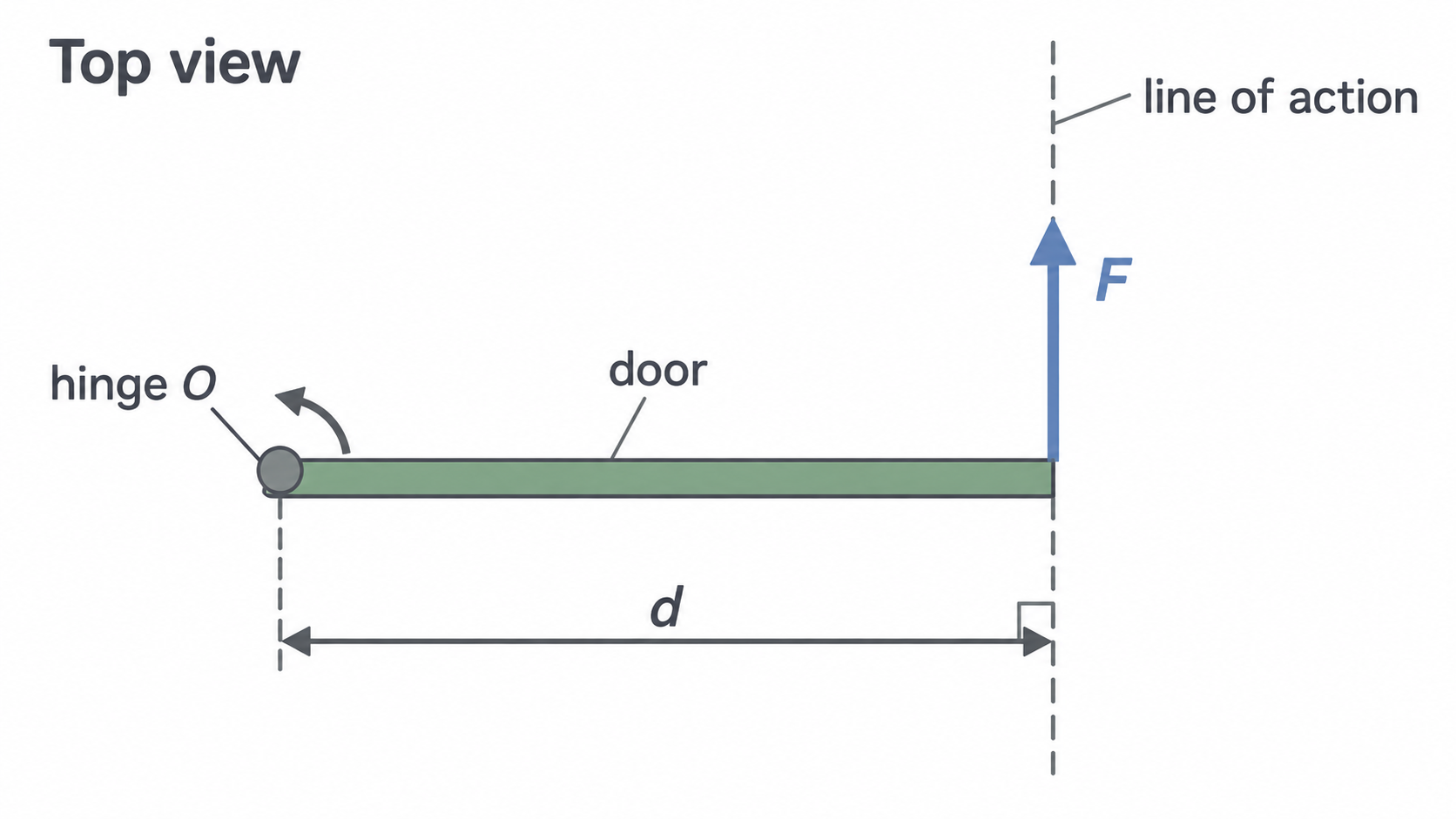
A force along a line through the pivot has zero moment. For a spanner of length and force at angle to the spanner, use , or resolve the force to perpendicular to the spanner. Both give .
For , , and , . The parallel component produces no moment. A perpendicular push of the same size would give twice this moment.
Balancing forces and moments
For equilibrium of an extended body, both the resultant force and the resultant moment must be zero. The principle of moments states that total clockwise moment equals total anticlockwise moment about the same point for a body in equilibrium.
Choose a pivot through an unknown force to remove that force from the moment equation. This does not remove it from the vertical-force equation. A support reaction through the chosen pivot has zero moment but still helps balance the total weight.
[DIAGRAM: asset_name: 4.1.2 - Moments - Diagram 2; asset_slug: 4.1.2 - Moments - Diagram 2; recommended_method: retained_png; caption: A balanced beam: 200 N at 1.20 m and 300 N at 0.80 m each give a 240 N m moment in opposite senses.; description: A balanced beam: 200 N at 1.20 m and 300 N at 0.80 m each give a 240 N m moment in opposite senses.]
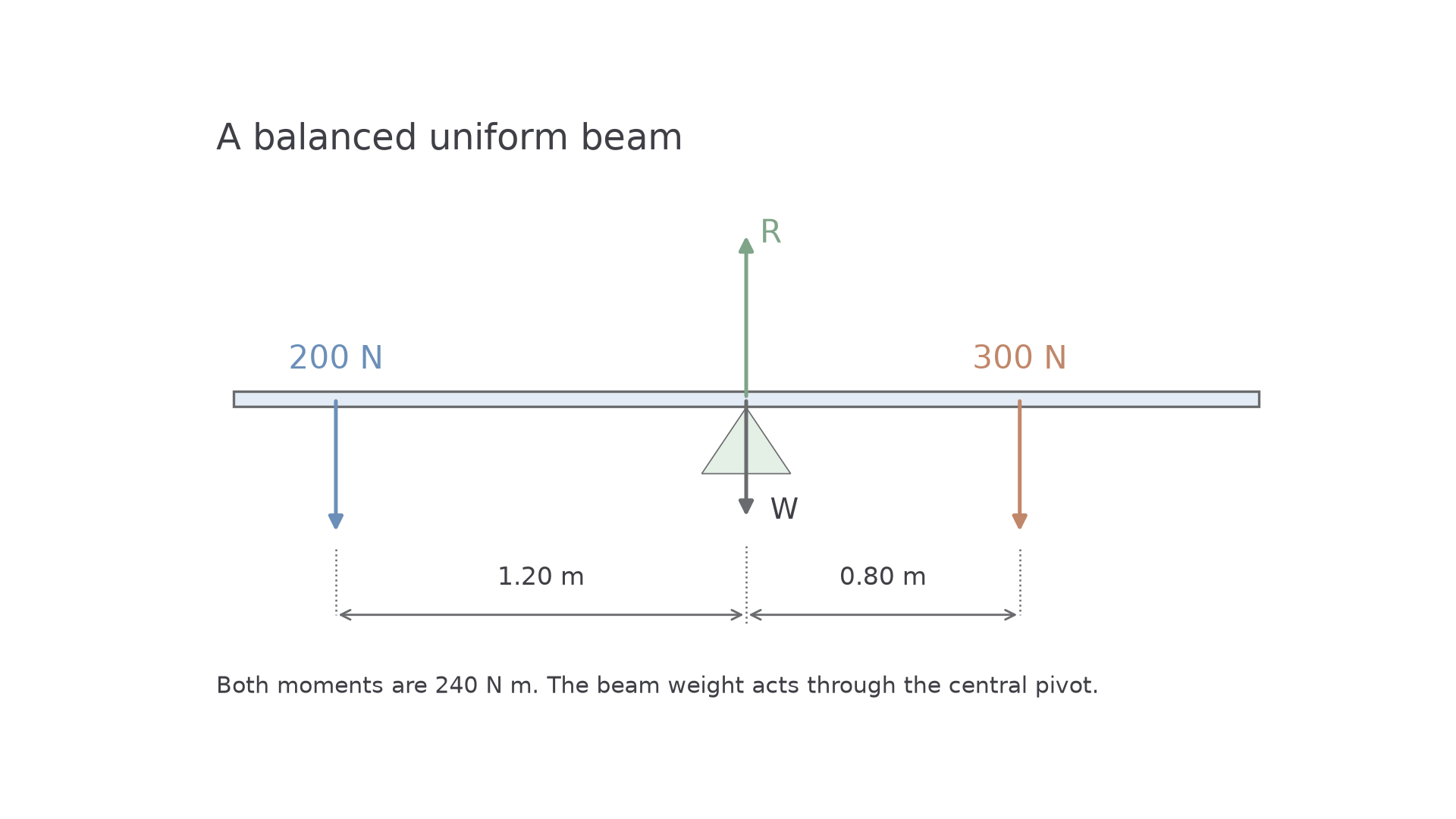
In this example the uniform beam is pivoted at its centre, so its own weight has zero moment. About the pivot,
The left downward force turns anticlockwise; the right downward force turns clockwise. Vertical equilibrium separately gives . If the beam weighs , the support force is .
Locating weight at the centre of mass
The centre of mass describes the balance point of the mass distribution. In a uniform gravitational field, the body's entire weight can be represented by one force through this point. A uniform regular solid has its centre of mass at its geometric centre: the midpoint of a uniform rule or the centre of a uniform sphere.
Uniformity matters. An irregular or nonuniform body need not have its centre of mass at the geometric centre. Suspending a thin body freely places its centre of mass vertically below the suspension point; repeating from another point gives intersecting vertical lines through it.
[DIAGRAM: asset_name: 4.1.2 - Moments - Diagram 3; asset_slug: 4.1.2 - Moments - Diagram 3; recommended_method: retained_png; caption: Exact ruler coordinates: the 4.5 N force acts at 10 cm, the pivot at 34 cm, and the rule’s weight at 50 cm.; description: Exact ruler coordinates: the 4.5 N force acts at 10 cm, the pivot at 34 cm, and the rule’s weight at 50 cm.]
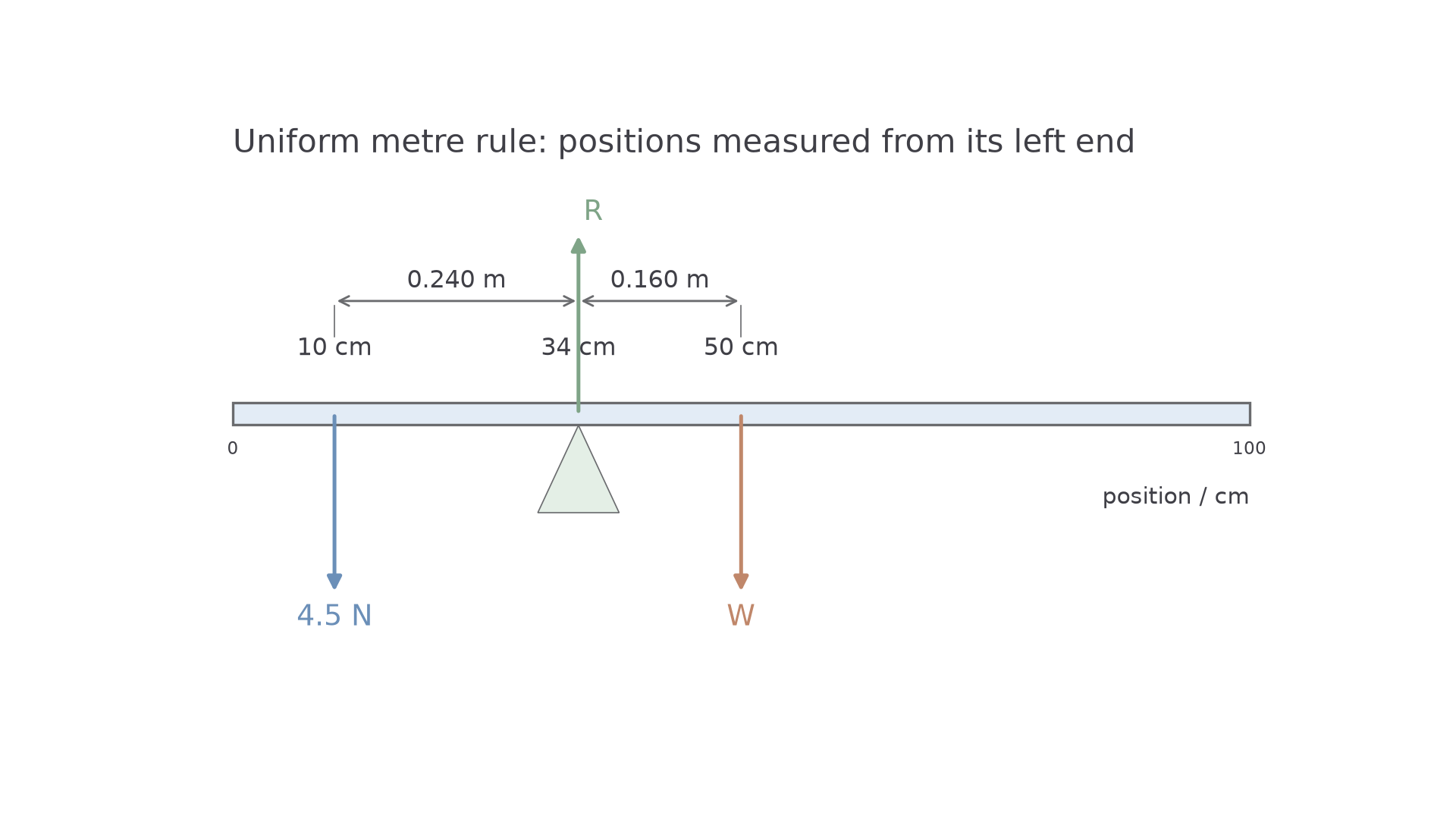
The distances in the diagram are measured from the pivot, not from the ruler's zero. Therefore,
Hence the rule's weight is .
The reaction is upward. If the pivot moved, the weight would still act at the same centre of mass. A standing object tips when its weight's line of action passes outside its support region, because the weight then turns it about the edge rather than restoring it.
Couples and zero resultant force
A couple consists of equal and opposite coplanar forces on different parallel lines of action. Their resultant force is zero, but their moments act in the same rotational sense. Thus a couple causes no acceleration of the centre of mass while producing a turning effect; it does not necessarily make an already-moving body stop translating.
[DIAGRAM: asset_name: 4.1.2 - Moments - Diagram 4; asset_slug: 4.1.2 - Moments - Diagram 4; recommended_method: retained_png; caption: Equal upward and downward tangential forces form a clockwise couple. Use the separation between their lines of action.; description: Equal upward and downward tangential forces form a clockwise couple. Use the separation between their lines of action.]
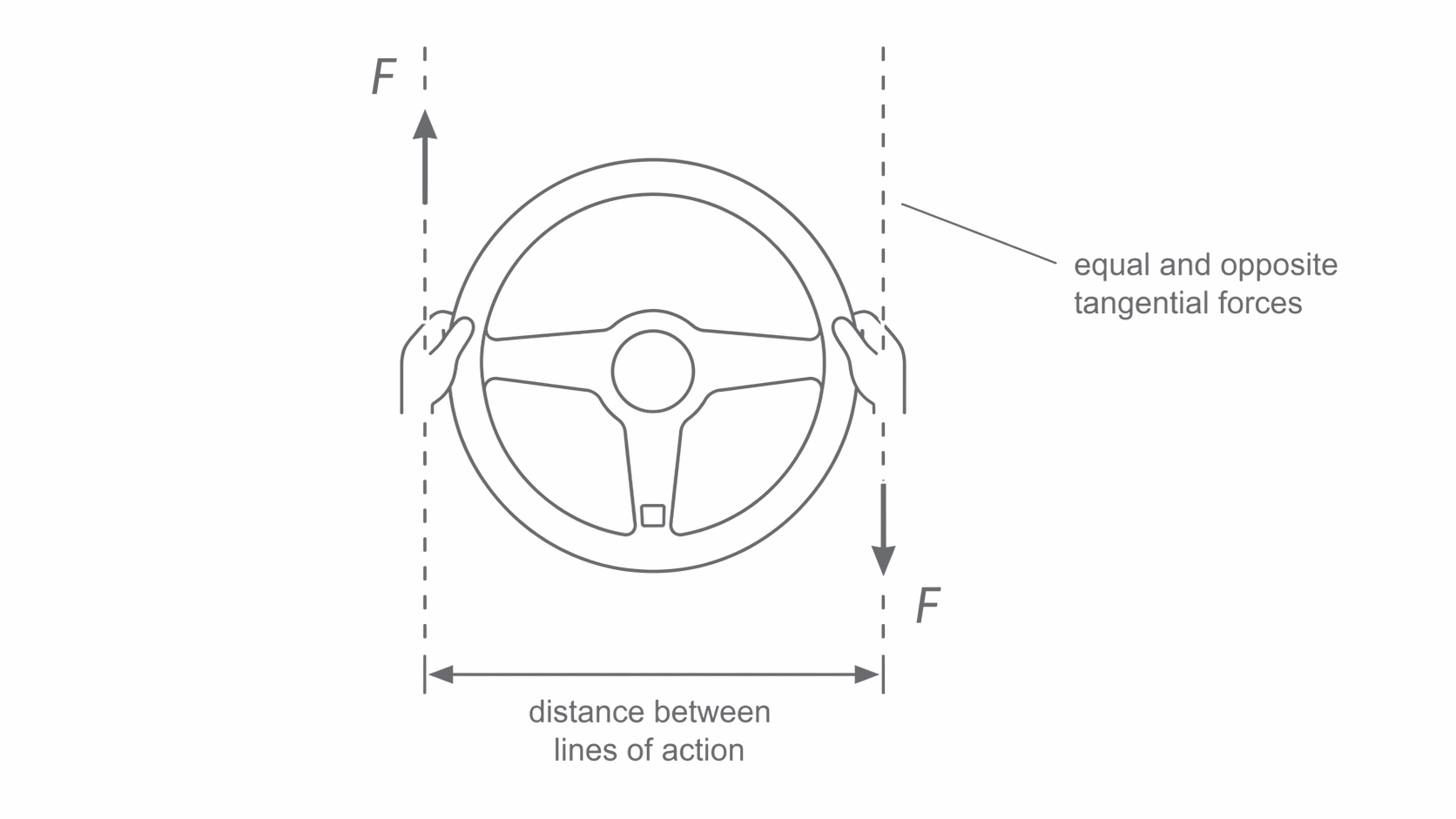
For forces each of magnitude separated by perpendicular distance ,
Taking moments about a point between the force lines gives ; choosing a point on one line gives zero moment from that force and from the other. The couple moment does not depend on the chosen point.
On a wheel of diameter , opposite tangential forces of give . Equivalently, add two moments . Using would double-count.