3.9.1.2 - Reflecting Telescopes
Mirrors can collect light over a large aperture without the colour separation produced by a simple lens. Follow the Cassegrain light path, distinguish chromatic from spherical aberration, and use those differences to justify telescope designs.
The Cassegrain light path
A Cassegrain telescope combines a large parabolic concave primary mirror with a small convex secondary mirror. These are the two shapes required here; interchanging them changes the optical system.
Parallel rays from a distant source pass the secondary and strike the primary. Reflection at the primary turns them back towards its focus in front of the primary. The secondary intercepts this converging beam before it reaches that focus. It reflects the light back again, through a central hole in the primary. The rays then meet behind the primary, and an eyepiece views this real image.
[DIAGRAM: asset_name: A.1.2 - Reflecting Telescopes - Diagram 1; asset_slug: A.1.2 - Reflecting Telescopes - Diagram 1; recommended_method: retained_png; caption: Cassegrain reflection from parabolic primary to convex secondary before the primary focus, then through the hole to an image and eyepiece.; description: Cassegrain reflection from parabolic primary to convex secondary before the primary focus, then through the hole to an image and eyepiece.]
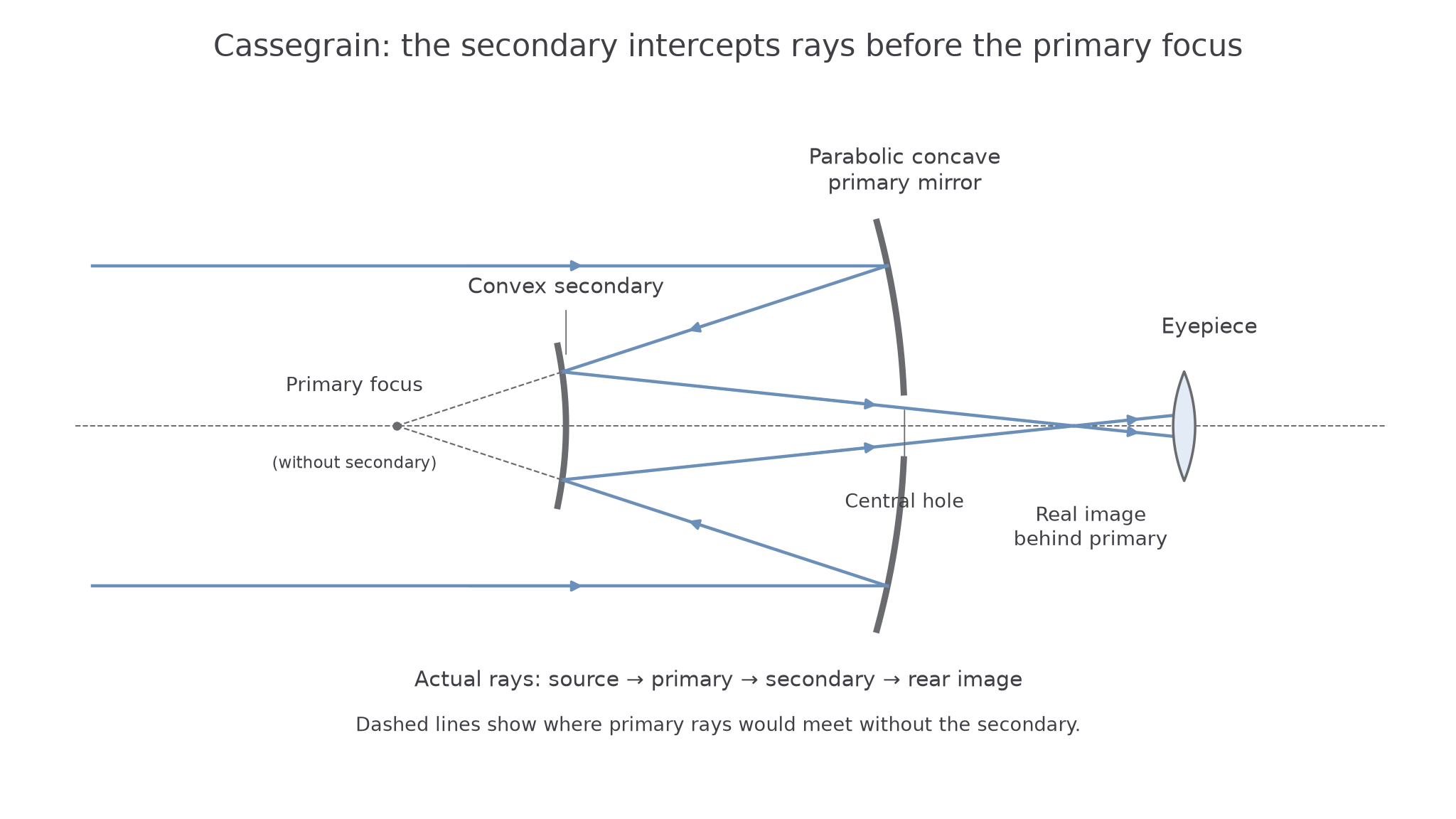
Solid arrows follow the light to the eyepiece. Dashed continuations show the primary focus that would be reached if the secondary were absent; no actual ray reaches that focus in this arrangement.
A convex mirror normally makes a parallel beam diverge, but it receives an already-converging beam here. It reduces that convergence while reversing the travel direction, so the final image can lie behind the primary. The folded path and secondary magnification allow a long effective focal length in a relatively short tube. Do not identify effective focal length with the sum of the physical distances travelled by one ray.
For a ray diagram, show both mirror shapes, arrows for all three travel stages, the primary's hole and the eyepiece behind it. The returning rays must pass through the hole, not through reflective material. The unperturbed primary focus lies beyond the secondary along the primary-reflected rays' direction of travel.
Other designs are useful contrasts, not additional required constructions: a Newtonian uses a plane diagonal secondary to send light out of the side; a Gregorian uses a concave secondary beyond the primary focus, after the rays have crossed. Neither is the required Cassegrain arrangement.
Supporting a large aperture
A mirror needs an accurately shaped reflecting surface, whereas a lens must also transmit light through optically uniform material.
An astronomical mirror usually has a thin reflecting coating on a shaped substrate. Its full thickness need not be transparent or optically homogeneous because useful light reflects from the front. A large lens, by contrast, requires clear, homogeneous glass and accurately formed optical surfaces; absorption and internal defects can affect transmitted light.
A mirror can be supported at many points across its back without blocking the incoming light. A lens is supported around its edge because supports across its faces would obstruct the beam. Rear support makes a large mirror's deformation easier to control. Mirrors can still sag: the advantage is that their shape can be supported and adjusted, not that reflection abolishes gravity. Segmented primaries extend this approach to very large apertures.
The physical consequence is more collecting area and more photons from faint sources. A precise reflecting surface is still essential; roughness scatters light and distortion blurs the image. A thin coating alone does not make a complete telescope mirror lightweight or eliminate all manufacturing difficulty.
Chromatic aberration
A simple converging lens generally has a different focal length for each wavelength because its refractive index varies with wavelength.
This dispersion causes chromatic aberration: different colours from the same object focus at different axial positions. In ordinary optical glass, blue light is refracted more strongly and has a shorter focal length than red light. If a detector is at one colour's focus, other colours are out of focus, giving blur and coloured fringes.
[DIAGRAM: asset_name: A.1.2 - Reflecting Telescopes - Diagram 2; asset_slug: A.1.2 - Reflecting Telescopes - Diagram 2; recommended_method: retained_png; caption: Blue and red thin-lens rays with both focal lengths correctly measured from the lens.; description: Blue and red thin-lens rays with both focal lengths correctly measured from the lens.]
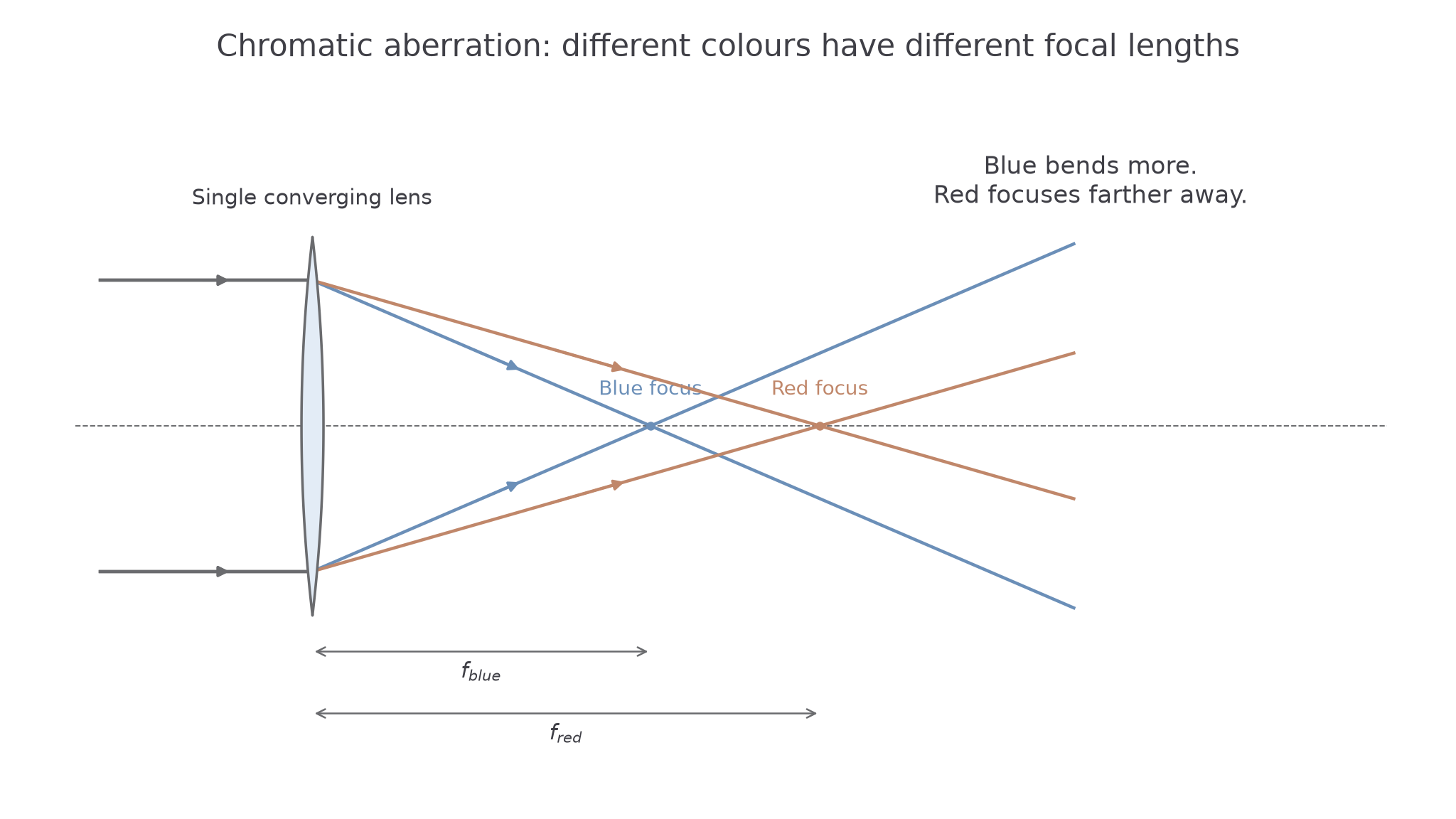
Both focal lengths start at the lens. The blue rays cross closer to it and continue onwards; the red rays cross farther away.
Continue this lesson.
You’re previewing NovaLearn without an account. Create a free account to read the rest.
Create free account