3.9.3.2 - Hubble's Law
The relation between galaxy recession speed and distance gives a measure of cosmic expansion and an approximate age. Connect that evidence with the microwave background and the primordial hydrogen–helium abundance.
Hubble's law and redshift
A galaxy's redshift is found by comparing identified spectral lines with their laboratory wavelengths. For nearby galaxies in the large-scale expansion, a small redshift gives recession speed . Here is positive away from us, unlike the approach-positive convention in the Doppler lesson.
Hubble's law
The Hubble constant is the present recession speed per unit distance. With in and in megaparsecs, its unit is . A graph of recession speed against distance has gradient . It is not a velocity–time graph: its gradient is not acceleration, and the area is not a distance travelled.
[DIAGRAM: asset_name: A.3.2 - Hubble's Law - Diagram 1; asset_slug: A.3.2 - Hubble's Law - Diagram 1; caption: Recession speed against distance with a classroom Hubble constant of 65 km s⁻¹ Mpc⁻¹; description: Illustrative galaxy points and best-fit line v=65d. Both axes use linear scales; horizontal axis is distance, not time.]
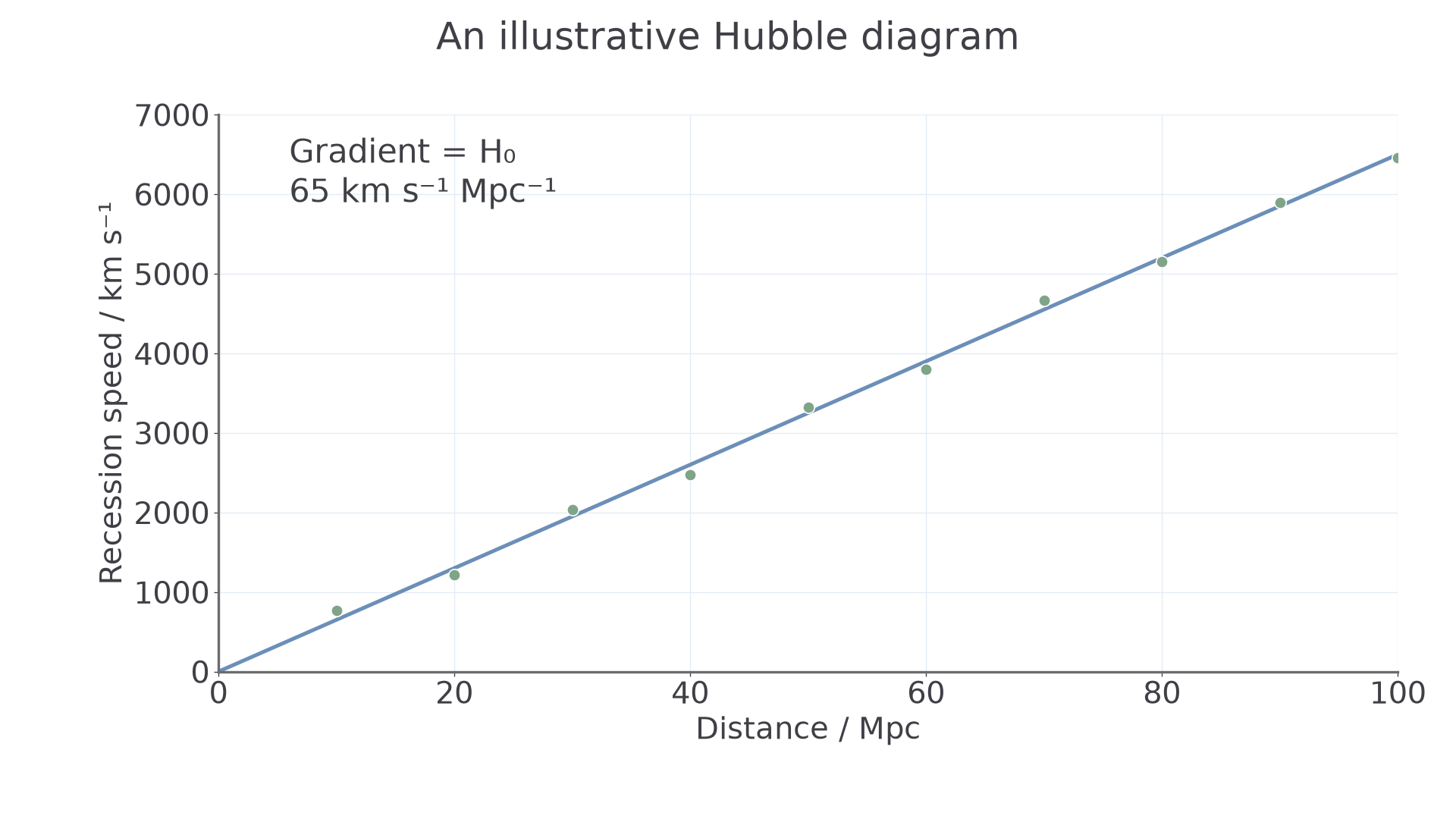
In the example, means more recession speed for each extra Mpc. Use the value supplied in a question. A line through and has gradient in those units.
Individual galaxies also have peculiar velocities caused by local gravitational interactions. These produce scatter; a nearby galaxy can even approach us. A gravitationally bound pair is not a reliable sample of the smooth Hubble flow. This does not overturn the large-scale expansion pattern.
Estimating the age of the universe
An age estimate comes from extrapolating the observed expansion backwards at constant recession speed. If the present separation is and the speed is , the time to remove that separation is . Substituting Hubble's law gives
This is the Hubble time, an approximate age scale. AQA describes the approximation as assuming is constant: use a fixed supplied value and ignore changes in the expansion history. The actual distance-over-speed extrapolation assumes constant recession speeds; it is not an exact cosmological solution in which stays fixed. Real expansion has changed, so is not an exact age.
Convert the units before taking the reciprocal
For and ,
The length units cancel, leaving inverse seconds for and seconds for its reciprocal. Taking and calling it seconds loses the Mpc/km conversion. A larger gives a smaller age estimate. Because , a small percentage uncertainty in produces approximately the same percentage uncertainty in the age scale, but does not account for the model's simplifying assumption.
Continue this lesson.
You’re previewing NovaLearn without an account. Create a free account to read the rest.
Create free account