3.4.1.8 - Conservation of Energy
Energy conservation lets you compare initial and final states without finding the motion at every instant. Track gravitational and kinetic energy carefully, include work by resistance over the actual path, and use the result to judge speeds, stopping distances and realistic energy estimates.
Energy conservation and the system boundary
Energy cannot be created or destroyed. It can be transferred between objects and redistributed between stores. The total energy of an isolated system, with no energy transfer across its boundary, remains constant. If energy does cross the chosen boundary, include that transfer in the accounting rather than declaring that energy is not conserved.
For a falling ball, gravitational potential energy belongs to the ball–Earth system. If the surrounding air is outside that system, work against drag transfers energy to the air. Include the air and the ball's internal energy in a larger system and total energy is still conserved. “Lost energy” in mechanics normally means a decrease in mechanical energy, the sum of kinetic and potential energy being tracked.
For a chosen system over an interval,
A brake can transfer kinetic energy to the internal energy of the brake, tyres and surroundings. Regenerative braking transfers some kinetic energy to a battery via a generator; it cannot recover all energy in a real journey because there are dissipative transfers and operating limits. The recovered fraction depends on the situation, so no single efficiency applies to every vehicle or stop.
An energy method gives speeds or energy changes, not the direction of velocity on its own. It also does not usually give a travel time without extra information. Choose it when the initial/final states and work transfers are known; choose a force equation when acceleration or interaction forces are the main unknowns.
Height changes and speed squared
Near the Earth's surface, a mass raised by vertical height gains gravitational potential energy:
This assumes approximately constant . Choose upward height as positive: descent gives a negative change in potential energy, while the loss is its positive magnitude. The zero of potential energy is arbitrary; height differences matter. Distance along a slope is not the vertical height change.
For a body treated as a translating particle,
Use mass in kilograms and speed in to obtain joules. This is the translational kinetic energy; rotating wheels or other internal motions require extra energy terms if significant. The expression is the classical result for speeds much smaller than the speed of light. Kinetic energy cannot be negative even if velocity is negative.
Doubling mass doubles kinetic energy at fixed speed; doubling speed quadruples it at fixed mass. A car changing from to gains . It is incorrect to use , which would give only . By contrast, raising the same car increases potential energy by , independent of the route.
Mechanical energy without dissipation
When no external agent supplies work and dissipative transfers are negligible, kinetic plus gravitational potential energy is conserved. For a mass descending through a positive vertical drop , with initial speed and final speed ,
The familiar is restricted to release from rest. Mass cancels because both gravitational and kinetic energies are proportional to it; different masses then reach the same speed after the same drop under the same assumptions.
[DIAGRAM: asset_name: 4.1.8 - Conservation of Energy - Diagram 1; asset_slug: 4.1.8 - Conservation of Energy - Diagram 1; caption: Energy exchange in an ideal pendulum with zero potential energy at the lowest point; description: Energy exchange in an ideal pendulum with zero potential energy at the lowest point.]
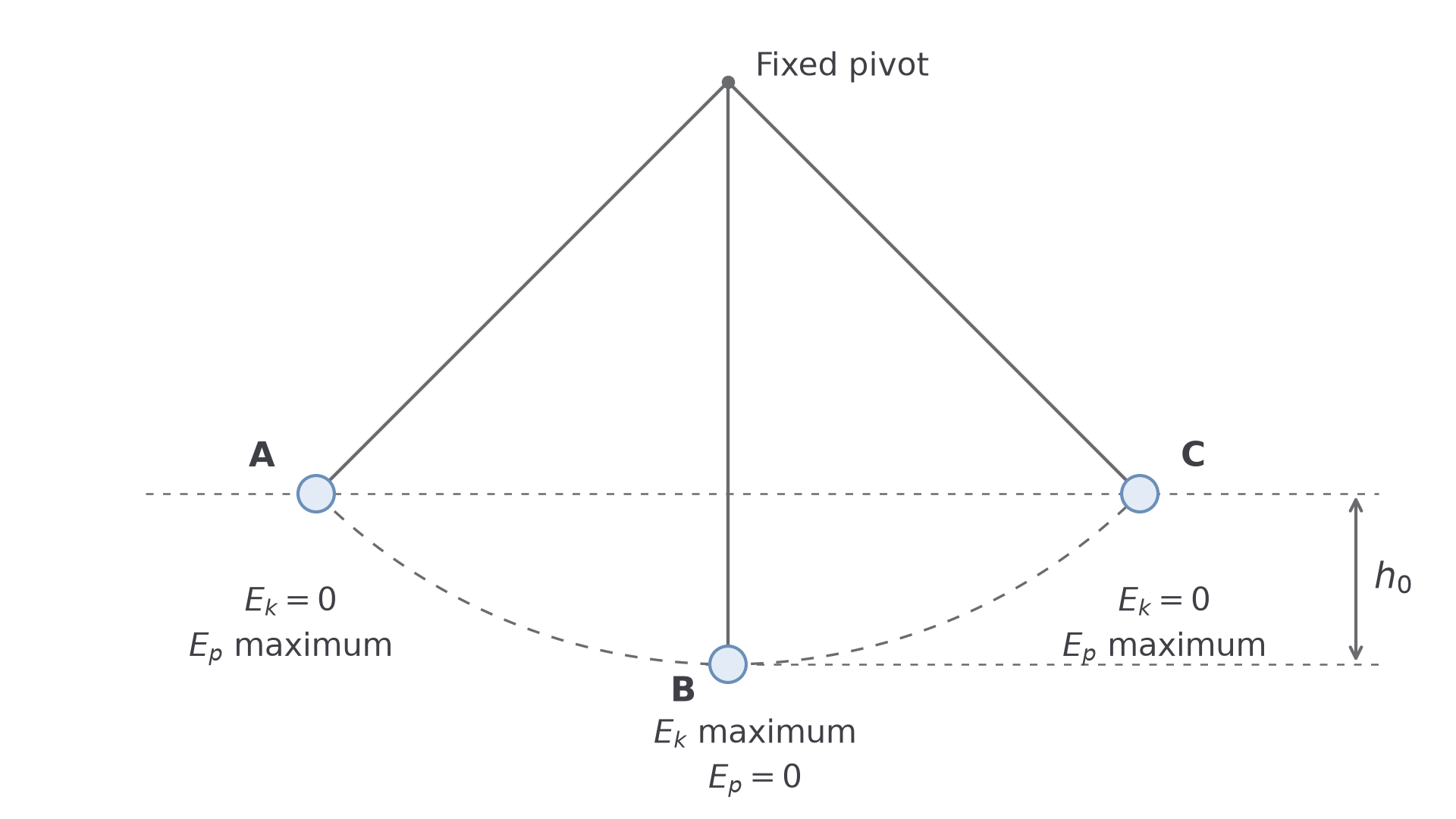
For the ideal pendulum, the string is light and inextensible, the pivot is fixed and frictionless, and air resistance is negligible. Tension is perpendicular to the motion and does no work. Take the lowest point as zero gravitational potential energy. At equal extreme heights A and C, speed is zero and potential energy is greatest. At B speed and kinetic energy are greatest. The figure is a schematic of positions on one circular arc; it does not imply the bob stops accelerating at B.
A bob released from rest above B has maximum speed . Halfway down in vertical height, half its initial potential energy has become kinetic energy: its speed is of the maximum, not half. A stationary frictionless track's normal force likewise does no work where it is perpendicular to motion; a moving support can transfer energy and requires a different accounting.
Work against resistance along the path
When resistance acts, part of the available mechanical energy is dissipated. For descent through positive vertical drop , path length , initial speed and final speed ,
For constant resistance, . For variable resistance, use its force–distance area. The value is a distance-averaged resistive force; it need not equal a force averaged over time. Resistance must oppose motion along the path for this positive “work against” convention.
[DIAGRAM: asset_name: 4.1.8 - Conservation of Energy - Diagram 2; asset_slug: 4.1.8 - Conservation of Energy - Diagram 2; caption: Vertical drop determines potential-energy loss while path length determines resistive work; description: Vertical drop determines potential-energy loss while path length determines resistive work.]
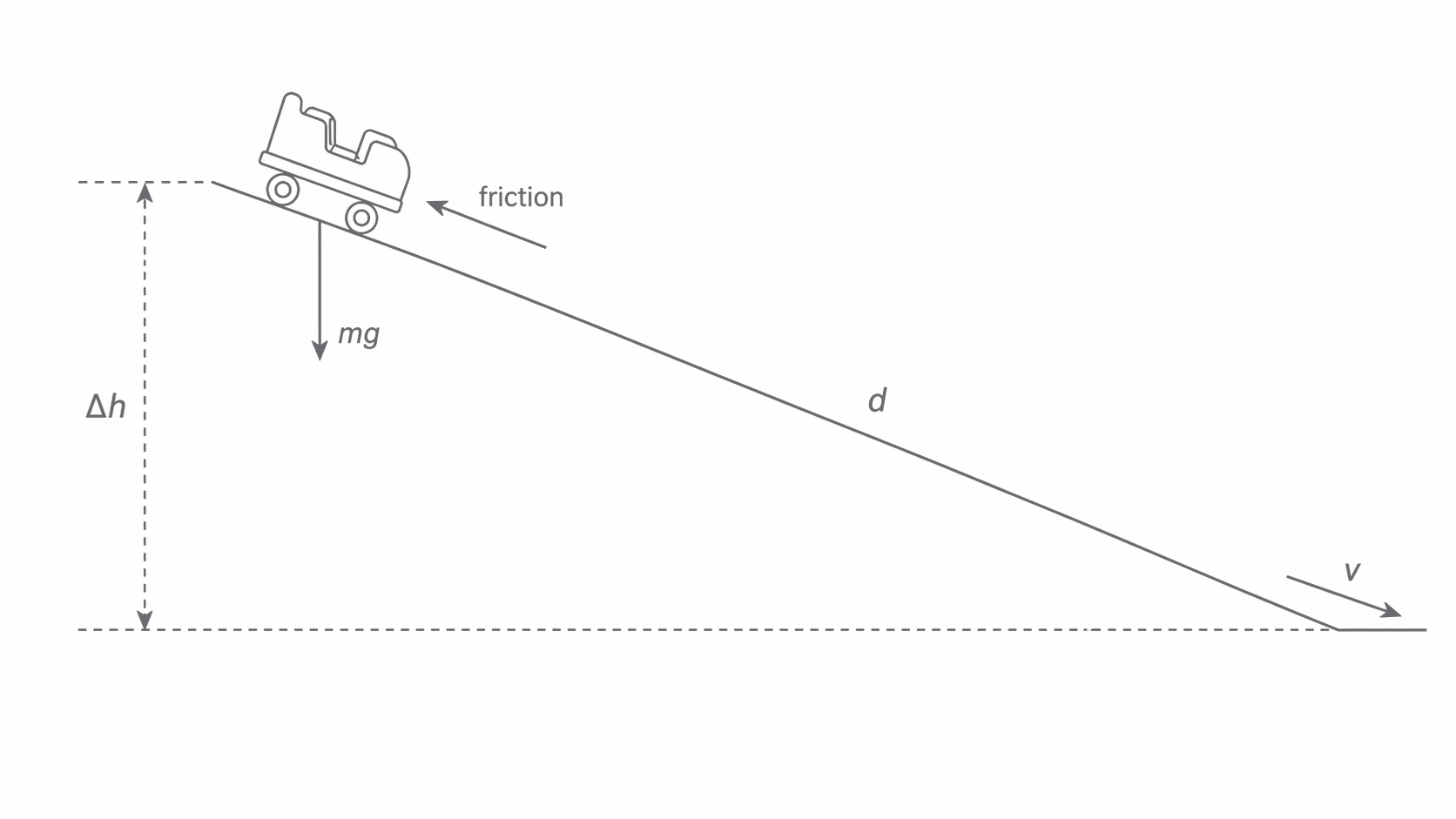
The diagram shows energy-related forces only, not a complete free-body diagram: the track also exerts a normal force. Weight is vertically downward, friction is uphill for the descending vehicle, and speed is along the track. Treat the vehicle as a particle, with negligible rotational kinetic-energy changes.
A cart enters a rough descent at , drops vertically and travels , emerging at . Initial kinetic energy is , potential-energy loss , and final kinetic energy . Dissipation is ; average resistance is . Dividing by 12 m would use the wrong distance. A negative dissipation would contradict this passive unpowered model and prompt a check of the data or an omitted energy input.
For braking on a level road with approximately constant braking-force magnitude , . Thus braking distance is proportional to speed squared when mass and braking force are fixed. This does not include thinking distance; changing the road or tyres can change , so the assumptions must accompany the prediction.
Return journeys and energy estimates
Comparing two visits to the same height removes the potential-energy difference but does not remove dissipation. A ball thrown upwards against air resistance transfers kinetic energy into gravitational potential energy and internal energy of the ball/air. At the top it has zero instantaneous speed, but gravitational force still acts. On descent, drag again opposes motion and transfers mechanical energy to internal energy.
[DIAGRAM: asset_name: 4.1.8 - Conservation of Energy - Diagram 3; asset_slug: 4.1.8 - Conservation of Energy - Diagram 3; caption: On ascent, some initial kinetic energy becomes potential energy and some is dissipated; description: On ascent, some initial kinetic energy becomes potential energy and some is dissipated.]
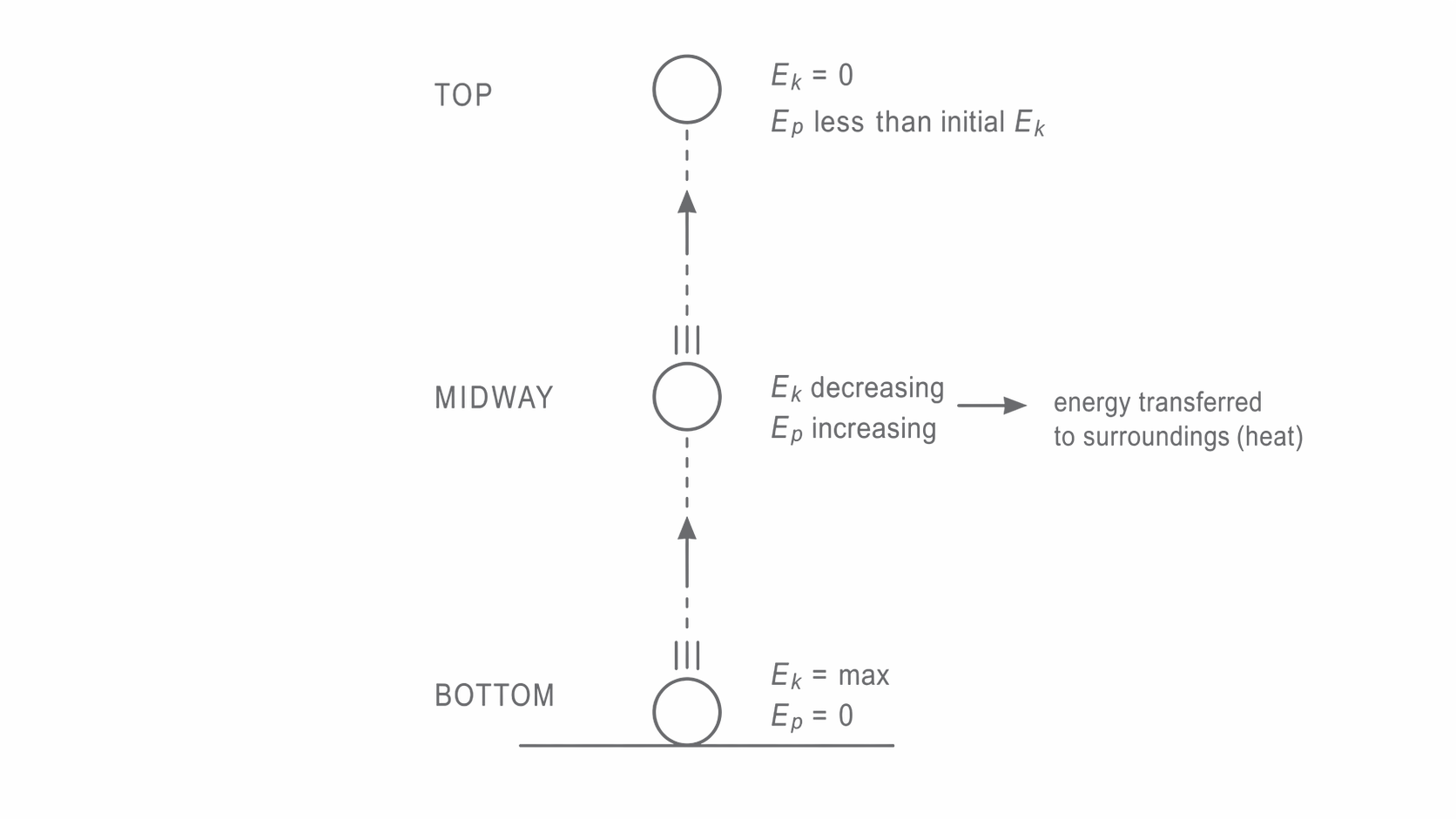
The figure follows the upward journey and takes launch height as zero potential energy. On returning to that same height, potential energy is unchanged from launch but kinetic energy is smaller, so return speed is smaller. If a ball launches at , its initial kinetic energy is . If the whole flight dissipates , it returns with , giving speed . Momentum changes direction; kinetic energy never becomes negative.
Estimating energy from food
A food label gives an energy supply, not a promise that all of it becomes mechanical work. Suppose a snack provides and assume is available as useful mechanical energy for climbing. Then . A person could ideally gain height . This order-of-magnitude estimate neglects the bicycle/load, changing efficiency and other transfers. If the useful fraction or total mass changes, the estimate changes directly or inversely. State those assumptions rather than reporting a spurious exact height.
Use the same check for hydroelectric generation: each kilogram descending through height supplies at most joules of gravitational energy. The electrical output is smaller after conversion losses. These examples apply conservation across chemical, gravitational and electrical transfers without confusing total energy conserved with useful output recovered.