3.10.2.3 - Defects of Hearing
Hearing loss changes the sound levels needed for detection and equal loudness. Compare age-related deterioration and noise injury using measured frequency patterns, without assuming that a graph uniquely identifies a cause.
What reduced sensitivity means
Hearing loss is a reduction in auditory sensitivity. At an affected frequency, a faint sound may no longer be detected, and a larger intensity may be needed to achieve a specified perceived loudness. A threshold test finds the least detectable level; an equal-loudness test matches a reference. These measurements are related but are not interchangeable.
For the same loudness target, an upward shift of a curve on a level-versus-frequency graph means a higher required intensity. A 20 dB increase means a factor of 100 in intensity, not a 20-fold increase or 20 times the perceived loudness.
The comparison must use the same frequency, listening conditions and reference loudness. If different people use different reference tones, simply comparing two lines may not establish the same perceptual target. Physiological changes are excluded from this specification point: concentrate here on the observed curves and experience of hearing.
Deterioration with age
Age-related hearing deterioration usually affects high frequencies more strongly than low frequencies. Quiet high-pitched sounds become harder to detect, the upper audible frequency can decrease, and speech may be less distinct because some higher-frequency components are lost.
[DIAGRAM: asset_name: B.2.3 - Defects of Hearing - Diagram 1; asset_slug: B.2.3 - Defects of Hearing - Diagram 1; caption: Illustrative age-related change for the same loudness target; description: Illustrative age-related change for the same loudness target]
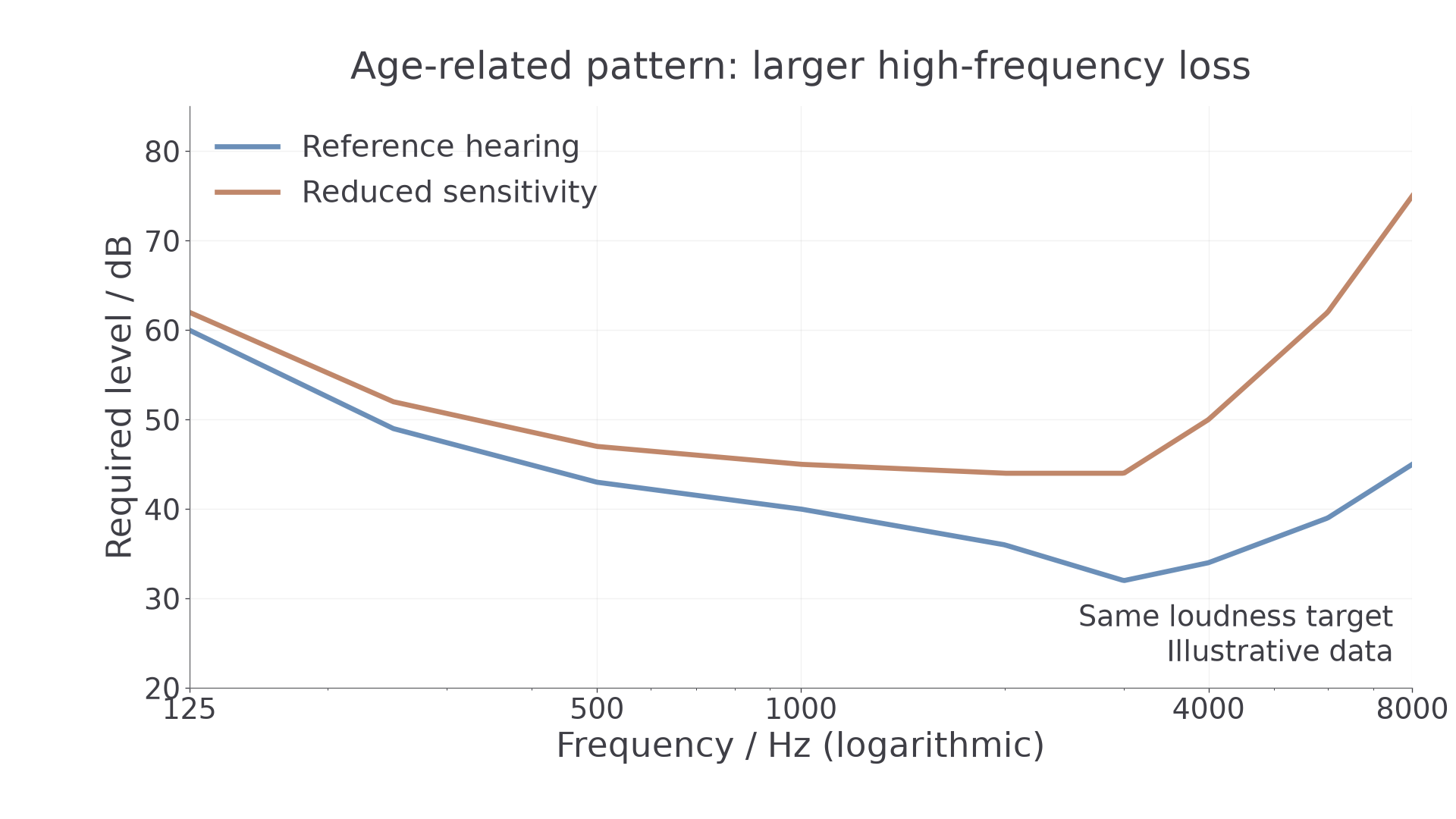
In this comparison the required level rises across a broad frequency region, with the largest additional level at the high-frequency end. A greater vertical separation between the two curves means a larger intensity increase for the same target loudness. Low-frequency sensitivity can be relatively well preserved, especially earlier in the loss.
Do not impose a universal cutoff such as “everyone over 60 cannot hear above 8 kHz”, or require every point to shift equally. The graph illustrates a typical broad high-frequency pattern; individual changes and their extent vary. A raised curve is not a louder sensation if the experiment has kept the loudness target fixed.
Injury from excessive noise
Noise-induced hearing loss can follow a single intense event or repeated/prolonged exposure. The relevant exposure includes level, duration and frequency content. Damage may be permanent even when the sound did not feel painful.
Continue this lesson.
You’re previewing NovaLearn without an account. Create a free account to read the rest.
Create free account