3.10.6.3 - Gamma Camera
A gamma camera selects photon directions, converts gamma energy into light and amplifies the light into electrical pulses. Follow each conversion and see how the pattern of pulses estimates the position of an event.
The photomultiplier tube structure
A photomultiplier tube (PMT) turns a faint light flash into a measurable electrical pulse. Its evacuated envelope contains a photocathode, a sequence of dynodes and a collecting anode. It detects light from the scintillator, not normally the original gamma photon directly.
At the photocathode, absorption of a visible-light photon can release a photoelectron by the photoelectric effect, provided the photon energy exceeds the work function. The emitted electron is accelerated towards a dynode at higher electric potential. Each successive dynode is more positive than the previous one; because the electron has negative charge, the electric force accelerates it towards higher potential.
[DIAGRAM: asset_name: B.6.3 - Gamma Camera - Diagram 1; asset_slug: B.6.3 - Gamma Camera - Diagram 1; caption: Electrons multiply at dynodes held at successively higher potentials; description: Electrons multiply at dynodes held at successively higher potentials.]
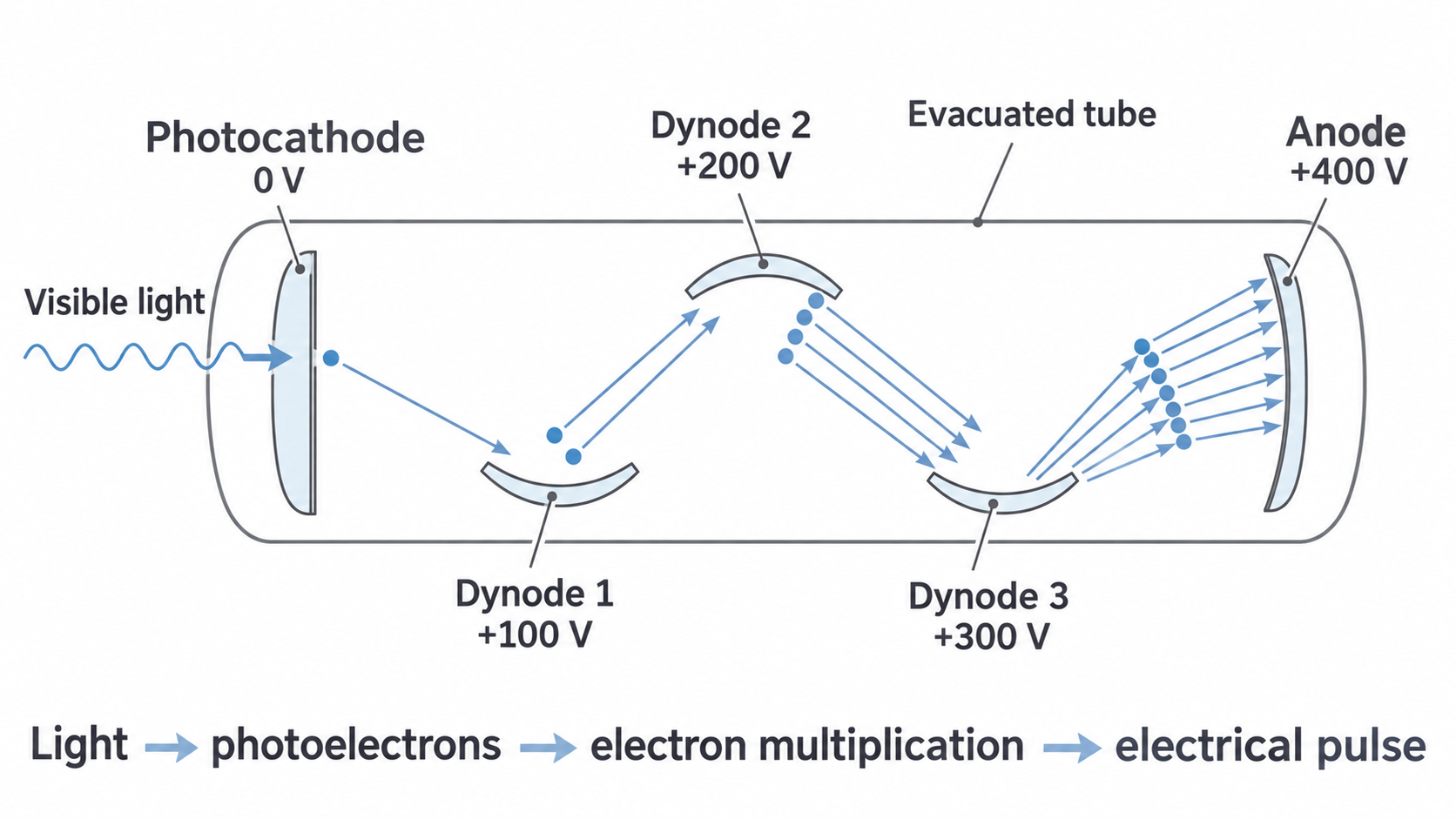
The voltages in the diagram illustrate increasing potential, not a required set of operating values. The vacuum reduces collisions with gas molecules so electrons can reach the electrodes. The anode collects the multiplied electrons as an electrical pulse; it is not another light-producing crystal.
Secondary emission and signal gain
An electron arriving at a dynode can release several secondary electrons. These are accelerated to the next dynode, where multiplication repeats. Energy for amplification comes from the high-voltage supply, not from creating energy out of the original light flash.
For a simplified tube with mean gain at each of dynodes,
Here is the number of initial photoelectrons and is the magnitude of electron charge. Gain is repeated multiplication, not . Not every scintillation photon reaches a tube, and not every photon at the photocathode releases an electron.
For example, a flash creates visible photons; reach one tube and of those release photoelectrons. Then . With six dynodes of mean gain 3,
The collected electrons carry negative charge, but a question asking for the pulse-charge magnitude uses the positive value. These are ideal mean gains; a real pulse fluctuates.
Selecting direction and converting gamma energy
A gamma camera detects radiation from a tracer inside the patient. Its head does not emit the imaging radiation. In a parallel-hole camera the order from patient to electronics is collimator, scintillator, PMT array, then signal processing.
The lead collimator has narrow channels. Near-parallel photons can pass through an open channel; oblique photons that strike its walls are absorbed. The collimator does not bend photons into parallel paths. Selecting direction allows the position of an accepted event on the detector to represent a projected source position. Depth within the body remains unresolved in a single planar view.
Continue this lesson.
You’re previewing NovaLearn without an account. Create a free account to read the rest.
Create free account