3.11.1.4 - Torque and Angular Acceleration
Torque is the turning effect of a force about an axis. Identify its lever arm, combine opposing torques, then apply the rotational form of Newton’s second law to wheels, brakes and a falling-mass experiment.
Torque and the perpendicular lever arm
A force can turn a body only if its line of action misses the rotation axis.
Torque is the product of force and the perpendicular distance from the axis to its line of action:
Its SI unit is . Although this has the same dimensions as energy, torque is a turning effect and is not measured in joules.
For a tangential force at radius , the force is perpendicular to the radius, so and .
[DIAGRAM: asset_name: C.1.4 - Torque and Angular Acceleration - Diagram 1; asset_slug: C.1.4 - Torque and Angular Acceleration - Diagram 1; caption: An upward tangential force at the right rim produces an anticlockwise torque; description: An upward tangential force at the right rim produces an anticlockwise torque.]
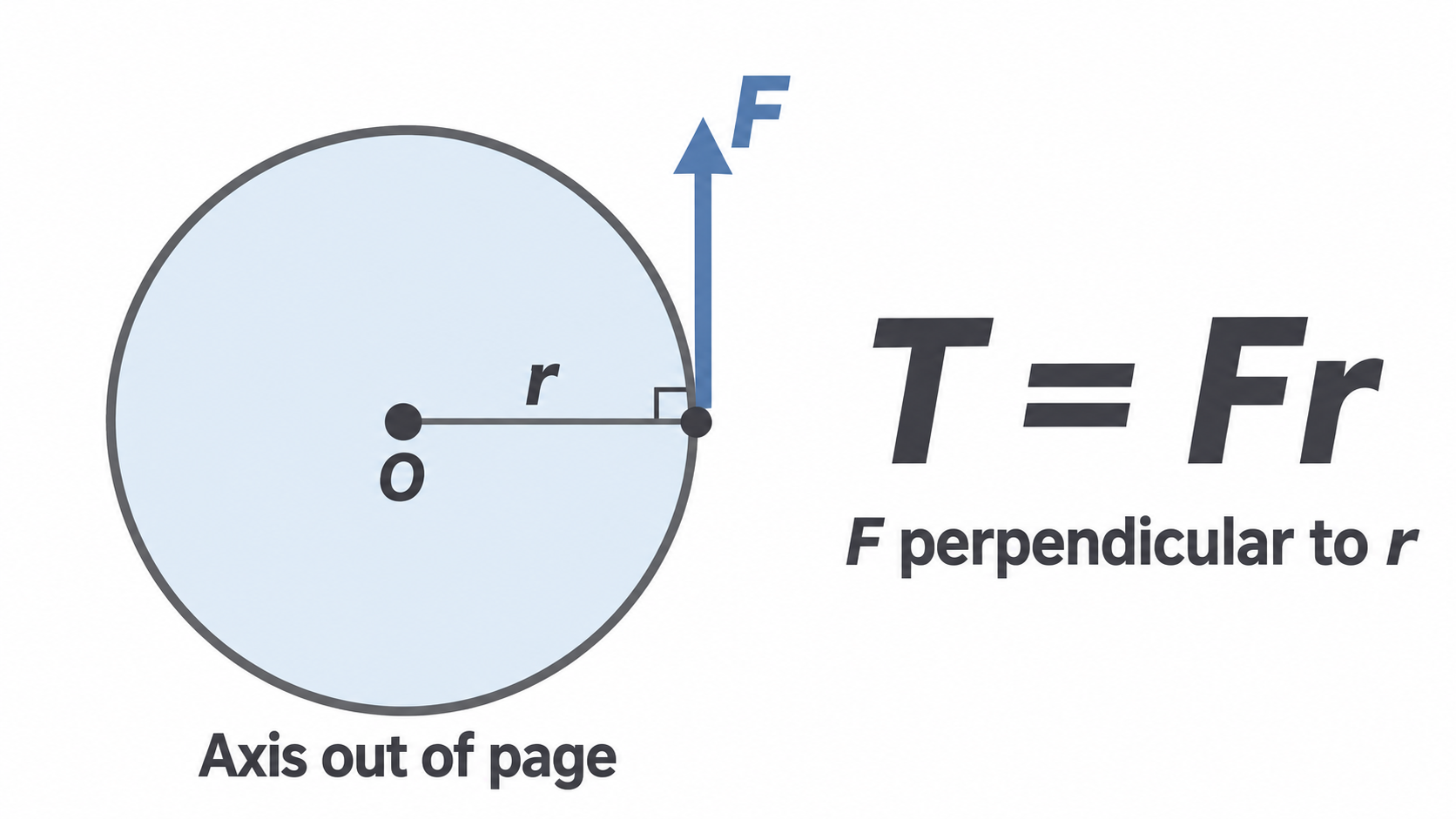
If a force makes angle to the radius, use or the perpendicular force component times . The radial component has zero torque because its line of action passes through the axis.
A force perpendicular to a spanner at produces . For a brake pad, use the distance to the line of action of its friction force, not automatically the disc’s outer radius. Two pads exerting separate forces contribute two torques.
Resultant torque and angular acceleration
For a rigid body with constant moment of inertia about a fixed axis, the resultant external torque sets its angular acceleration.
Rotational form of Newton’s second law
is in and in .
For a small mass at radius , tangential acceleration is . The required tangential force is , so its torque is . Summing over a rigid body gives ; internal interaction torques cancel for the complete system. This is why mass distribution enters the rotational law.
Choose a positive rotational sense, then add torques with signs. A motor torque of and opposing resistance of give . For , .
A larger produces smaller under the same net torque. Over an equal pulse duration, is also smaller, explaining how a flywheel reduces speed fluctuations. Balanced torques give zero acceleration, even when the wheel is already turning.
Continue this lesson.
You’re previewing NovaLearn without an account. Create a free account to read the rest.
Create free account