3.12.1.1 - Cathode Rays
A discharge tube turns an insulating gas into a conductor. Follow how collisions sustain a stream of electrons, and distinguish those electrons from the light that makes the discharge visible.
The discharge tube
A discharge tube contains a small amount of gas at low pressure between a negative cathode and a positive anode. A large potential difference, typically several thousand volts, is applied across the electrodes. The glass vessel keeps the pressure low; it is not a wire in the circuit.
Cathode rays are streams of electrons emitted from the cathode. In this cold-cathode tube, ion impacts release them; the cathode does not need a separate heater. Positive gas ions travel towards the cathode, while electrons accelerate towards the anode. The electric field points from anode to cathode, so a negative electron experiences a force opposite to the field.
Low pressure increases the mean free path, the average distance travelled between collisions. Electrons can then gain enough kinetic energy from the field between collisions to ionise gas atoms. A large potential difference supplies this energy. Merely making the gas rarer is not sufficient: in an almost perfect vacuum there are too few gas collisions and positive ions to sustain this particular discharge.
[DIAGRAM: asset_name: D.1.1 - Cathode Rays - Diagram 1; asset_slug: D.1.1 - Cathode Rays - Diagram 1; caption: Opposite particle motion in a low-pressure discharge tube; description: Negative cathode left and positive anode right. Positive ions move left and electrons right. The glow is a schematic region, not a brightness profile.]
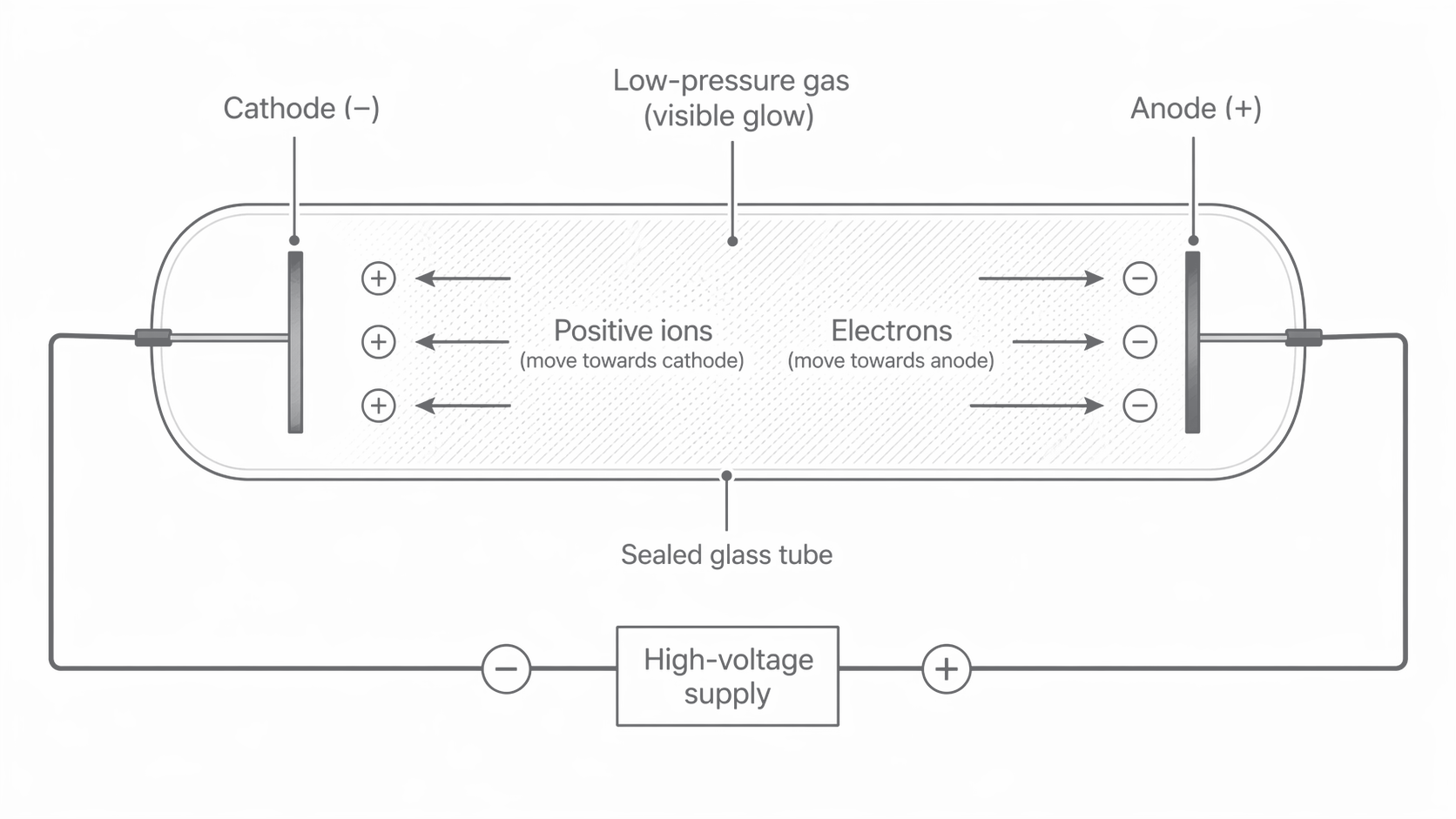
How cathode rays are produced
A few charged particles are initially present in the gas, for example because background radiation has ionised some atoms. The large potential difference starts a repeating chain:
- Free electrons accelerate and collide with gas atoms. An energetic collision can remove a bound electron: ionisation creates a positive ion and another free electron. The incident electron also remains after the collision.
- Positive ions accelerate towards the negative cathode. Their impacts transfer energy to the metal and eject electrons from its surface. The ions do not turn into electrons.
- The emitted electrons accelerate away from the cathode. Further ionising collisions produce more positive ions, so the chain sustains the discharge while the supply delivers energy.
Continue this lesson.
You’re previewing NovaLearn without an account. Create a free account to read the rest.
Create free account