3.2.2.3 - Energy Levels and Photon Emission
Atomic spectra contain lines at particular wavelengths because atoms can change their energy only by allowed amounts. Energy-level diagrams let you connect each transition to the energy, frequency and wavelength of its photon.
Reading discrete energy levels
The internal energy of an atom can take only particular allowed values, called discrete energy levels. The ground state is the lowest allowed state. A higher bound state is an excited state; it is different from ionisation, in which an electron leaves the atom.
Horizontal lines on an energy-level diagram represent allowed energies, not circular electron orbits or physical heights. Energy increases upwards. An upward transition needs an input of energy; a downward transition releases energy. The arrows mark changes between states, not an electron sitting at an intermediate allowed energy.
[DIAGRAM: asset_name: 2.2.3 - Energy Levels and Photon Emission - Diagram 1; asset_slug: 2.2.3 - Energy Levels and Photon Emission - Diagram 1; recommended_method: retained_png; caption: Energy increases upwards. Excitation leads to a higher allowed state and de-excitation leads to a lower state. the horizontal lines represent energies, not spatial orbits.; description: Energy increases upwards. Excitation leads to a higher allowed state and de-excitation leads to a lower state. the horizontal lines represent energies, not spatial orbits.]
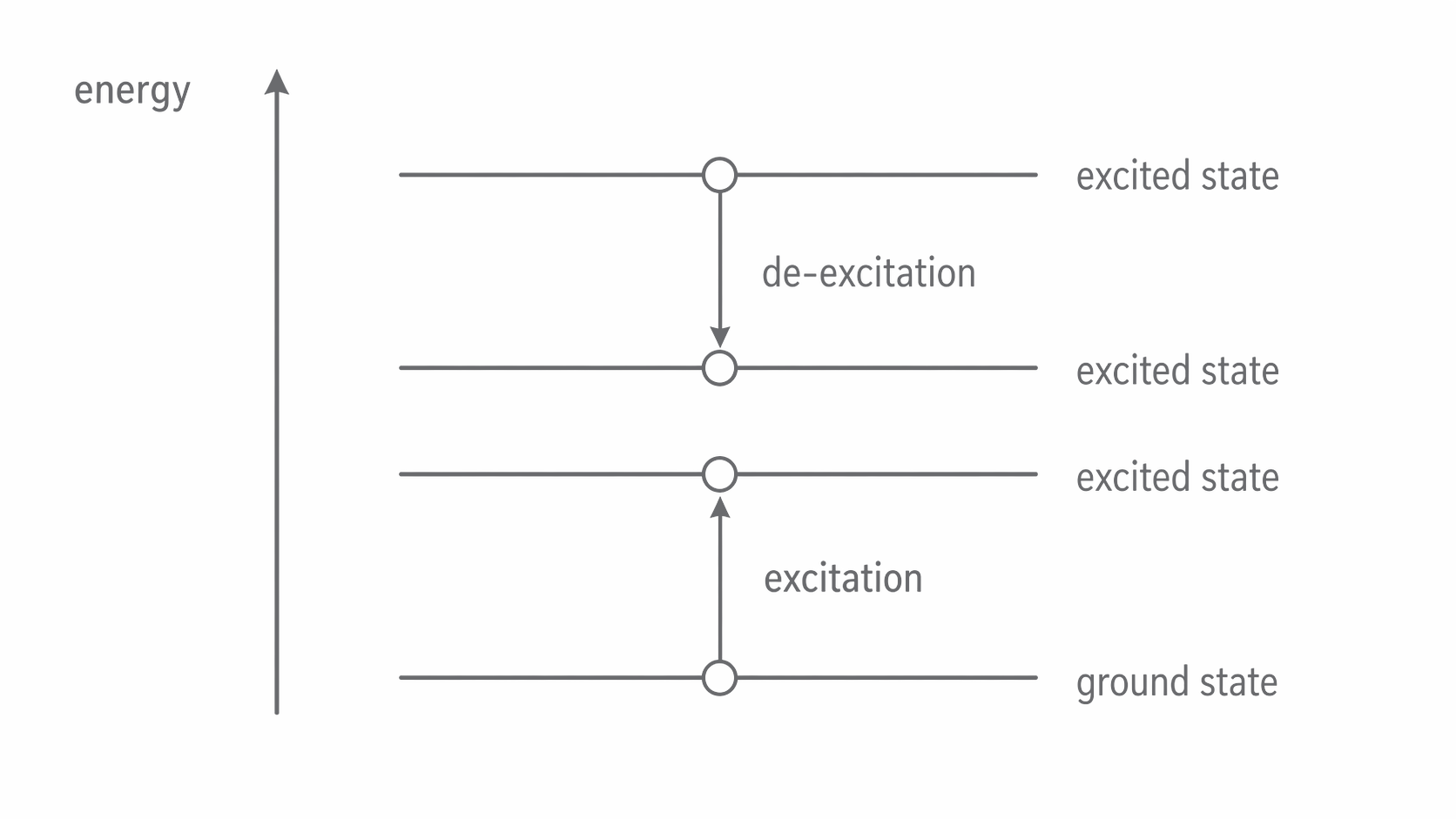
The choice of zero energy is conventional. A diagram may set the ground state to and give positive excited-state energies. Alternatively, it may set a free electron at rest to zero and show negative bound-state energies. With that convention, is higher than . The energy difference is unchanged by shifting the zero.
For example, a drop from to releases , a positive photon energy. If denotes the ionisation limit, removing an electron from the state needs at least .
Energy gaps and emitted photons
During a radiative downward transition, the atom loses energy and emits a photon. The photon energy is the difference between the initial higher state and final lower state :
Energy conservation in photon emission
Use a positive energy difference. With in , must be in joules.
A larger gap produces a higher frequency and a shorter wavelength. The atom can sometimes return to its ground state directly or through intermediate states. A direct drop emits one photon; a cascade emits a sequence of lower-energy photons whose energies sum to the same total drop. Their wavelengths do not add because is inversely proportional to photon energy.
[DIAGRAM: asset_name: 2.2.3 - Energy Levels and Photon Emission - Diagram 2; asset_slug: 2.2.3 - Energy Levels and Photon Emission - Diagram 2; recommended_method: retained_png; caption: The vertical scale is proportional to energy. A 5.7→4.9 eV transition releases 0.8 eV. a 4.9→0 eV transition releases 4.9 eV and therefore gives a shorter-wavelength photon.; description: The vertical scale is proportional to energy. A 5.7→4.9 eV transition releases 0.8 eV. a 4.9→0 eV transition releases 4.9 eV and therefore gives a shorter-wavelength photon.]
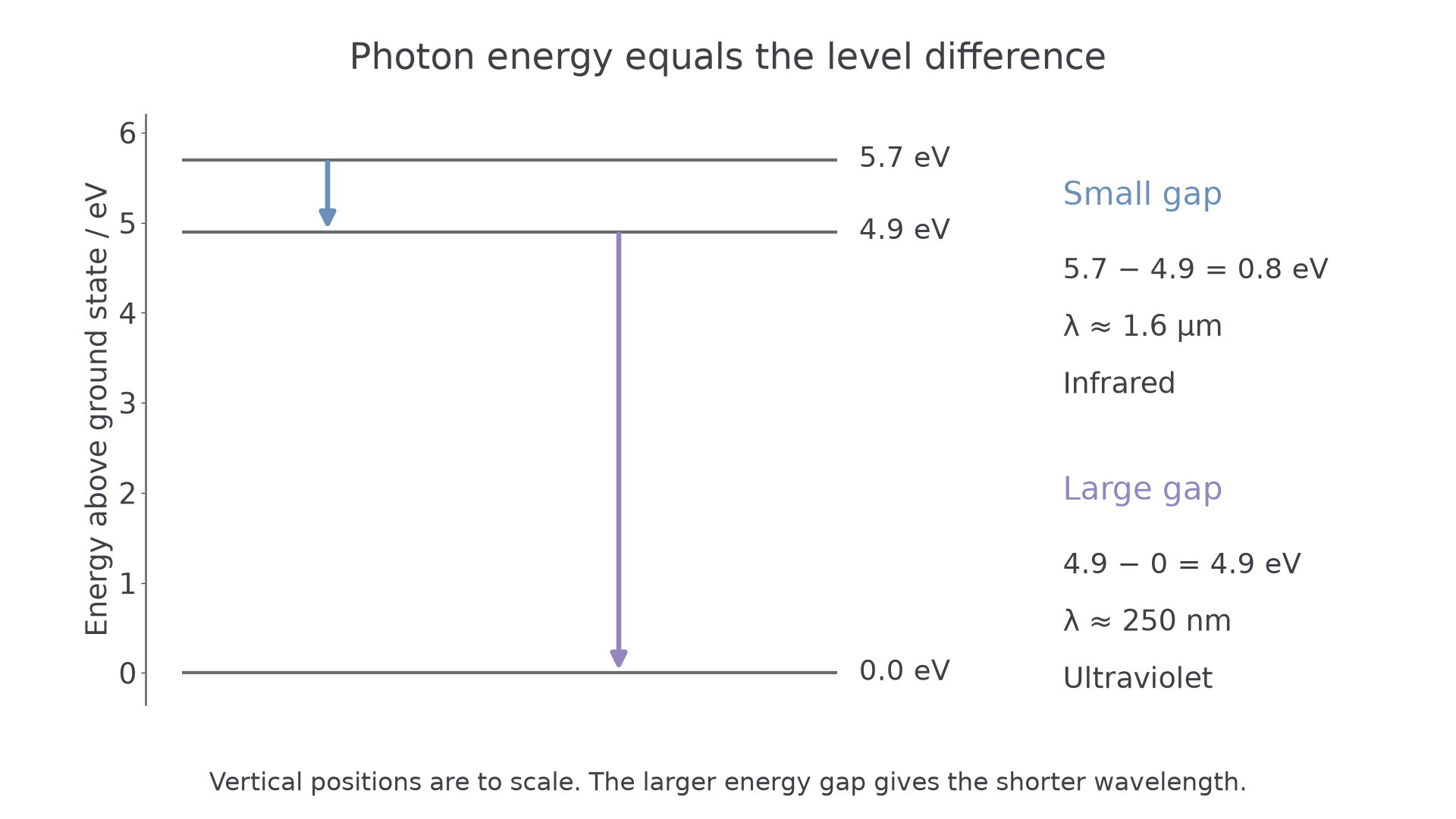
For the small drop shown, . It gives in the infrared. The drop gives approximately in the ultraviolet. This comparison depends on the gaps, not on the absolute label of either level.
If a population of atoms starts at a particular excited level, list every permitted downward transition between accessible states to predict possible emitted energies. One atom takes one decay route; an ensemble may show several routes. Do not count a transition from a level that no atom can reach, and do not assume every mathematically possible transition is allowed if the question imposes restrictions.
Line spectra as evidence
A low-pressure excited gas gives a line emission spectrum: separate bright lines at particular wavelengths. A narrow slit and diffraction grating can separate the emitted light into its wavelength components. The dark spaces between lines indicate wavelengths absent or very weak, not simply a dimmer continuous spectrum.
[DIAGRAM: asset_name: 2.2.3 - Energy Levels and Photon Emission - Diagram 3; asset_slug: 2.2.3 - Energy Levels and Photon Emission - Diagram 3; recommended_method: retained_png; caption: Both plots use the same wavelength scale. The prominent visible hydrogen lines occur near 410, 434, 486 and 656 nm. their positions, not the illustrative heights or colours, carry the energy information.; description: Both plots use the same wavelength scale. The prominent visible hydrogen lines occur near 410, 434, 486 and 656 nm. their positions, not the illustrative heights or colours, carry the energy information.]
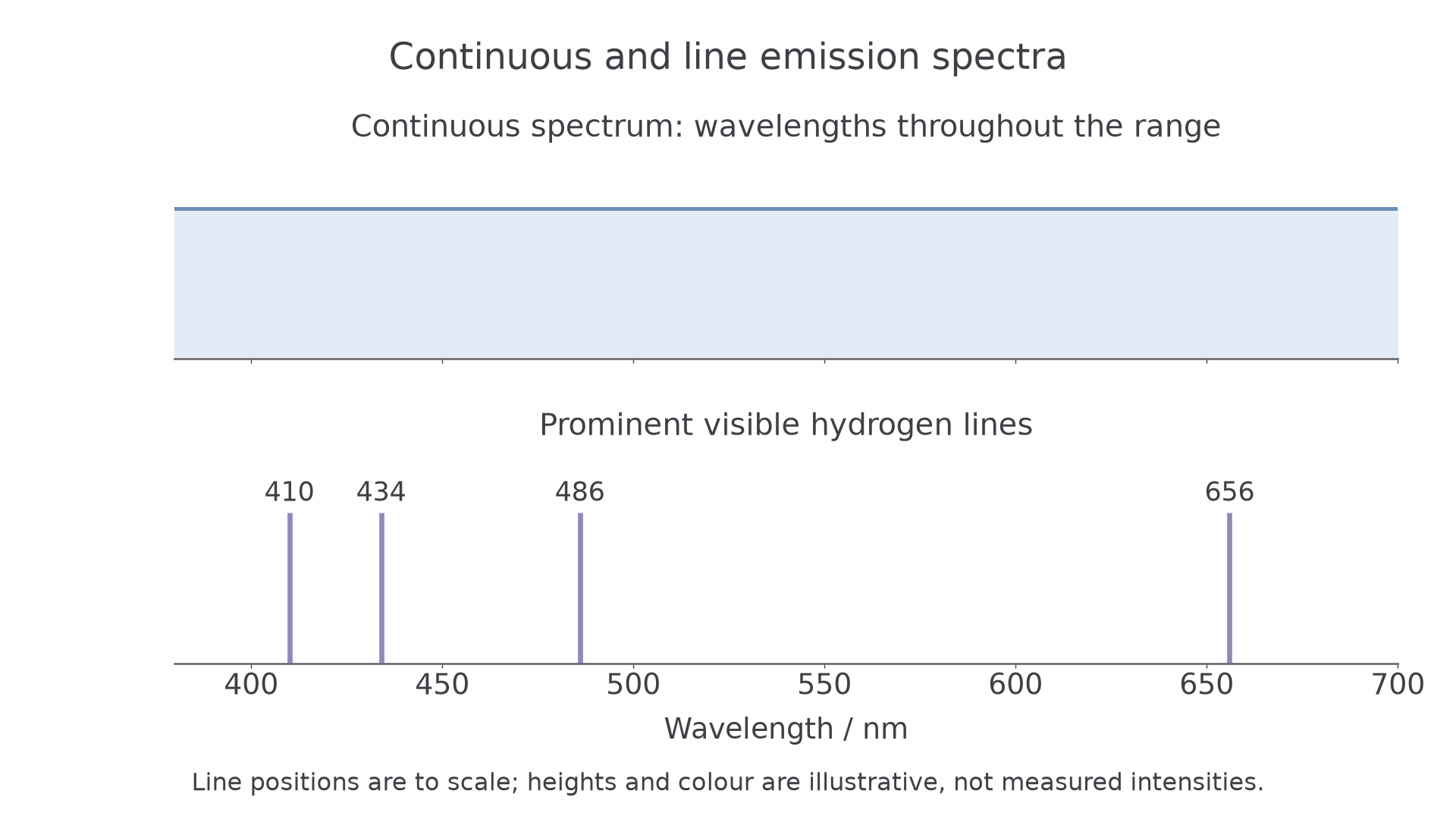
The evidence proceeds from observation to a model. Only certain wavelengths occur; therefore means only certain photon energies occur. Since each emitted photon carries an allowed transition energy, only certain energy gaps occur in the atom. This supports discrete energy levels. The visible hydrogen lines shown arise from transitions ending at one particular excited level, so they do not represent all possible hydrogen transitions; other lines lie outside the visible region.
Different atoms have different allowed levels and therefore characteristic line patterns. Matching several line wavelengths in an unknown source with a laboratory spectrum supports identifying that element. An absorption line spectrum is complementary: light passing through cooler gas loses photons whose energies match allowed upward transitions. The atom must initially occupy the appropriate lower state. Other photon energies do not cause those bound-to-bound transitions.
Calculating energies from wavelengths
A measured wavelength reveals an energy gap, and a known gap predicts a wavelength. Use with consistent units: and .
From a spectral line to an energy gap
For a hydrogen line at ,
The corresponding level difference is . Carry extra figures through the conversion before rounding to the requested precision. The gap alone does not specify both absolute level energies.
From a gap to a line
For a downward gap, , giving . A double-sized gap would halve this wavelength, not double it.