3.2.1.4 - Particle Interactions
When particles attract, repel, or change identity, physicists describe the process as an interaction. This lesson focuses on the four fundamental interactions, the idea of exchange particles, and the simple electromagnetic and weak-interaction diagrams you need to recognise for A-Level Physics.
Four Fundamental Interactions
There are four fundamental interactions in nature: gravity, electromagnetic, strong nuclear, and weak nuclear. They describe different couplings: being electrically neutral does not make a particle immune to the strong or weak interaction.
Fundamental interaction
A fundamental interaction is one of the four basic forces of nature: gravity, electromagnetic, strong nuclear, or weak nuclear.
The key features are summarised below.
| Interaction | What it does | Typical range | Exchange particle you need here |
|---|---|---|---|
| Gravity | Acts between particles with mass and is always attractive | Infinite | Not required |
| Electromagnetic | Acts between charged particles and can attract or repel | Infinite | Virtual photon |
| Strong nuclear | Binds nucleons in nuclei | About between nucleons | Pion model between nucleons (3.2.1.5) |
| Weak nuclear | Changes one particle into another in beta processes | About | and bosons |
The names gluon, , and graviton are not required knowledge for this specification point. The learner-facing names you do need are the virtual photon for the electromagnetic interaction and the and bosons for the weak interaction.
Reading Interaction Diagrams
A particle diagram is a representation of an interaction, not a picture of tracks in a detector. First identify the time direction, then read which external particles are present before and after the interaction. A vertex is a meeting of lines where an interaction occurs; the internal line between vertices represents the exchange particle.
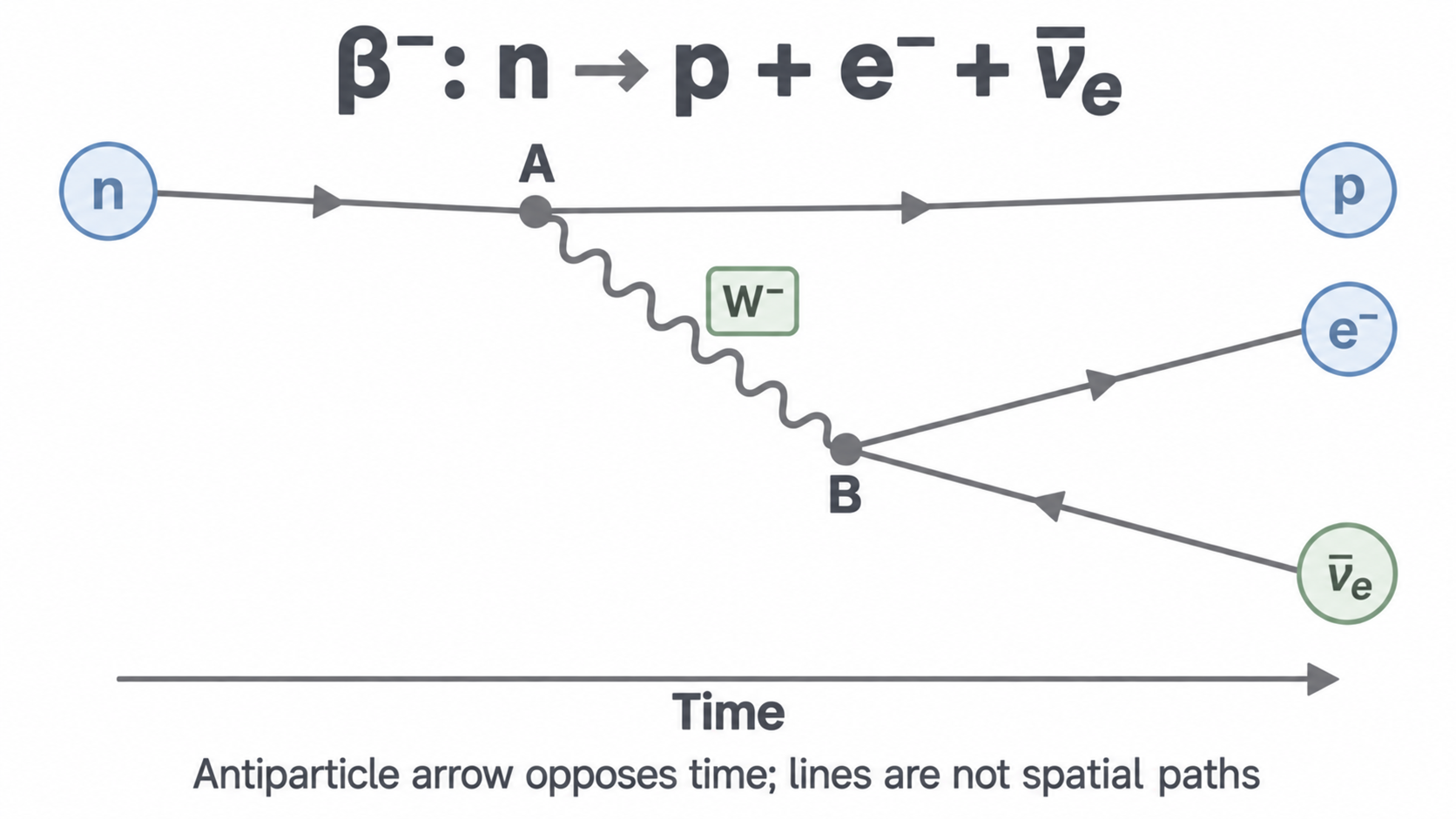
For the conventional Feynman diagrams in this lesson, time increases to the right. Arrows on particle lines point with time; arrows on antiparticle lines point against time. An outgoing positron or antineutrino is still drawn on the right of its production vertex, but its arrow points back towards the vertex. Do not reinterpret that arrow as the antiparticle physically travelling back into the reaction.
Check every vertex
For the charges, in units of , are . For , they are . If a proposed picture uses with those same emission directions, it fails charge conservation even though the overall beta-plus equation may look familiar.
An exchange line may have a charge-flow direction specified separately. For a reversed exchange direction, reverse the charged boson label as required by the vertex equations; never change a particle label simply because a sloping line looks like a spatial path.
Exchange Particles and the Electromagnetic Interaction
Forces between particles are explained using exchange particles. One particle emits an exchange particle and another absorbs it, so energy and momentum are transferred between them.
Exchange particle
An exchange particle is a particle passed between interacting particles to transfer energy and momentum and so mediate a force.
For the electromagnetic interaction, the exchange particle is a virtual photon. A virtual photon is not a real detected photon travelling to a detector. It is the exchange particle used in the interaction model.
In the three diagrams below, notice that the particles keep the same identity before and after the interaction while the virtual photon is the exchanged particle in every case.
[DIAGRAM: asset_name: 2.1.4 - Particle Interactions - Diagram 1; asset_slug: 2.1.4 - Particle Interactions - Diagram 1; recommended_method: retained_png; caption: Time runs left to right. Virtual photons mediate these electromagnetic interactions without changing the particle identities.; description: Three simple interaction diagrams shown side by side: proton-proton repulsion with a wavy line labelled gamma between the particle lines, proton-electron attraction with a wavy gamma between them, and electron-electron repulsion with a wavy gamma between the lines]
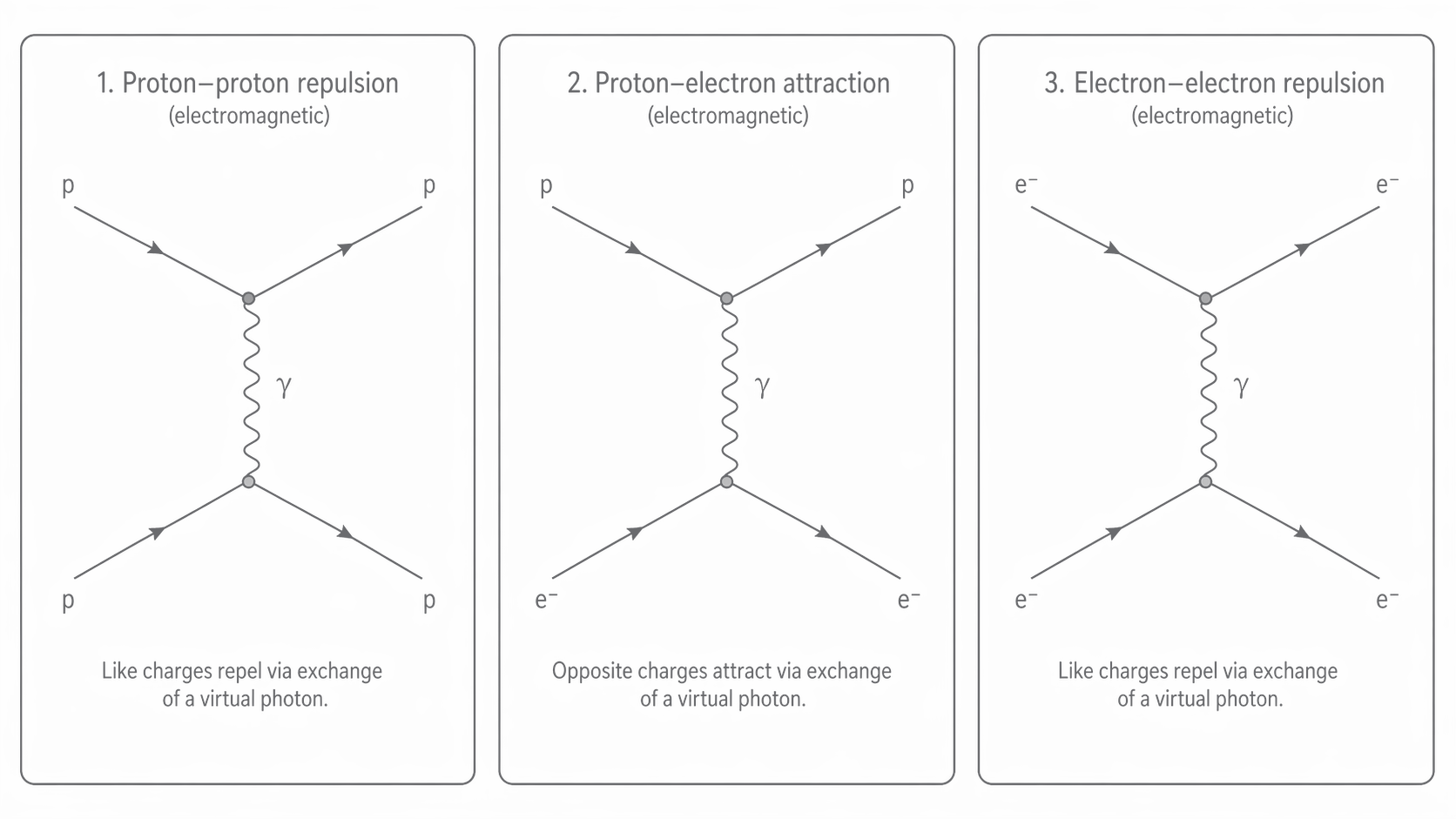
In an electromagnetic interaction diagram, the particles entering and leaving are the same particles. A proton remains a proton, an electron remains an electron, and only their momenta change. Time runs from left to right in these drawings. The line angles are not paths through space, so a V shape does not itself demonstrate attraction or repulsion. The labels and virtual-photon exchange identify the electromagnetic process.
Electromagnetic interaction diagrams show the same charged particles before and after the interaction. The exchanged particle is always a virtual photon.
Momentum transfer and the ball model
Imagine two people on low-friction trolleys passing a heavy ball. The thrower gains momentum opposite to the ball’s motion; the catcher gains momentum when the ball is stopped. Each transfer changes a person’s momentum while the total momentum of people and ball is conserved. This models how exchange can cause a force, since force is rate of change of momentum. It is an analogy: a virtual photon is not a classical thrown ball, and the ball story by itself does not explain electromagnetic attraction.
The Weak Interaction and Beta Decay
The weak interaction is different because it can change one particle into another. This is why it is responsible for beta decay. The exchange particles here are charged bosons. Their large mass is associated with the weak interaction’s very short range; charge alone is not the reason for that short range.
The two beta-decay processes you need are:
Beta-minus decay
In beta-minus decay, a neutron becomes a proton and emits a boson at the first vertex. The then produces the electron and the electron antineutrino at the second vertex.
In the beta-minus diagram below, notice the two vertices: the neutron changes into a proton first, and the emitted then creates the electron and electron antineutrino.
[DIAGRAM: asset_name: 2.1.4 - Particle Interactions - Diagram 2; asset_slug: 2.1.4 - Particle Interactions - Diagram 2; recommended_method: imagegen; caption: Beta-minus: the neutron emits W−, the outgoing antineutrino arrow opposes the time direction.; description: A simple beta-minus interaction diagram with a neutron line entering, a proton line leaving from the first vertex, a wavy line labelled W- heading to a second vertex, and electron plus electron antineutrino lines leaving that second vertex]
Beta-plus decay
In an energetically allowed beta-plus decay inside a nucleus, a proton becomes a neutron and emits a boson. The then produces the positron and the electron neutrino.
In the beta-plus diagram below, notice the same two-vertex structure, but this time the proton changes into a neutron and the exchanged particle is a instead of a .
[DIAGRAM: asset_name: 2.1.4 - Particle Interactions - Diagram 3; asset_slug: 2.1.4 - Particle Interactions - Diagram 3; recommended_method: imagegen; caption: Beta-plus inside a nucleus: the proton emits W+, the outgoing positron arrow opposes the time direction.; description: A simple beta-plus interaction diagram with a proton line entering, a neutron line leaving from the first vertex, a wavy line labelled W+ heading to a second vertex, and positron plus electron neutrino lines leaving that second vertex]
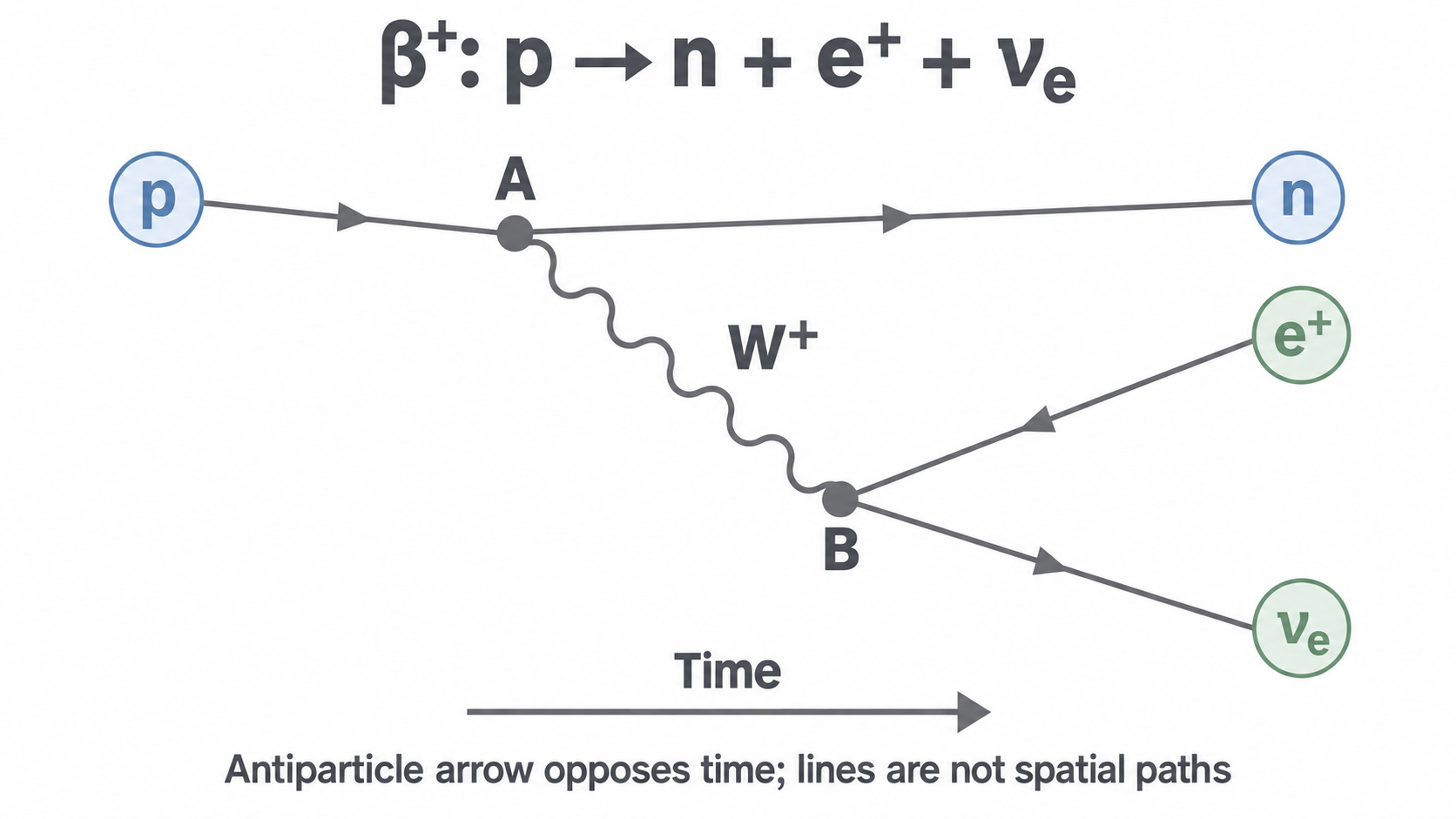
A free proton cannot undergo this beta-plus decay: the neutron and positron products have greater total rest energy. Nuclear beta-plus decay is possible when the complete nuclear energy change supplies the required energy. The internal is virtual, so do not require the decay to supply the rest energy of a freely detectable real boson.
Electron Capture and Electron-Proton Collisions
Electron capture uses an electron already bound to an atom. A proton in the nucleus and that electron are converted into a neutron and an electron neutrino. In an electron–proton collision, an incident electron interacts with a proton and must have sufficient energy for the products. Both processes have the same net particle equation:
Determine the boson charge from the chosen direction
One valid representation has the proton emit : , followed by . Charge balances at both vertices: and .
An equivalent charge-flow representation uses in the opposite direction: , followed by . Now and . Do not identify capture versus collision from the sign of alone. Match its charge to its direction and the particle labels. The physical distinction is a bound electron versus an incident electron.
[DIAGRAM: asset_name: 2.1.4 - Particle Interactions - Diagram 4; asset_slug: 2.1.4 - Particle Interactions - Diagram 4; recommended_method: imagegen; caption: Both drawings conserve charge at each vertex, the W charge matches the chosen exchange direction.; description: Two valid charge-flow representations of proton plus electron becoming neutron plus electron neutrino.]
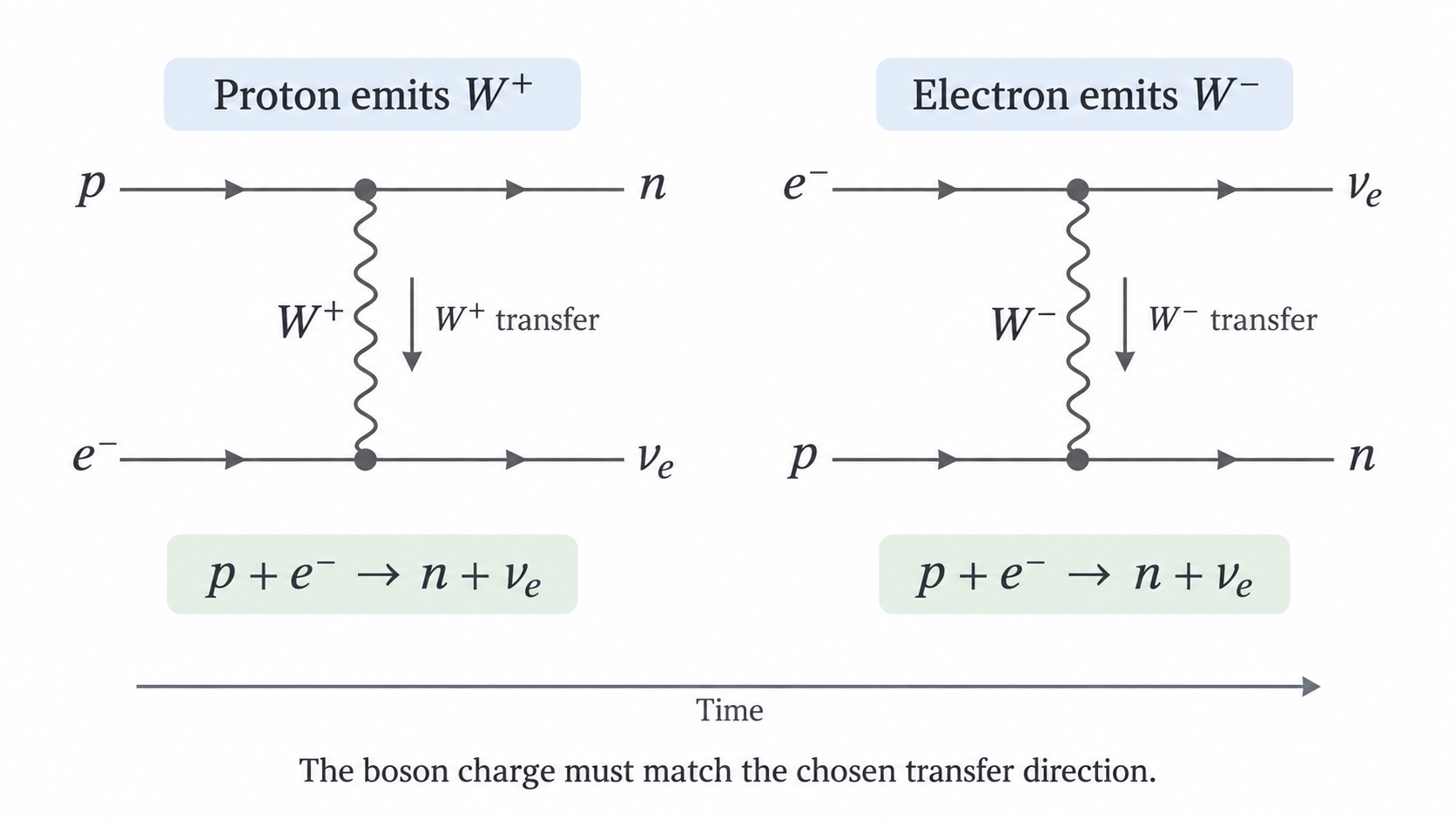
At the quark level the proton’s changes to the neutron’s : one becomes . A diagram asked for quarks must label and , not merely and . The electron becomes an electron neutrino, not an antineutrino.
An isotope that can decay only by electron capture needs an electron to capture. Removing all its atomic electrons suppresses that channel until an electron becomes available; orbital electrons do not destabilise it merely by electrostatic repulsion.