3.9.2.3 - Stellar Temperature and Black-Body Radiation
The shape of a stellar spectrum reveals temperature; its total power also depends on surface area. Combine Wien’s law, Stefan’s law and geometrical spreading to infer stellar properties, while keeping emitted power separate from the intensity measured at Earth.
Black-body radiation curves
A black body absorbs all incident electromagnetic radiation and, at a given temperature, emits the maximum possible thermal radiation at every wavelength. Its spectrum depends on temperature alone. A star's continuous spectrum can often be approximated by this model, although absorption lines and intervening dust alter real observations.
The vertical axis matters when reading a black-body curve. Here it is power emitted per unit surface area per unit wavelength interval, , plotted against wavelength. Multiplying its value by a small wavelength interval gives the power per surface area in that interval. Therefore the area under the whole curve gives total emitted power per unit surface area, , not the star's entire luminosity.
[DIAGRAM: asset_name: A.2.3 - Classification by Temperature, Black-Body Radiation - Diagram 1; asset_slug: A.2.3 - Classification by Temperature, Black-Body Radiation - Diagram 1; caption: Calculated black-body spectra: hotter surfaces emit more at every wavelength; description: Power emitted per surface area per wavelength interval versus wavelength. Exact Planck curves for 3000, 5000 and 7000 K; no normalisation of individual curves. Peak shifts shorter as temperature increases.]
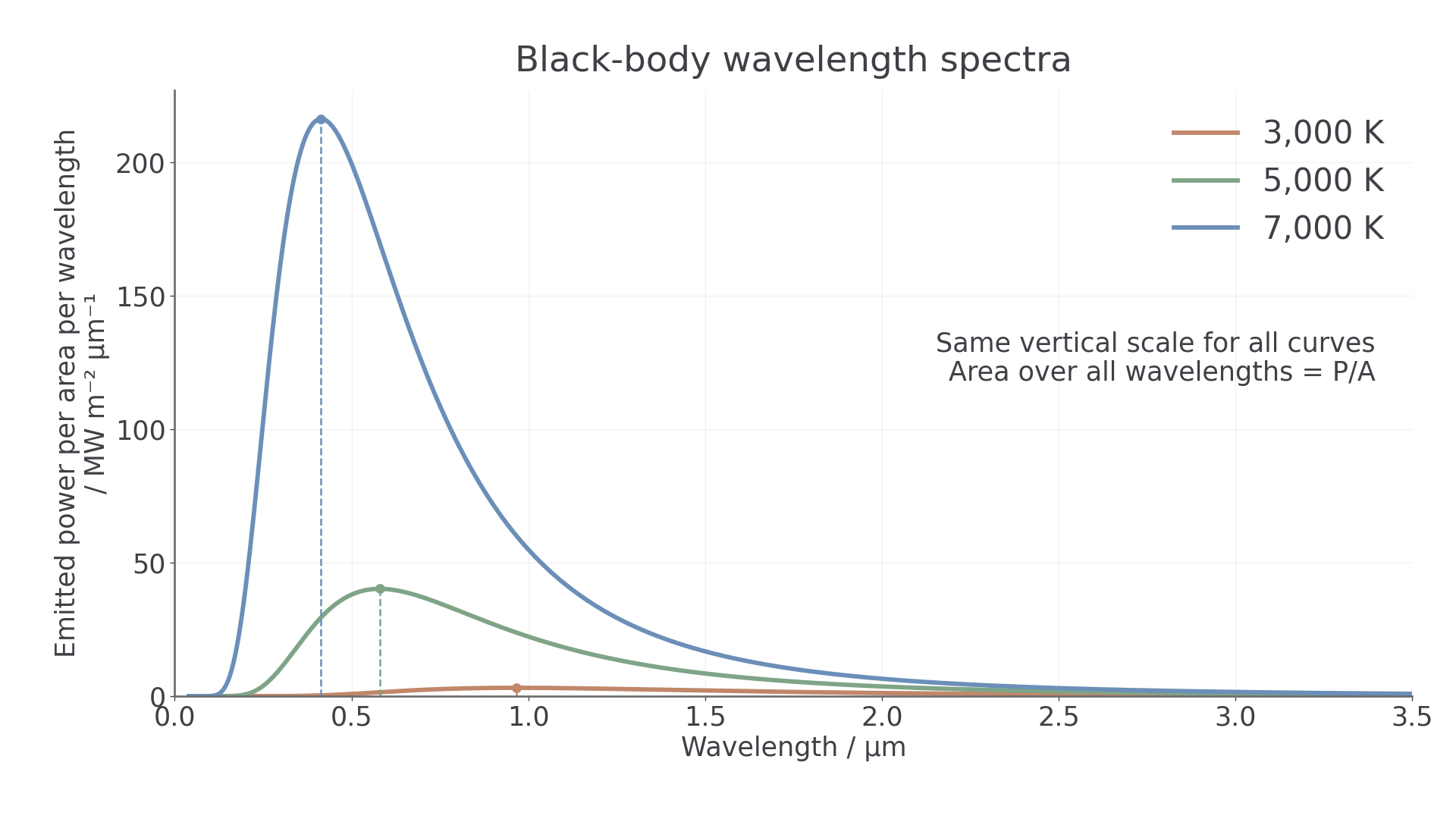
Each curve rises steeply from nearly zero at short wavelengths, has one peak, then falls gradually into a long-wavelength tail. Increasing temperature shifts the peak to shorter wavelength and increases the area under the curve. At any fixed wavelength the hotter black body emits more; the curves do not cross.
The visible colour depends on the range of visible wavelengths together, not simply the wavelength of the peak. A 3000 K surface peaks in the infrared but emits visible red light as well. A 5800 K surface peaks near 500 nm and emits broadly across the visible range, producing approximately white light. A plot per unit frequency has a different-shaped density, so do not locate its peak by simply converting the wavelength peak with .
Wien’s displacement law
The peak wavelength of the wavelength spectrum is inversely proportional to absolute surface temperature. This is Wien’s displacement law:
Peak wavelength and temperature
Use in metres and in kelvin. The unit means metre kelvin, not millikelvin. Doubling the absolute temperature halves the peak wavelength.
For a hypothetical star whose spectrum peaks at , convert first: . Then
This estimates surface temperature under the black-body assumption. It is not a measurement of the much hotter core. Nor does temperature alone establish whether the star is large or small.
To test a claimed temperature against a graph, read the peak and calculate , or predict the peak from , then compare within the graph's reading precision. If dust removes short wavelengths more strongly than long wavelengths, the observed peak can shift to longer wavelength. Ignoring that shift would underestimate the temperature.
Stefan’s law: temperature and emitting area
A hotter surface radiates more power per square metre, but a star's total luminosity also depends on how many square metres it has. Stefan’s law combines both factors:
Total black-body power
is the entire emitting surface area of a spherical star, not its projected disc area . , also written , is luminosity in watts across all wavelengths. is surface temperature in kelvin.
Continue this lesson.
You’re previewing NovaLearn without an account. Create a free account to read the rest.
Create free account