3.12.1.3 - Specific Charge of the Electron
A beam’s response to a known magnetic field reveals its charge-to-mass ratio. The fine-beam method connects energy and circular motion, while comparisons across materials and with hydrogen ions explain why the result changed the model of the atom.
Meaning of specific charge
The specific charge of a particle is its charge divided by its mass, with SI unit . The signed ratio for an electron is negative; in electron-beam calculations conventionally denotes its positive magnitude.
A large specific charge means a large electric acceleration in a given field, because . It does not, by itself, tell us whether the charge is large, the mass is small, or both. An independent charge measurement or a justified equal-charge comparison is needed to separate these possibilities.
Measuring specific charge with a fine-beam tube
A fine-beam tube contains an electron gun and a trace of low-pressure gas. A pair of coils produces a magnetic field approximately uniform across the beam path. The coil axes must be perpendicular to the plane of the circle. Electron collisions excite the gas and reveal the path; the gas pressure is low enough for energy loss over the measured path to be small.
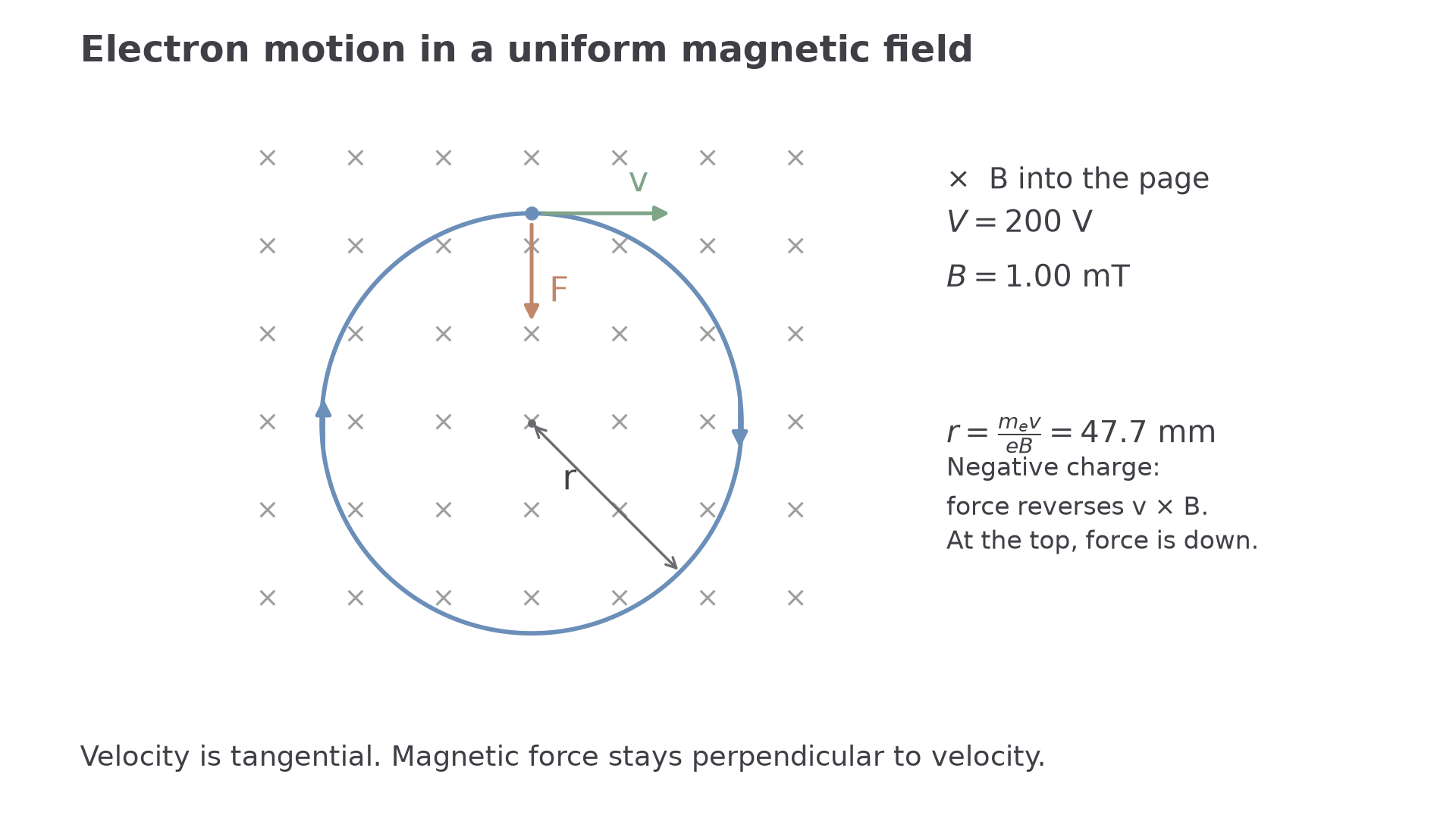
The gun accelerates electrons through a measured potential difference . The beam enters the magnetic field at right angles to it. Magnetic force is perpendicular to velocity, so it changes direction without doing work: the speed remains approximately constant and the beam follows a circle.
[DIAGRAM: asset_name: D.1.3 - Specific Charge of the Electron - Diagram 1; asset_slug: D.1.3 - Specific Charge of the Electron - Diagram 1; caption: A calculated electron orbit with perpendicular magnetic force; description: Plan view of trajectory in a uniform field into the page. Electron velocity is tangent at the top of the circle, pointing right; negative charge makes force downward there. Coils and supply wiring are omitted. Radius is calculated from V=200 V and B=1.00 mT.]
Deriving the measured ratio
With negligible initial kinetic energy, . The magnetic force supplies the centripetal force:
Writing makes elimination clear: and . Equate them and cancel the nonzero :
Fine-beam determination
Measure with a voltmeter across the accelerating electrodes, with a calibrated field probe or from a calibrated coil-current relationship, and the path diameter with the tube scale; halve the diameter to obtain . We are determining the ratio experimentally, so do not insert accepted and in place of the measured , and .
For , and ,
This gives .
Checking a measurement
A finite beam width limits where its centre can be read. Measure a full diameter to reduce the fractional effect of a fixed reading uncertainty; view an external scale normally to reduce parallax if the scale and beam are in different planes. Repeating readings can reveal random spread, but does not remove a calibration or alignment error. Keep the beam perpendicular to the field: a parallel velocity component produces a helix rather than the intended circle.
Continue this lesson.
You’re previewing NovaLearn without an account. Create a free account to read the rest.
Create free account