3.9.2.1 - Classification by Luminosity
A star can look faint because it emits little power, because it is far away, or both. Separate those possibilities by distinguishing luminosity from received intensity, then use apparent magnitude to compare the light that reaches us.
Luminosity, intensity and brightness
Luminosity is the total energy a star emits per second, measured in watts. Received intensity is the power arriving per unit detector area, measured in . Moving the detector changes the received intensity without changing the star's luminosity.
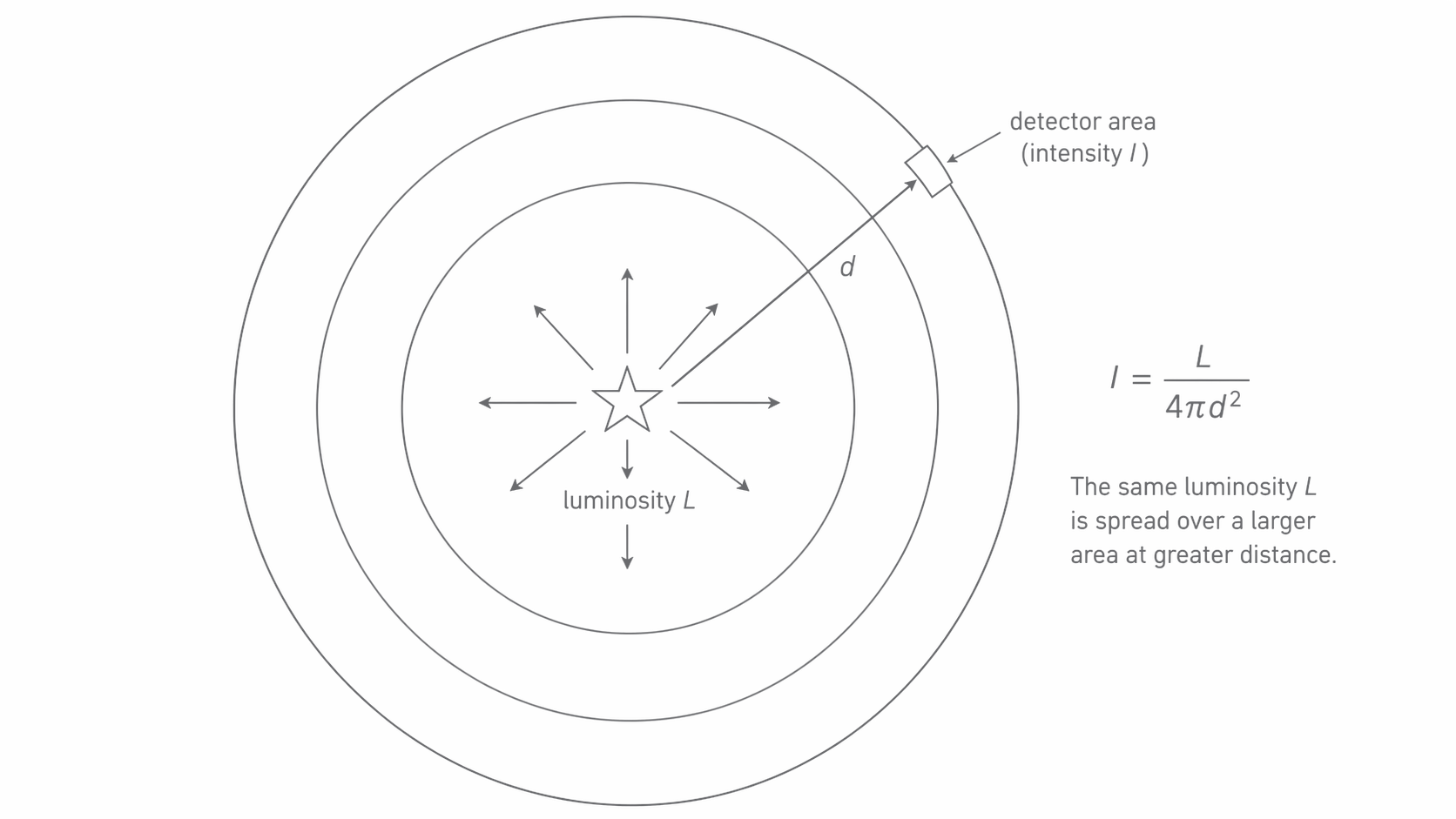
Imagine the star inside an imaginary sphere centred on it. If no light is lost, the same emitted power crosses each larger sphere, but its area is . For radiation emitted uniformly in all directions,
Here is distance from the star, much larger than its radius. Twice the distance spreads the power over four times the area, giving one quarter of the intensity. This geometrical argument is developed quantitatively in the black-body lesson.
[DIAGRAM: asset_name: A.2.1 - Classification by Luminosity - Diagram 1; asset_slug: A.2.1 - Classification by Luminosity - Diagram 1; caption: The same stellar power spreads over larger spherical surfaces; description: Concentric shells represent spherical surfaces, not physical barriers. Luminosity L is in watts and detector intensity I is power per unit area.]
Brightness in this specification means a subjective impression: how bright something seems to the eye. It depends on the observer and observing conditions. Modern apparent magnitudes use measured intensity in a specified wavelength band, so they provide a reproducible numerical comparison. Compare measurements made in the same band; a visible-light measurement is not automatically the total power across all wavelengths.
The reversed apparent-magnitude scale
Apparent magnitude describes how bright an object appears from Earth. It does not measure the total power emitted by the object.
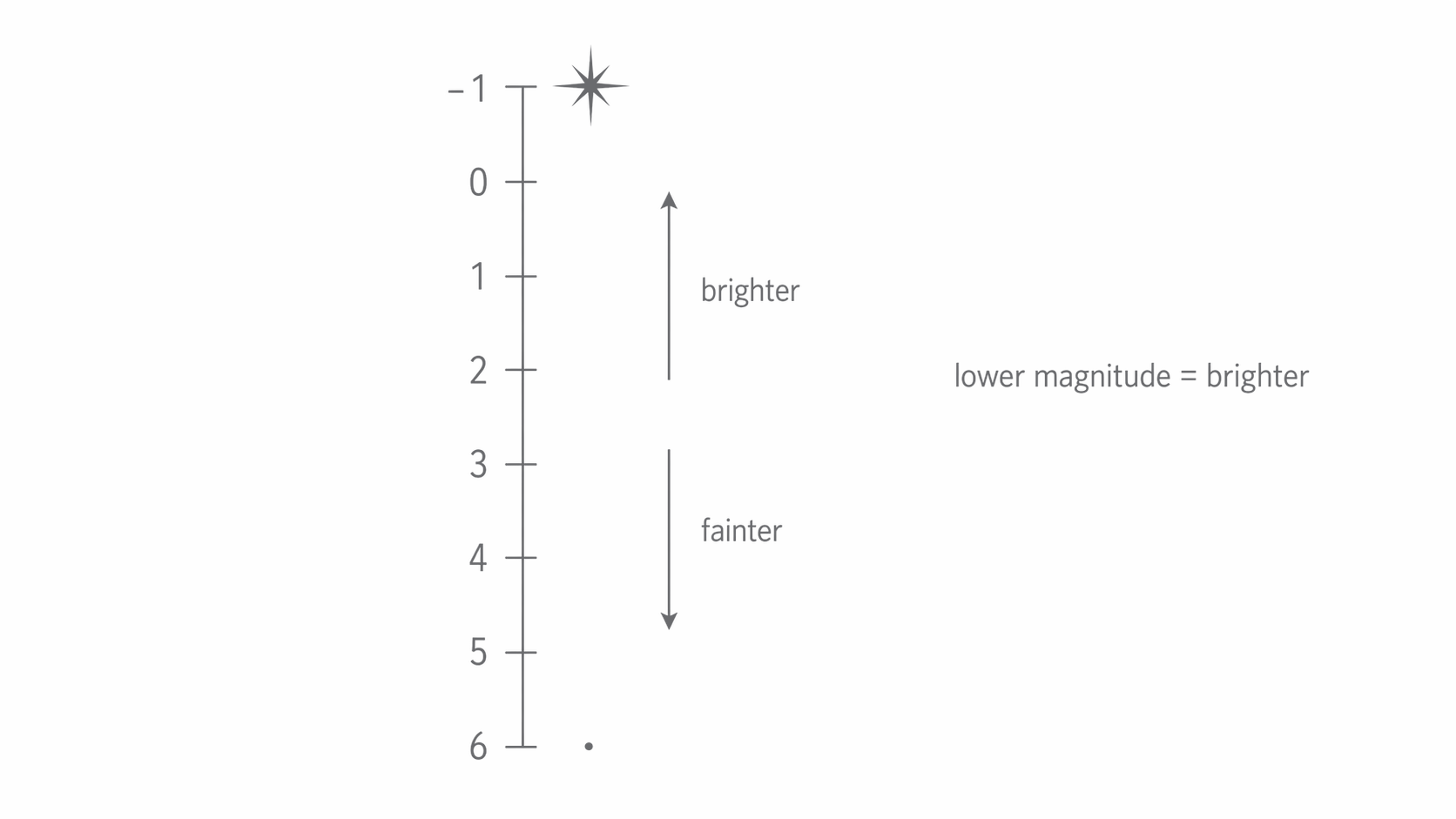
The historical scale ranked the brightest naked-eye stars near magnitude 1 and the dimmest visible stars near magnitude 6. AQA calls it the Hipparcos scale. The essential convention survives: a smaller, or more negative, magnitude means greater received intensity. Magnitude 6 is an approximate naked-eye limit under suitable dark-sky conditions, not a universal limit for every observer.
Modern measurements extend the scale to negative values and to stars much fainter than magnitude 6. For example, is brighter than , which is brighter than . Magnitude has no unit.
[DIAGRAM: asset_name: A.2.1 - Classification by Luminosity - Diagram 2; asset_slug: A.2.1 - Classification by Luminosity - Diagram 2; caption: Lower apparent magnitude means a brighter appearance; description: The ladder runs from -1 near the top to +6 at the bottom; the faint naked-eye limit is approximately +6.]
Continue this lesson.
You’re previewing NovaLearn without an account. Create a free account to read the rest.
Create free account