3.9.1.1 - Two-Lens Astronomical Telescopes
A two-lens telescope forms a real image of a distant object and lets the eye view it at a larger angle. Trace that process through the focal planes, then connect the ray geometry to lens separation and angular magnification.
Focal planes and real images
A distant point on a star or planet sends an almost parallel bundle of rays into the telescope. Different points on an extended object send bundles arriving at slightly different angles.
A converging lens bends an incident bundle towards a real image point: the rays actually meet, so a screen placed there could intercept the image. The principal axis passes through the lens centre perpendicular to the lens. The principal focus is where rays parallel to that axis meet. Its distance from the lens centre is the focal length in the thin-lens model.
[DIAGRAM: asset_name: A.1.1 - Astronomical Telescope Consisting of Two Converging Lenses - Diagram 1; asset_slug: A.1.1 - Astronomical Telescope Consisting of Two Converging Lenses - Diagram 1; recommended_method: retained_png; caption: Parallel axial rays focus at F one focal length beyond the converging lens.; description: Parallel axial rays focus at F one focal length beyond the converging lens.]
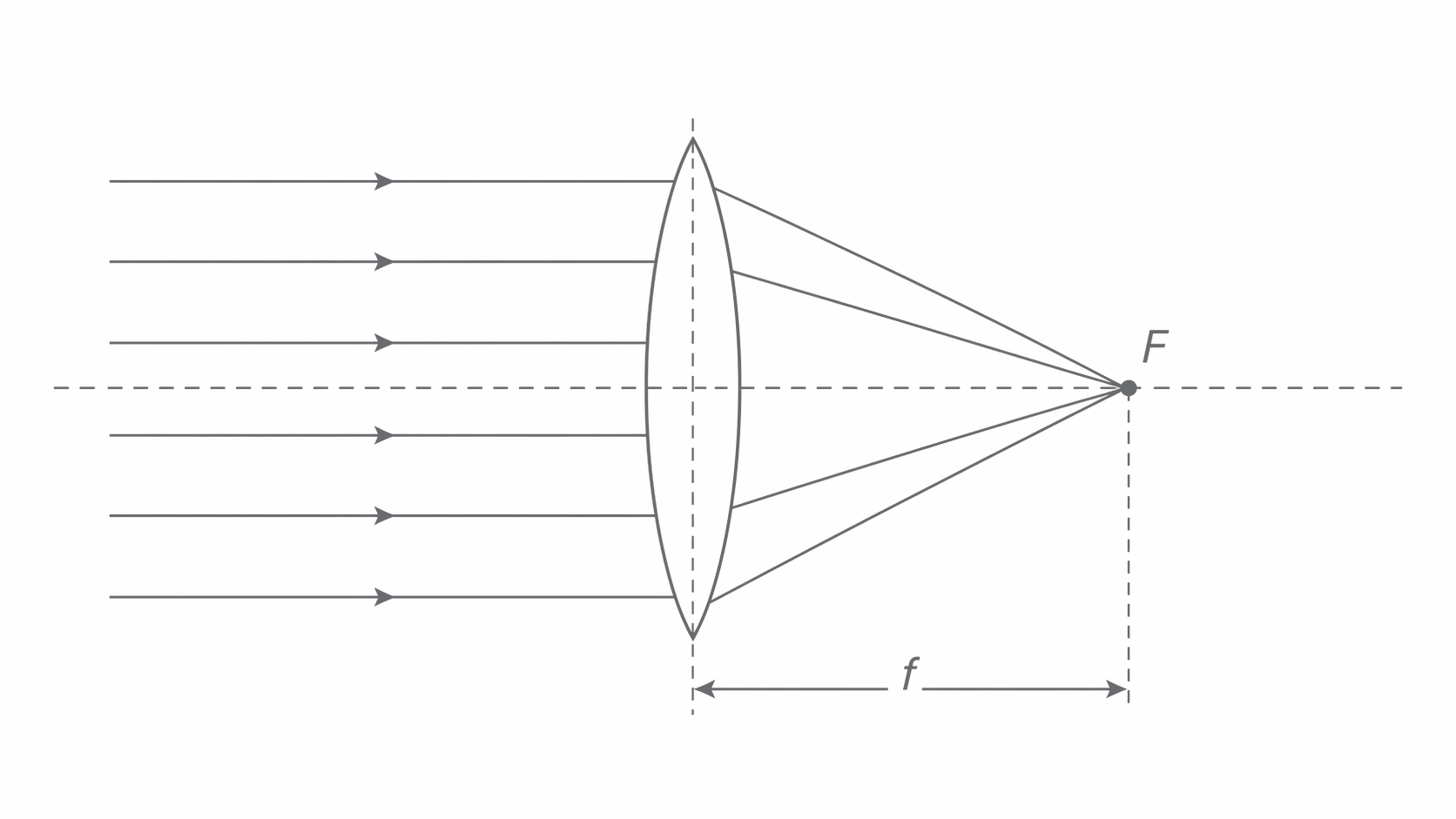
An axial bundle meets at the principal focus. The focal length is measured from the lens centre.
The focal plane passes through the principal focus and is perpendicular to the principal axis. A parallel bundle arriving at a small angle to the axis meets at an off-axis point in the focal plane, not at the principal focus. This distinction is essential for a telescope diagram: the shared principal foci remain on the axis even when the image point is below it.
Rays through the optical centre of an ideal thin lens continue straight. A ray entering parallel to the principal axis leaves towards the far principal focus. These construction rules let you locate the real image. Light from the top of a distant object is focused below the axis, so the objective's image is inverted.
Objective and eyepiece
The two lenses perform different jobs: the objective makes the first image, and the eyepiece lets the eye inspect that image at a larger angle.
The objective is the front converging lens. Its aperture collects light and it forms a real, inverted intermediate image of the distant object. A large diameter collects more light. A long focal length produces a larger intermediate image for a given object angle. These are different design choices: a long focal length does not itself give a greater collecting area.
The eyepiece is a second converging lens close to the eye. It acts as a magnifying glass for the intermediate image. For high angular magnification, the objective has a longer focal length than the eyepiece. The final image remains inverted; the eyepiece does not turn it upright.
An extended astronomical object has an image height, but a star too small to resolve is effectively a point source. The telescope still collects more of its light; making the point look bigger is not the purpose of every observation. A detector can also be placed at an image plane to record the real image without an observer looking through an eyepiece.
Normal adjustment and ray paths
A telescope is in normal adjustment when its final image is at infinity, so a relaxed eye receives parallel rays from each image point.
The real intermediate image must lie in the eyepiece's front focal plane. For a distant object it already lies in the objective's rear focal plane, so those planes coincide. Their principal foci coincide on the axis and the lens separation is
Normal-adjustment separation
Continue this lesson.
You’re previewing NovaLearn without an account. Create a free account to read the rest.
Create free account