3.8.1.4 - Nuclear Instability
A nucleus can change its neutron–proton balance or lose excitation energy. Use the neutron-number graph and conservation equations to track decay, read gamma transitions, and explain why technetium-99m is useful for medical diagnosis.
The N-Z graph and nuclear stability
A nuclide is specified by proton number and nucleon number ; its neutron number is . On an -against- graph, is vertical and horizontal. The stable nuclides occupy a narrow band rather than every point on a continuous curve.
[DIAGRAM: asset_name: 8.1.4 - Nuclear Instability - Diagram 1; asset_slug: 8.1.4 - Nuclear Instability - Diagram 1; caption: Selected stable nuclei show increasing neutron excess at larger proton number; description: Exact N and Z for eight selected stable nuclides. The dashed N equals Z line is a comparison, not the heavy-nucleus stability trend. Selected points are illustrative rather than a complete nuclide chart.]
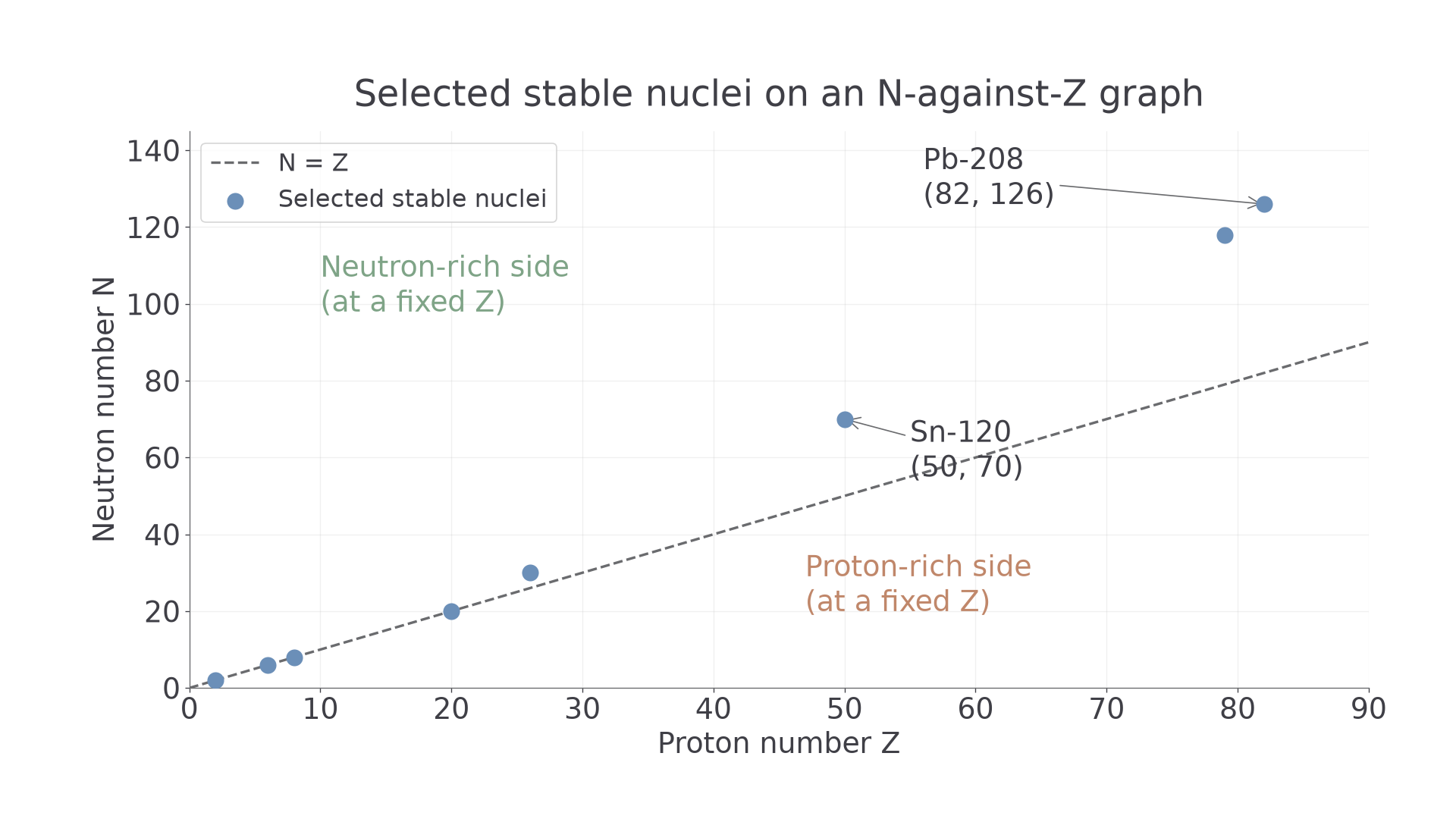
Light stable nuclei often have approximately equal proton and neutron numbers. Heavy stable nuclei need a neutron excess: lead-208 has and . Protons repel electrostatically; adding neutrons can contribute attractive strong nuclear interactions without adding electric charge. Because the strong interaction is short-ranged whereas electrostatic repulsion extends across the nucleus, the balance changes as nuclear size grows.
At a fixed , a point above the stability band is neutron-rich; below it is proton-rich. Beta-minus decay can reduce neutron excess. Beta-plus decay or electron capture can reduce proton excess. Very heavy nuclei can undergo alpha decay. These are useful tendencies, not an algorithm that uniquely predicts every nuclide's decay: the energy available and possible transitions also matter. Some nuclides have more than one decay route.
An excited nucleus may emit gamma without changing its location on this graph. Composition stability and excitation energy are different questions.
Decay modes of unstable nuclei
Decay equations conserve total electric charge and nucleon number across all reactants and products. The nucleus's own may change; the charge carried by an emitted or captured particle balances the change. A negative lower index on an electron records charge, not a negative number of protons inside the electron.
| Process | Change in parent nucleus | Direction on the -against- graph |
|---|---|---|
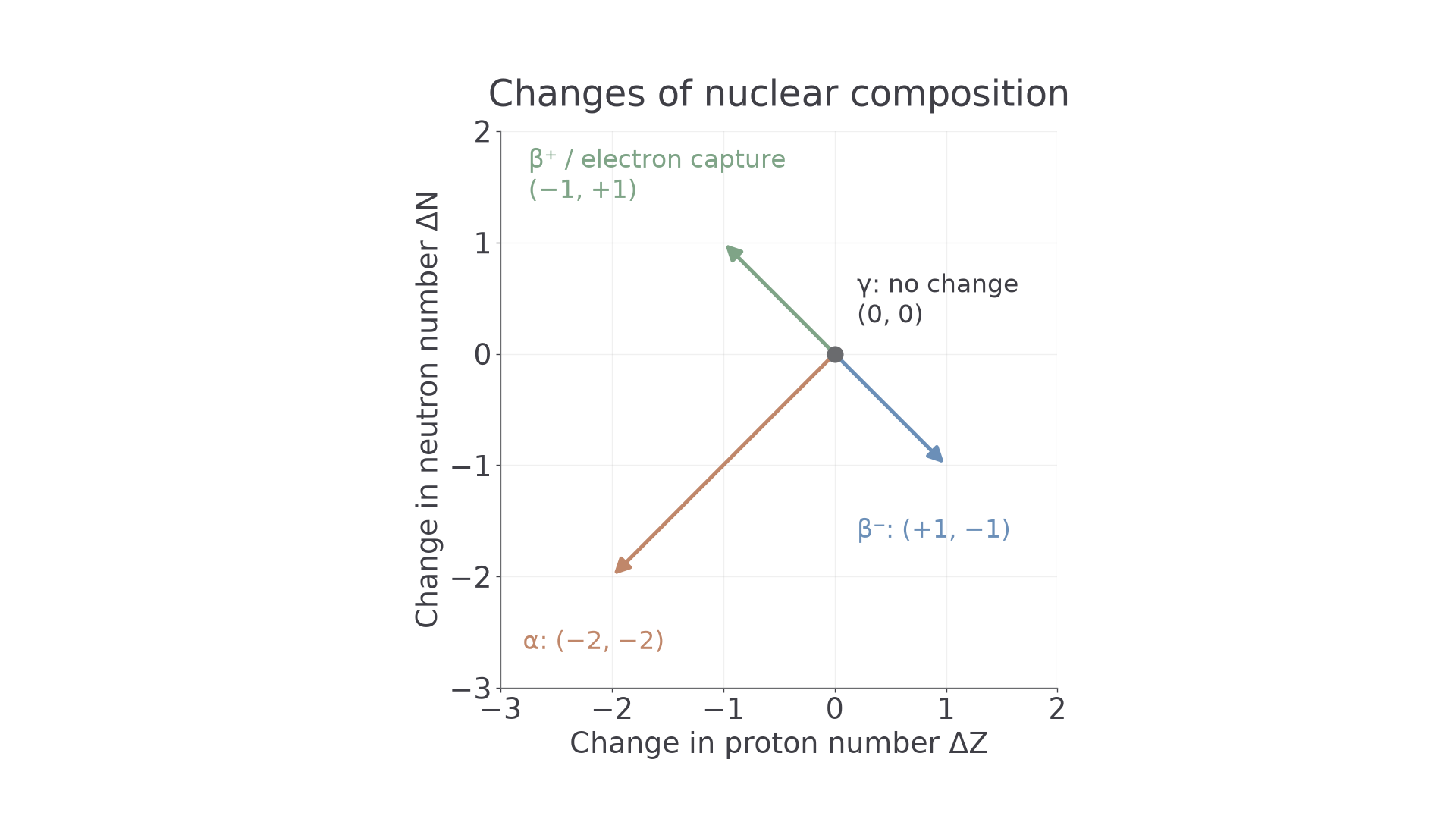
| Alpha: loses two protons and two neutrons | Two left, two down | |
| Beta-minus: neutron becomes proton | One right, one down | |
| Beta-plus: proton becomes neutron | One left, one up | |
| Electron capture: proton combines with an orbital electron to become neutron | One left, one up | |
| Gamma: nuclear de-excitation | No displacement |
[DIAGRAM: asset_name: 8.1.4 - Nuclear Instability - Diagram 2; asset_slug: 8.1.4 - Nuclear Instability - Diagram 2; caption: Exact changes in neutron and proton number for the main decay modes; description: Each grid interval is one unit. Arrows end at alpha minus two minus two, beta-minus plus one minus one, and beta-plus or electron capture minus one plus one. Gamma stays at the origin.]
The corresponding equations are
The beta electron or positron is created in the decay; it is not an electron previously orbiting the atom. In electron capture, an existing inner orbital electron is a reactant, so it appears on the left. Neutrinos carry energy and lepton number but do not change the charge or nucleon-number sums. Gamma de-excitation is written schematically as , where the star denotes excitation.
For example, : , and . The neutron number falls from eight to seven. Write the particle first or use the number changes, then check both conservation sums.
Radioactive decay series
A daughter produced by one decay can itself be radioactive. A decay series follows these successive transformations until a stable product is reached; a branch can give more than one possible route. Do not assume that one decay automatically produces a stable daughter.
For the initial uranium-238 sequence,
The alpha step removes four nucleons; each beta-minus step changes a neutron into a proton. The final nuclide has the original proton number but four fewer neutrons. Alpha followed by two beta-minus decays therefore does not restore the original isotope.
For a heavy nucleus with , removing two of each increases : for uranium-238, becomes . A daughter can be left relatively neutron-rich, and beta-minus decays may move it towards the stable region. The ratio alone does not establish which branch is energetically possible. Avoid a universal claim that all natural radioactive nuclides or chains exclude beta-plus decay.
Continue this lesson.
You’re previewing NovaLearn without an account. Create a free account to read the rest.
Create free account