3.8.1.1 - Rutherford Scattering (A-level only)
Alpha scattering reveals atomic structure indirectly: the pattern of deflections tests how charge and mass are distributed. Learn how the apparatus made that evidence interpretable, why the nuclear model replaced diffuse positive charge, and what scattering alone could not establish.
The model before Rutherford
An atom is electrically neutral but contains negatively charged electrons. Thomson's plum pudding model balanced their charge with positive charge spread throughout the atomic volume, with the electrons embedded in it. It contained no tiny, massive nucleus.
An alpha particle is a helium-4 nucleus with charge , moving rapidly compared with ordinary atomic motion. It provides a probe: electrostatic forces can change its momentum and direction. Under the diffuse-charge model, the positive charge encountered in a small region is too spread out to exert the very large force needed to reverse a fast alpha particle. The light electrons also cannot account for large-angle scattering of these much heavier projectiles. Passage with small deflections is expected; substantial backscattering is not.
This is a testable prediction, not an observation. A model can explain electrical neutrality yet fail to explain a different experiment.
Rutherford's experiment
Geiger and Marsden measured alpha scattering under Rutherford's direction by directing a narrow beam at a very thin metal foil. Gold could be made particularly thin. A fluorescent screen produced a scintillation, a small flash, when an alpha particle struck it; a microscope allowed flashes to be counted at different scattering angles.
[DIAGRAM: asset_name: 8.1.1 - Rutherford Scattering - Diagram 2; asset_slug: 8.1.1 - Rutherford Scattering - Diagram 2; caption: Collimated alpha beam, thin gold foil and scintillation detection at different angles; description: Schematic apparatus. The screen locations illustrate possible detection angles, not equal measured count rates.]
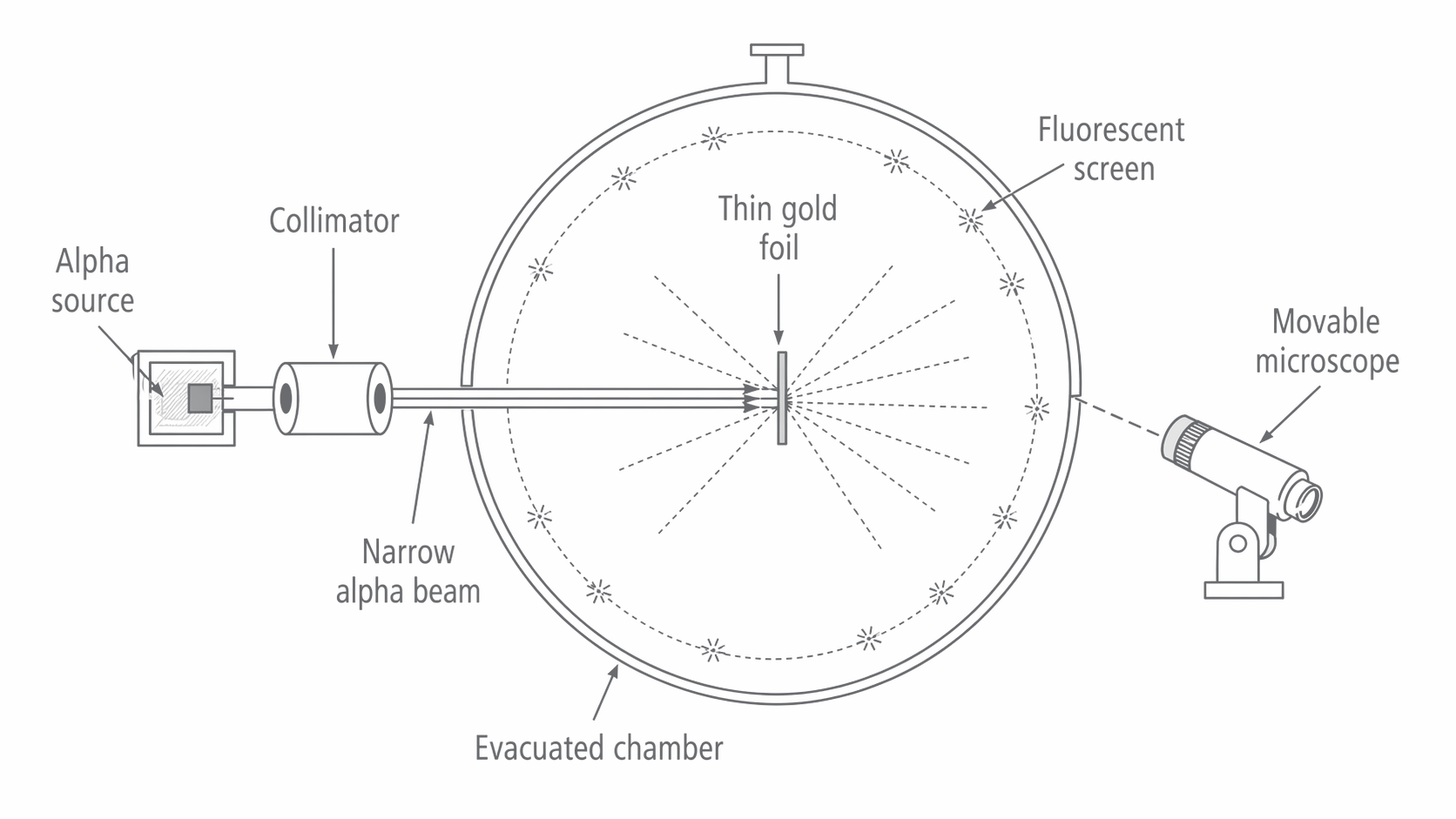
The collimator restricts the beam's spread, giving a known incident direction from which to measure the angle. Evacuating the chamber reduces energy loss and scattering in air. A thin foil reduces absorption and the chance of several substantial deflections: an observed large angle can then be attributed mainly to a single close encounter. Thin does not mean one atom thick or no interactions with other atoms.
Counts at different angles must be compared for equal collection times, or converted to count rates. Keep the beam and detector geometry fixed while changing the detection angle. A single flash is a detection; the distribution of many detections is the evidence about structure. The sketch is a layout, not a plot of that distribution.
What Rutherford observed
Most incident alpha particles passed through with little deflection, while a small fraction underwent large-angle scattering, including angles greater than . The exact fractions depend on foil thickness, material and alpha energy; they are not universal constants to memorise.
Continue this lesson.
You’re previewing NovaLearn without an account. Create a free account to read the rest.
Create free account