3.11.2.6 - Reversed Heat Engines
Follow energy from cold to hot using work input, choose the correct coefficient of performance and compare real heat pumps with their reversible limit.
Moving heat from cold to hot
A reversed heat engine uses work input to move thermal energy from a colder reservoir to a hotter one. Heat does not transfer spontaneously in this direction; the work supply makes the combined process possible.
Over a complete cycle the working substance returns to its starting internal energy. If it removes from the cold reservoir and receives work , it delivers
All three symbols here are positive transfer magnitudes. AQA’s COP formulae call the work input . This is the opposite of work by the gas in : .
[DIAGRAM: asset_name: C.2.6 - Reversed Heat Engines - Diagram 1; asset_slug: C.2.6 - Reversed Heat Engines - Diagram 1; caption: Both work and heat from the cold reservoir enter the device, their sum is delivered to the hot reservoir. W denotes work input.; description: Both work and heat from the cold reservoir enter the device, their sum is delivered to the hot reservoir. W denotes work input.]
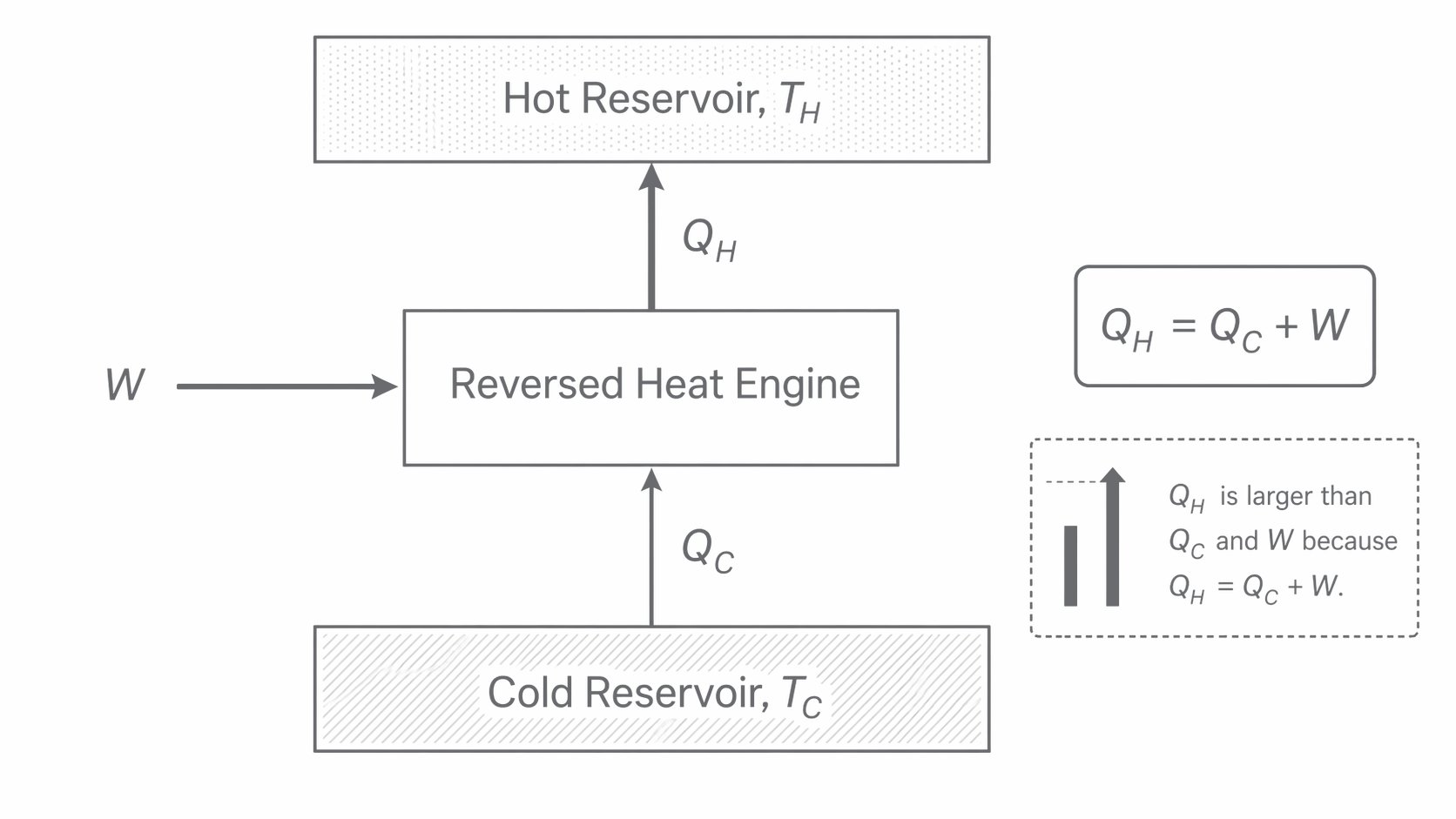
For example, removing from a fridge with electrical work delivers to the kitchen. Specify the direction and reservoir when saying “heat input”: it is otherwise unclear which energy is meant.
Choosing the useful thermal transfer
A refrigerator is judged by energy removed from the cold space. A heat pump is judged by energy delivered to the hot space. The energy-flow pattern can be the same; the intended service determines the numerator.
A kitchen fridge removes energy from its interior and releases it into the kitchen. An air conditioner removes energy from a room and releases it outdoors. A heating heat pump extracts energy from outside air, ground or water and delivers it indoors. “Cold” means colder than the heated space, not zero internal energy.
A fridge left running with its door open cannot cool the entire closed kitchen: its hot-side output exceeds its cold-side removal by the electrical work input, giving net heating of the room. This assumes both sides exchange energy with that same room.
The specification requires these principles and uses, not detailed compressor, evaporator or refrigerant-cycle construction.
COP definitions and reversible limits
The coefficient of performance (COP) is useful thermal energy transferred divided by work supplied. It has no units. It can exceed one because it counts transported energy as well as the electrical input; it is not an energy-conversion efficiency.
For any cyclic device with the stated two heat transfers,
Dividing by work gives for the same device and operating cycle. Two unrelated devices between the same reservoir temperatures need not have COPs differing by one.
Only for an ideal reversible device do the temperature expressions give equality. The maxima between fixed reservoirs are
Use kelvin in each numerator. A difference of equals a difference of , but an absolute Celsius temperature cannot replace an absolute kelvin temperature in the ratio.
Continue this lesson.
You’re previewing NovaLearn without an account. Create a free account to read the rest.
Create free account