3.7.4.1 - Capacitance
A capacitor separates charge without allowing electrons to cross its insulating gap. Learn what its capacitance measures, how charge–voltage data reveal it, and how to calculate charge and charging time.
Charge separation on two conductors
A capacitor consists of two conductors separated by an electrical insulator, which may be air, vacuum or a solid dielectric. Connecting it to a cell removes electrons from the conductor connected to the positive terminal and supplies electrons to the conductor connected to the negative terminal. The electrons move through the external wires and source; they do not cross an intact insulating gap.
The plates acquire equal and opposite charges, and . The charge stored, , means the magnitude on either plate. Their combined net charge remains zero. Separating these charges creates an electric field and stores energy; zero net charge does not mean zero stored energy.
[DIAGRAM: asset_name: 7.4.1 - Capacitance - Diagram 1; asset_slug: 7.4.1 - Capacitance - Diagram 1; caption: Charging separates equal and opposite plate charges. Conventional current in the external wires is opposite to electron motion, no electrons cross the insulator.; description: Charging separates equal and opposite plate charges. Conventional current in the external wires is opposite to electron motion, no electrons cross the insulator.]
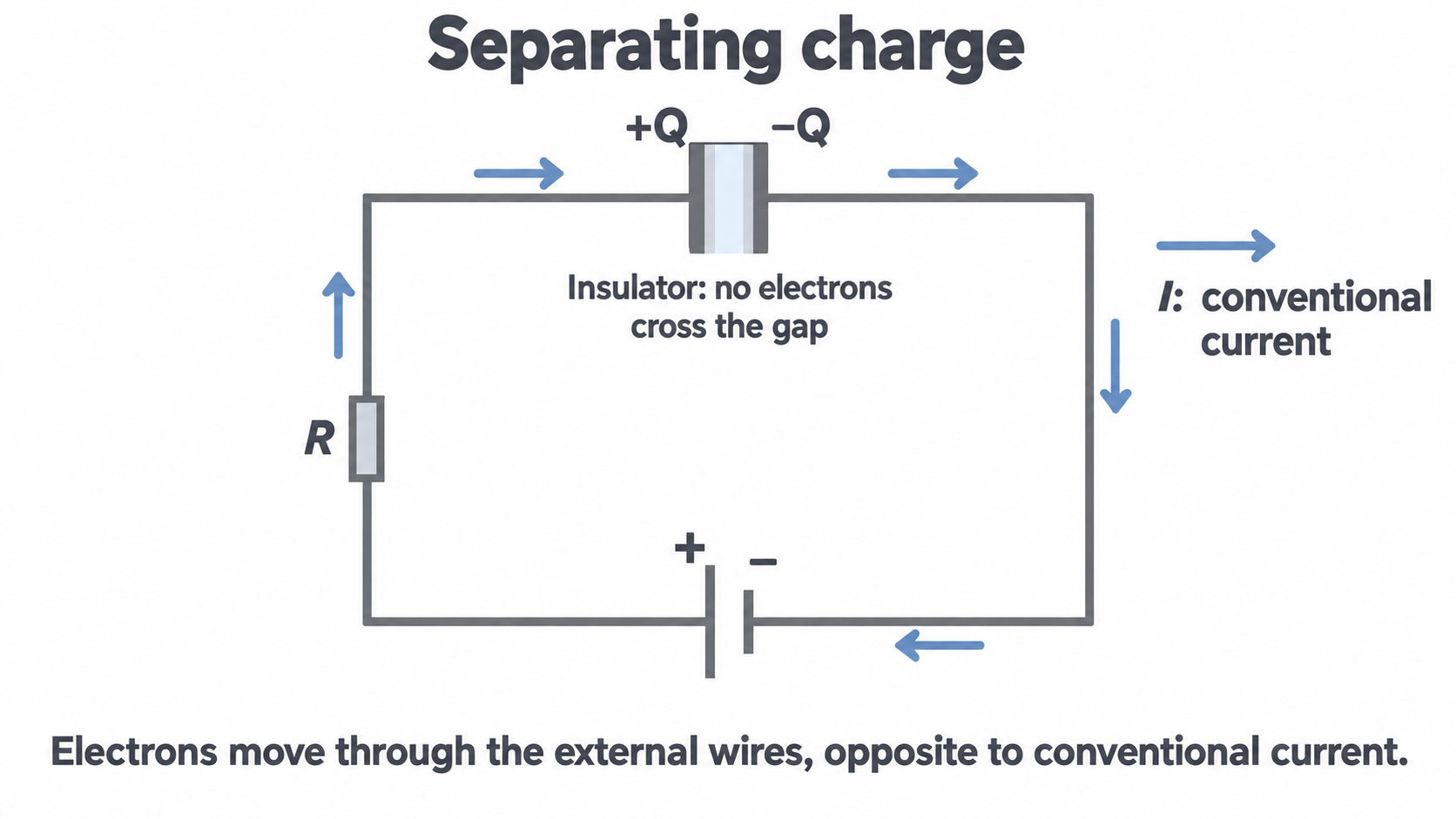
The arrows show conventional current while charging. Once the capacitor pd reaches the cell pd, the ideal steady current is zero. The resistor limits the charging current; its effect on charging speed is taught in 3.7.4.4.
Capacitance and the farad
Capacitance is the charge stored per unit potential difference across a capacitor. For a capacitor whose geometry and dielectric remain unchanged, charge is directly proportional to pd in its normal operating range.
Capacitance
Here is in farads, in coulombs and in volts. A capacitance of means on each plate for each volt across the capacitor: . Larger capacitance means more charge at the same pd; it does not by itself specify the charge stored.
| Prefix | Conversion |
|---|---|
| microfarad | |
| nanofarad | |
| picofarad |
For example, on a capacitor gives : matching prefixes cancel. If prefixes differ, convert before dividing.
Measuring capacitance from charge–voltage data
A constant charging current makes transferred charge measurable from time: , provided the capacitor starts uncharged. If the current varies, use the area under its current–time graph instead; multiplying one instantaneous current by the total time is invalid.
Use an adjustable current source, or adjust a series variable resistor while monitoring an ammeter, to maintain the current. Connect a high-resistance voltmeter across the capacitor and record pd at known times. Check the capacitor's polarity and keep below its working-voltage rating. Excess voltage may break down the dielectric and allow damaging conduction.
Continue this lesson.
You’re previewing NovaLearn without an account. Create a free account to read the rest.
Create free account