3.11.2.2 - Non-Flow Processes
Use the physical constraint on a fixed amount of ideal gas to choose a gas law, calculate its new state and account for heat and work.
A fixed amount of ideal gas
A non-flow process changes a fixed amount of gas inside a closed system. No gas crosses the boundary. The ideal-gas model neglects intermolecular potential energy and relates equilibrium states by
Use absolute pressure in pascals, volume in cubic metres, amount in moles, and kelvin temperature. Convert ; is adequate at usual A-level precision.
For example, , , give . Match pressure, volume and temperature from the same state, not changes between states.
For fixed ideal-gas amount, internal energy depends only on temperature. Throughout this lesson , with work positive when done by the gas. The gas equation describes states; the process condition tells us how those states connect.
Isothermal changes
An isothermal process has constant temperature. For a fixed amount of ideal gas this gives two separate consequences:
During expansion against pressure, , so heat must enter to maintain temperature. During compression, work enters and an equal energy leaves by heating. Constant temperature does not mean no heat transfer.
A piston moved slowly while in good thermal contact with a large reservoir can approximate an isothermal change: heat transfer has time to keep the temperature nearly constant. Slowness alone does not guarantee isothermal conditions if the cylinder is insulated.
If volume is reduced to one third at constant temperature, pressure triples: .
Adiabatic changes
An adiabatic process transfers no energy by heating, so . Insulation or a short transfer time can approximate this. Expansion against pressure uses internal energy to do work: , so the gas cools. Compression gives , so the ideal gas warms.
For a reversible (quasistatic) adiabatic ideal-gas change with constant heat-capacity ratio ,
This is the standard model for the compression and expansion strokes considered here. It does not apply to arbitrary irreversible changes such as free expansion into a vacuum.
Combining it with gives . You can instead find first and then use the ideal-gas equation; no extra formula needs memorising.
[DIAGRAM: asset_name: C.2.2 - Non-Flow Processes - Diagram 1; asset_slug: C.2.2 - Non-Flow Processes - Diagram 1; caption: From the same initial state, expansion follows a lower pressure path adiabatically because the gas also cools.; description: From the same initial state, expansion follows a lower pressure path adiabatically because the gas also cools.]
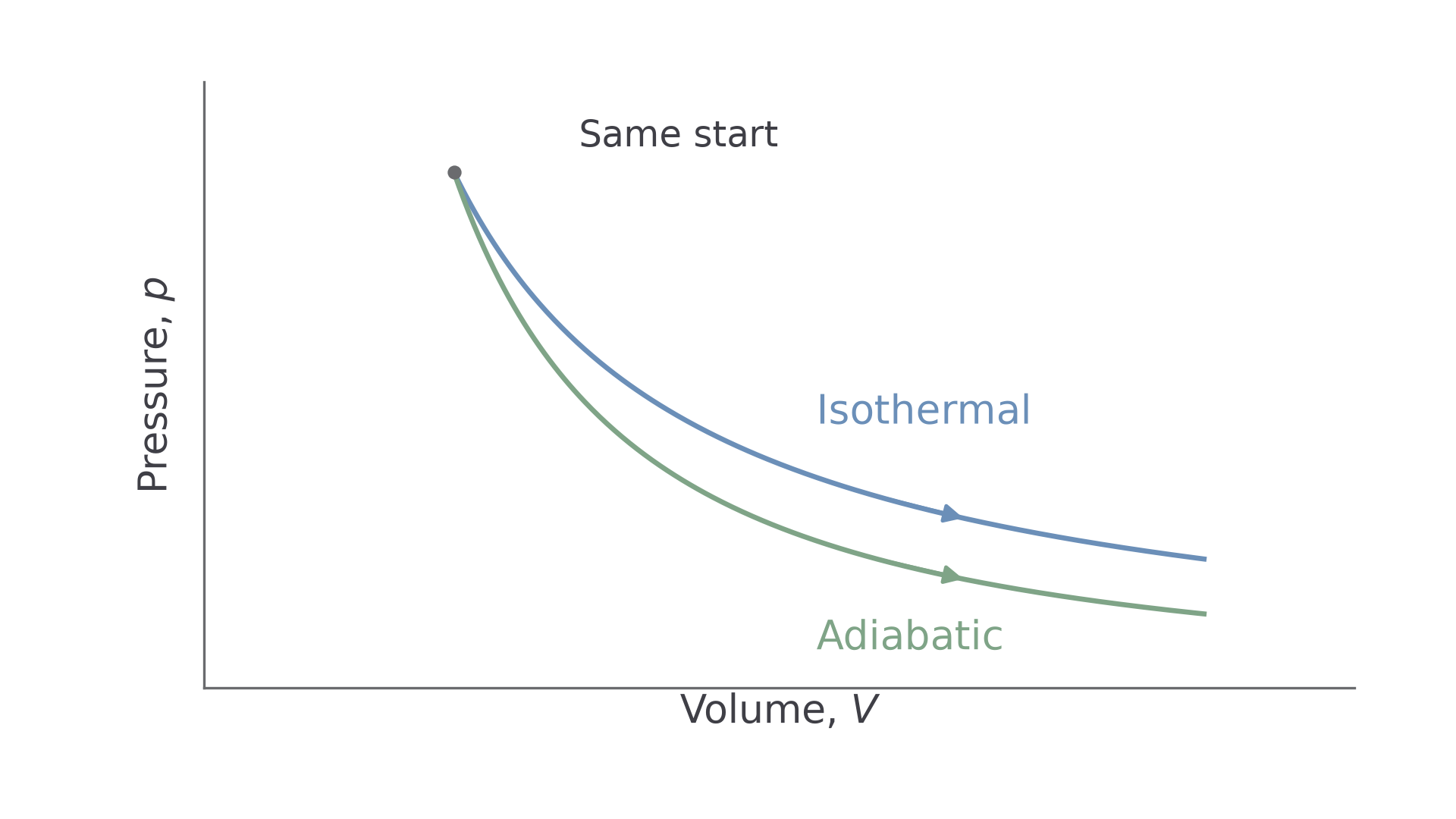
At the same state, an adiabatic curve has a larger gradient magnitude than an isotherm. This comparison needs a shared state: unrelated curves cannot be identified by apparent steepness alone.
Continue this lesson.
You’re previewing NovaLearn without an account. Create a free account to read the rest.
Create free account