3.2.1.3 - Particles, Antiparticles and Photons
Electromagnetic radiation can be described as photons, and the same energy ideas explain how matter and antimatter can be destroyed or created. In this lesson you will use the photon model, compare particles with their antiparticles, and link annihilation and pair production through conservation of energy and momentum.
Photons and Photon Energy
Electromagnetic radiation is emitted and absorbed in discrete packets called photons. A photon has zero rest mass, but it still carries energy and momentum.
Photon
A photon is a discrete packet of electromagnetic radiation. It has zero rest mass and energy proportional to its frequency.
The energy of a photon depends on the radiation frequency and wavelength .
Photon energy
Here is the Planck constant, is the speed of light in a vacuum, is measured in hertz, and is measured in metres. A higher frequency means a higher-energy photon, so shorter-wavelength radiation has the larger photon energy.
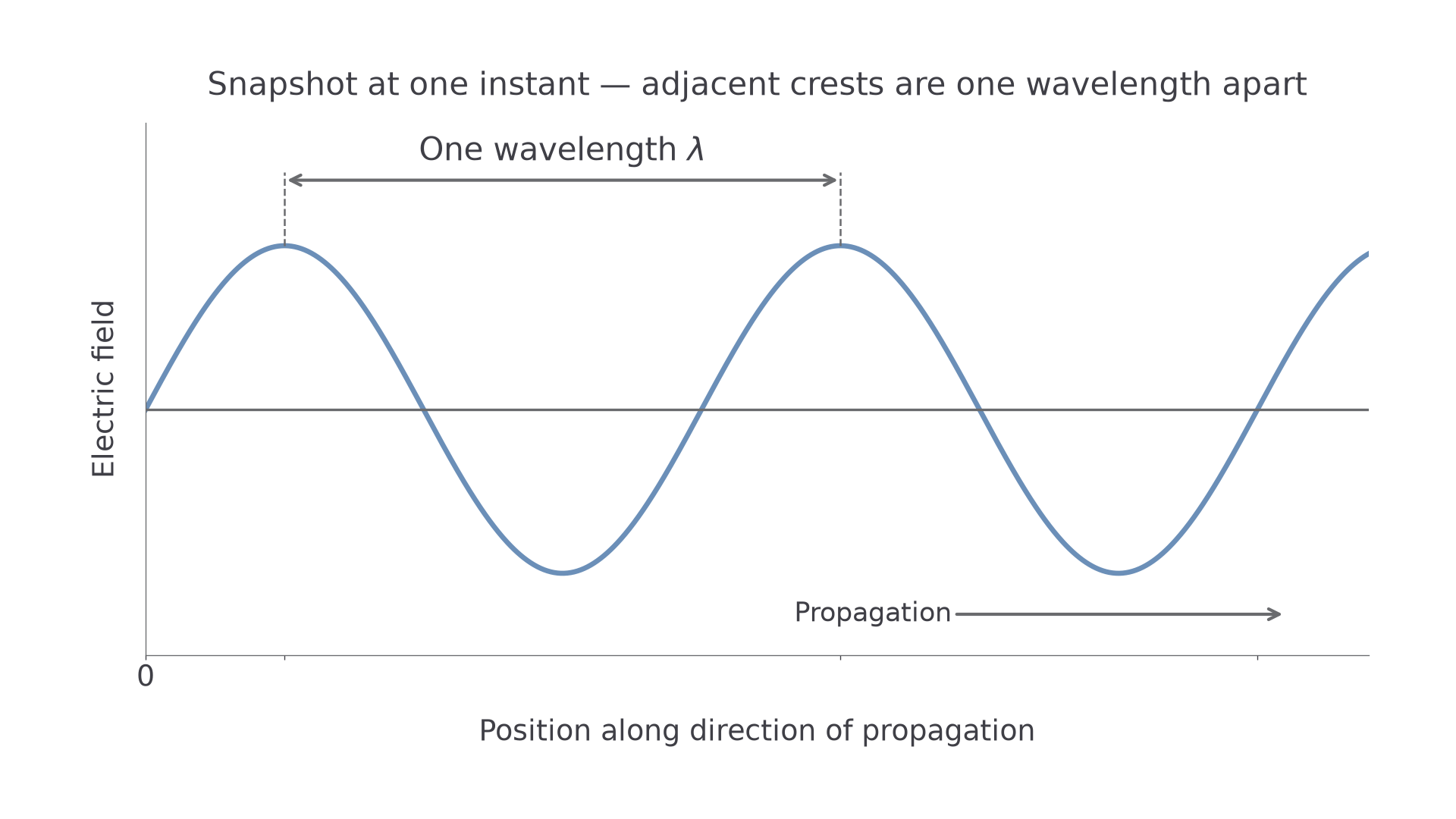
Wavelength is the distance between adjacent points with the same phase, such as two successive crests. The graph shows the electric field at one instant as a function of position; it is not the trajectory of a photon.
[DIAGRAM: asset_name: 2.1.3 - Particles, Antiparticles and Photons - Diagram 1; asset_slug: 2.1.3 - Particles, Antiparticles and Photons - Diagram 1; recommended_method: matplotlib; caption: One wavelength separates adjacent crests in this electric-field snapshot. The curve is not a photon path.; description: Electric field against position at one instant, with one wavelength spanning adjacent crests and propagation perpendicular to the electric field]
Photon energies are often converted from joules into electron volts because the values are small. The useful conversions are and .
Particles and Antiparticles
For every particle there is a corresponding antiparticle. The particle and antiparticle have the same mass and the same rest energy, but opposite charge if the particle is charged. Other quantum numbers are also opposite, which is why neutral pairs such as the neutron and antineutron are still distinct particles.
Antiparticle
An antiparticle has the same mass and rest energy as its particle partner, but opposite additive quantum numbers, including charge when non-zero.
The particle-antiparticle pairs named in this part of the course are the electron and positron, proton and antiproton, neutron and antineutron, and neutrino and antineutrino.
| Particle / antiparticle | Mass of each / kg | Charges / | Rest energy of each / MeV |
|---|---|---|---|
| Electron / positron | / | ||
| Proton / antiproton | / | ||
| Neutron / antineutron | / | ||
| Neutrino / antineutrino | Very small, not taken as exactly zero | / | Negligible in these calculations |
Multiply a charge in units of by to express it in SI units. A photon is its own antiparticle; not every particle has a distinct partner.
This table shows the comparison the specification expects: equal masses, equal rest energies in MeV, and charges that are opposite for charged pairs. The neutron has baryon number +1 and the antineutron −1. The neutron and antineutron, and the neutrino and antineutrino, both have zero charge, so they must be distinguished by their other quantum numbers rather than charge alone.
Rest energy is just another way of expressing mass. The link is Einstein's equation , but you are not required to use that equation in calculations in this topic.
Annihilation
An electron and a positron can annihilate into photons. Their rest energy and initial kinetic energy become photon energy. Other particle–antiparticle annihilations can produce different particles when enough energy is available; here we analyse the two-photon channel.
Annihilation
Annihilation removes a particle and its antiparticle, transferring their energy to other particles; electron–positron annihilation commonly produces photons.
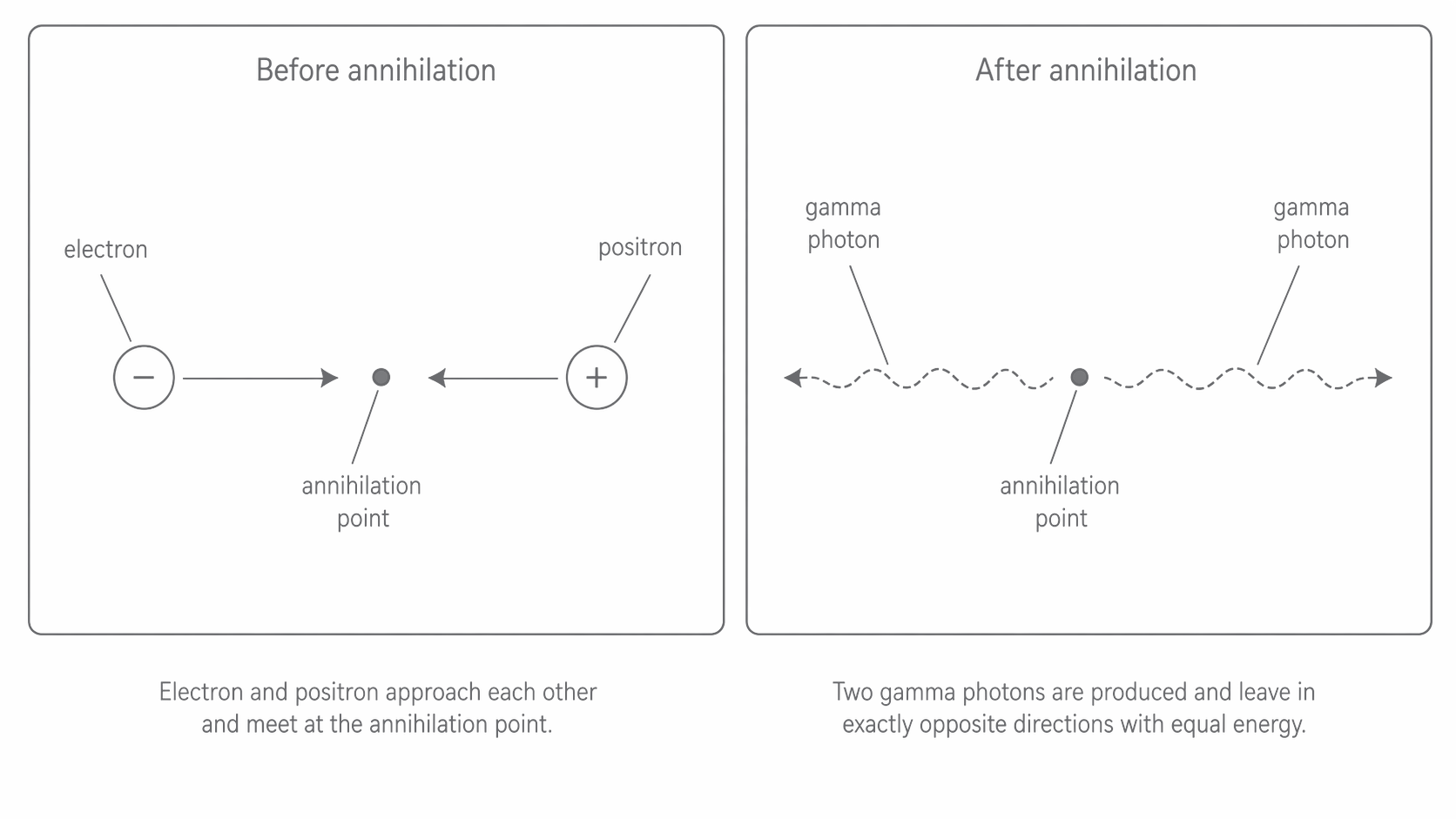
A single photon cannot conserve momentum for an isolated pair initially at rest. In the two-photon channel, if the particle and antiparticle are both at rest before the collision, the total momentum is zero, so the two photons must leave in opposite directions with equal energy.
In the diagram below, notice that the electron and positron meet and the two gamma photons leave in opposite directions, showing how zero initial momentum is balanced after annihilation.
[DIAGRAM: asset_name: 2.1.3 - Particles, Antiparticles and Photons - Diagram 2; asset_slug: 2.1.3 - Particles, Antiparticles and Photons - Diagram 2; recommended_method: retained_png; caption: In the centre-of-momentum case, two annihilation photons have equal energies and opposite momenta.; description: An electron and positron approaching, meeting, then two gamma photons leaving in opposite directions]
If each original particle has rest energy , the minimum-energy case is:
so in this rest-frame case each photon has energy:
Energy of each photon for a pair at rest
This result assumes two photons and zero initial total momentum. It is not a universal lower bound on each photon in every laboratory frame: if the initial total momentum is non-zero, the two photon energies need not be equal.
PET scanners use electron-positron annihilation. A tracer in the body emits positrons, each positron soon meets an electron, and two gamma photons are produced in opposite directions. Detecting those photon pairs allows the scanner to reconstruct where the tracer collected inside the body.
Any kinetic energy of the pair also contributes to the photon energy. In the centre-of-momentum case, where the electron and positron have equal and opposite momenta, the two photons leave in opposite directions with equal energies greater than .
Frequencies, wavelengths and gamma detection
For a slow electron–positron pair, each photon has energy . Therefore and . Convert MeV to joules before using in SI units.
Gamma photons are uncharged and do not leave a direct ionisation trail. A scintillation detector converts deposited energy into a light pulse, which is recorded electronically. A Geiger–Müller detector can count gamma events but does not measure individual photon energies. Compare equal-duration source and background measurements; a single pulse cannot by itself identify the radiation type. PET uses nearly simultaneous detections on opposite sides to locate an annihilation along the line joining the detectors, combining many events to form an image.
Pair Production
In pair production, energy is transferred in the opposite direction. A photon disappears and produces a particle together with its antiparticle.
Pair production
Pair production is the process in which a photon creates a particle and its corresponding antiparticle.
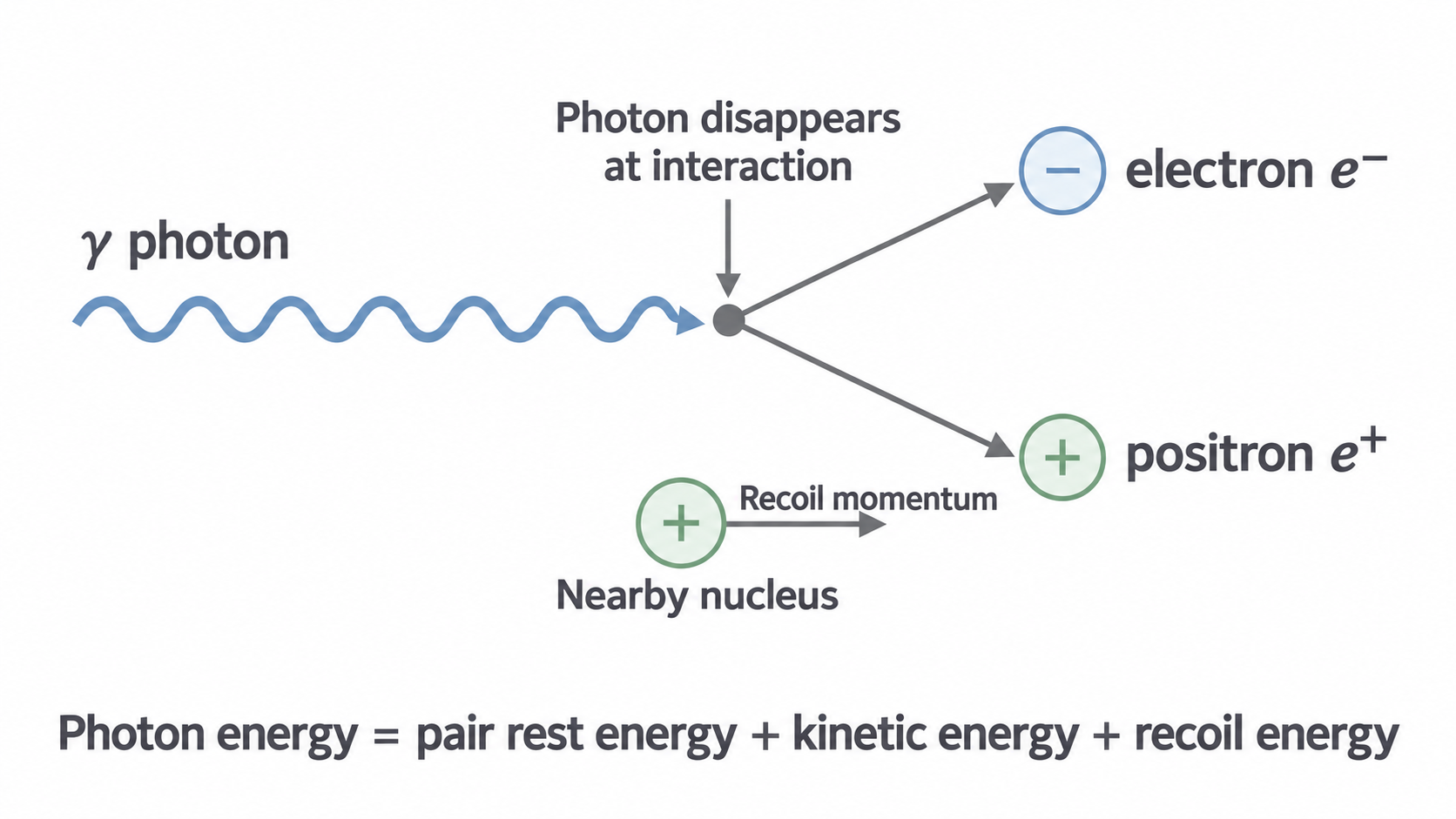
A single photon cannot produce a massive pair in empty space while conserving both energy and momentum. Near a nucleus, the nucleus can recoil and take momentum; the incoming photon supplies the pair’s rest energy. A massive nucleus can take appreciable momentum with very little kinetic energy.
In the diagram below, notice that the gamma photon passes close to the nucleus and turns into an electron-positron pair, with the nearby nucleus included to show how momentum can be conserved.
[DIAGRAM: asset_name: 2.1.3 - Particles, Antiparticles and Photons - Diagram 3; asset_slug: 2.1.3 - Particles, Antiparticles and Photons - Diagram 3; recommended_method: imagegen; caption: The photon supplies the pair rest energy and kinetic energy, a nearby nucleus takes recoil momentum.; description: A gamma photon passing close to a nucleus and producing an electron and a positron that move away from the interaction point]
If the particle and antiparticle each have rest energy , the usual A-level threshold approximation, neglecting nuclear recoil energy, is:
Minimum photon energy for pair production
More exactly, photon energy becomes the two rest energies, kinetic energy of the pair, and recoil energy of the nucleus. Neglecting recoil gives ; this approximation must be stated. The exact threshold is slightly above for a finite-mass recoiling nucleus.
For an electron-positron pair, the minimum photon energy is . Converting to joules gives , so the threshold frequency is
A useful comparison is therefore which total you must supply: producing the pair requires two rest energies in one incident photon, whereas two-photon annihilation of a pair at rest shares those two rest energies equally between two photons. The recoil/momentum conditions matter as much as the energy arithmetic.