3.8.1.6 - Mass and Energy
A bound nucleus has less rest mass than its separated nucleons. Learn to turn that mass difference into binding energy, account for every particle in fission and fusion, and use the binding-energy curve to judge which reactions can release energy.
Energy changes and the mass of a system
The rest energy of a system is . If energy is added to the internal energy of a stationary system, its mass increases by ; if energy leaves, its mass decreases. This applies to chemical, thermal and nuclear changes.
For example, a sealed, stationary hot object that loses to its surroundings loses of mass, using . The effect is tiny on everyday mass scales.
Choose the system boundary carefully. Energy transferred between components of an isolated system does not reduce the total mass-energy of the whole system. A moving object's increased kinetic energy does not increase its invariant rest mass. In nuclear calculations we compare the total rest masses of particles before and after a reaction; a decrease supplies kinetic energy and radiation.
Converting atomic mass units into energy
One atomic mass unit, , is one twelfth of the mass of a neutral carbon-12 atom at rest in its ground state. It is approximately .
Using and gives the energy equivalent
The unit measures mass, not energy: equivalently . Thus a mass decrease of releases , or .
Keep more figures in the mass subtraction than in the final answer. Subtracting two nearly equal masses after rounding them prematurely can destroy most of the useful precision.
Mass defect and consistent mass data
The binding energy is the energy needed to separate a nucleus completely into free protons and neutrons, with no extra final kinetic energy. The same energy is released when those nucleons form the bound nucleus.
[DIAGRAM: asset_name: 8.1.6 - Mass and Energy - Diagram 1; asset_slug: 8.1.6 - Mass and Energy - Diagram 1; caption: Binding preserves the nucleons while reducing their total rest mass; description: Binding preserves the nucleons while reducing their total rest mass.]
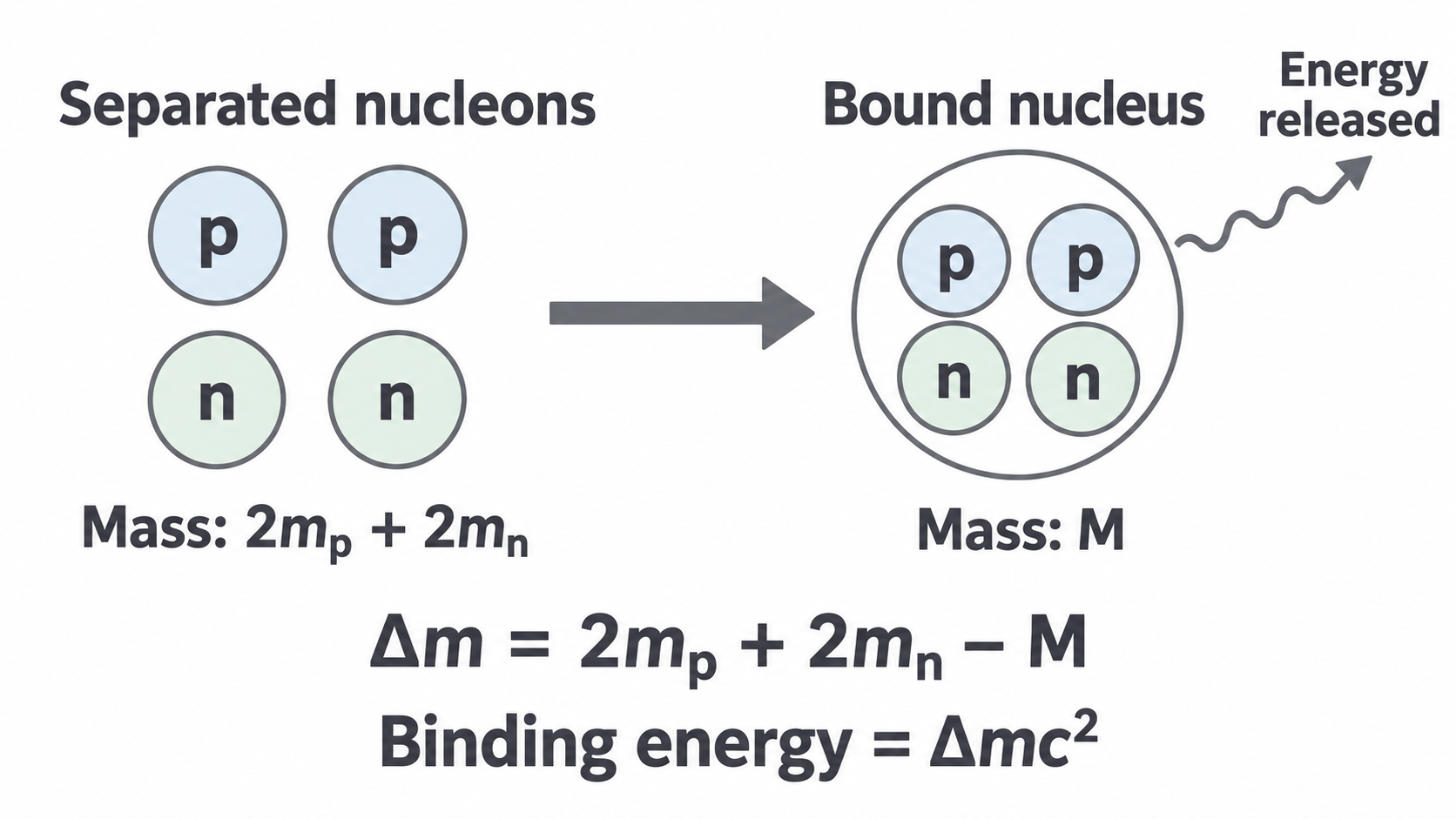
For nuclear mass , proton number and nucleon number ,
The mass defect is not evidence that a nucleon has disappeared. The bound system has lower energy and hence lower rest mass.
Nuclear masses exclude electrons; atomic masses include them. Do not subtract an atomic mass from a sum of bare proton and neutron masses. With neutral-atom masses, use hydrogen-atom mass instead of proton mass:
The electron masses then cancel, neglecting their much smaller electronic binding energies at this precision. In a reaction, neutral-atom masses can similarly be used when the total numbers of electrons on the two sides cancel. Check charge and particle accounting first.
For helium-4, take , and . The separate mass is , giving and . The binding energy per nucleon is .
Reading the binding-energy curve
Binding energy per nucleon compares how tightly nucleons are bound in different nuclei. It rises rapidly among the light nuclei, has local irregularities, reaches a broad maximum around iron and nickel (–), then decreases gradually towards very heavy nuclei.
Continue this lesson.
You’re previewing NovaLearn without an account. Create a free account to read the rest.
Create free account