3.4.1.4 - Projectile Motion
Resolve a projectile into simultaneous horizontal and vertical motions, then examine how drag, lift and friction change motion and limit speed.
Independent horizontal and vertical motion
An ideal projectile moves under gravity alone after release. Assume a uniform gravitational field and negligible air resistance: horizontal acceleration is zero and vertical acceleration is constant downward. With horizontal right and vertical up positive,
Here and are displacements from the launch point. The same elapsed time appears in both directions. Independence means that changing horizontal launch velocity does not change the vertical motion under these assumptions; it does not mean that the motions occur at different times.
A dropped ball and a horizontally projected ball released together at the same height have the same initial vertical velocity, zero, and the same acceleration . They reach a level floor together even though the projected ball travels farther. This conclusion need not hold if their initial vertical velocities differ or drag matters.
Launch and impact velocity components
For launch speed at angle above the horizontal, the initial components are
[DIAGRAM: asset_name: 4.1.4 - Projectile Motion - Diagram 1; asset_slug: 4.1.4 - Projectile Motion - Diagram 1; recommended_method: retained_png; caption: Resolve the launch velocity before applying a motion equation, gravity changes its vertical component.; description: Resolve the launch velocity before applying a motion equation, gravity changes its vertical component.]
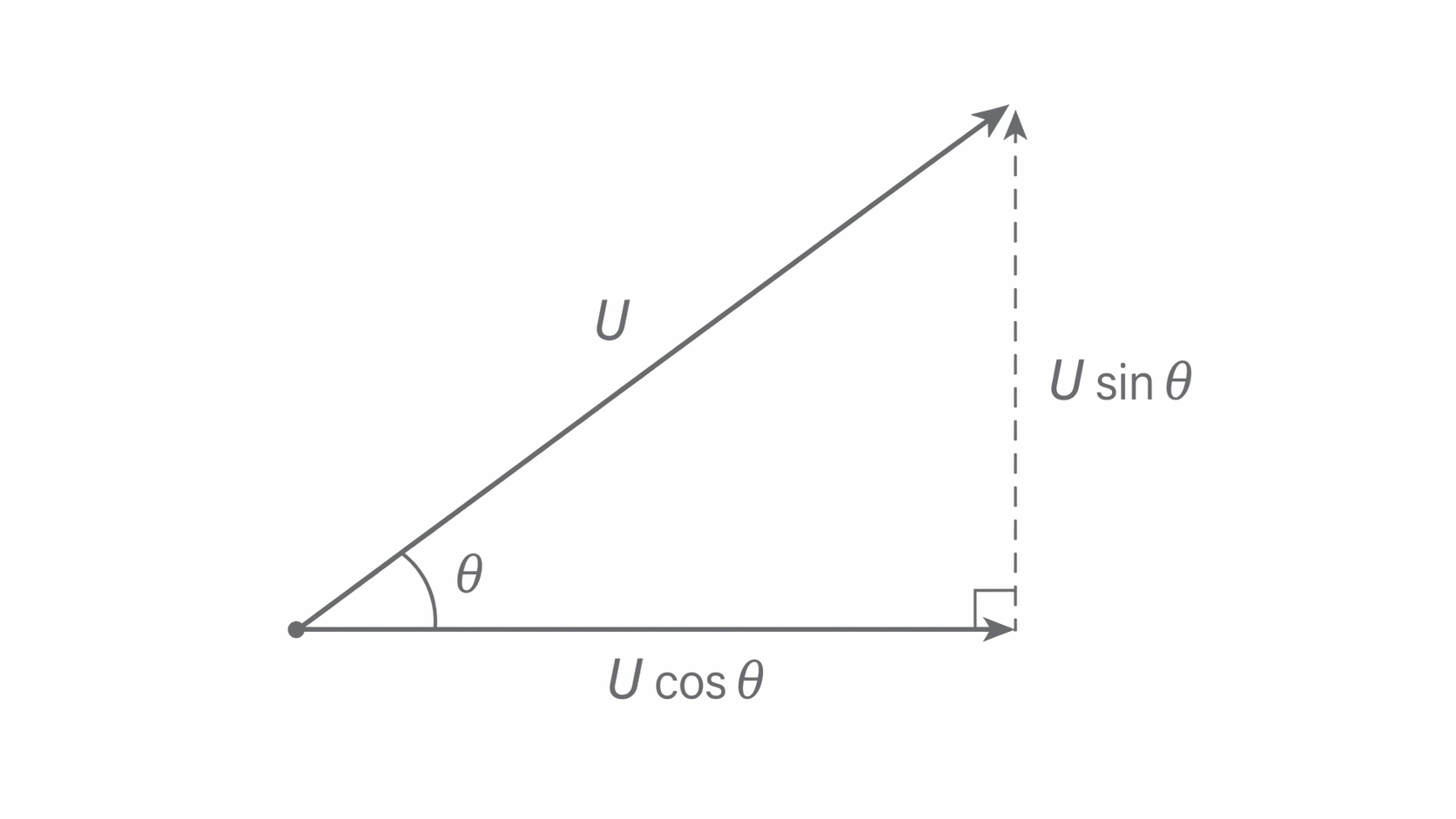
At and , and . Retain full calculator values for later stages.
At any later instant, , but . Combine these to find speed , and use for the angle above or below the forward horizontal. The sign of determines which. At the highest point but generally remains nonzero, so neither speed nor acceleration is generally zero.
Horizontal projection from a height
A horizontal launch has . Use the known vertical drop to find the time, then use that time horizontally. If the drop is , the vertical displacement is , giving
For a launch at from a tower with , the time is . The range is . Just before impact , so speed is , not the sum of the component speeds.
For a dart aimed horizontally at a point at launch height, the drop below that point determines time. Without specifying the relative launch height, a distance below the board's centre alone would not be enough information.
Angled launch and landing height
For an upward angled launch, solve the vertical motion using , not the total launch speed. At maximum height , so the rise above launch is . This rise does not depend on the later landing height.
If launch and landing are at the same height, set :
The root is launch; the landing time is . Hence . These time and range formulas require equal launch and landing heights. Deriving them from components is safer than applying them to a cliff launch.
For , and , the rise is , the same-level flight time , and range .
If that projectile instead lands below launch, solve . The positive root is , so its range is . The negative root refers to an extrapolated time before launch and is not the requested flight. Ascent and descent times are no longer equal.
Friction, lift, drag and terminal speed
Contact friction opposes relative motion or its tendency between surfaces. Drag acts opposite to an object's velocity relative to the fluid; in still air it opposes the object's motion. Air resistance increases with speed for the situations considered here. Shape and frontal area also affect its size.
Lift is the fluid force perpendicular to the relative flow. It can arise from a pressure difference around a wing or spinning ball; it is not always vertically upward. For a level aircraft wing it is usually upward. Lift and drag are distinct components of the force from the fluid.
For a dense object falling from rest in still air, ignore buoyancy for this model. Initially drag is negligible and weight gives downward acceleration. As speed increases, upward drag increases while weight stays constant. The resultant force and acceleration decrease until drag equals weight: acceleration is zero and the object continues at terminal speed. Balanced forces do not mean zero speed.
On a level road at a steady maximum speed, driving force balances drag and rolling resistance. Streamlining or reducing frontal area lowers drag at a given speed, allowing acceleration until a higher-speed balance is reached. More available engine power can support a larger driving force at a given speed. The engine does not generally provide the same driving force at every speed, so compare driving and resistive forces at the actual operating speed.
A fluid-motion investigation can compare the terminal speeds of equal-mass paper cones with different frontal areas. Use a sufficient fall distance, film against a fixed scale, and compare distances in equal late time intervals to check that speed is constant. Repeat drops, control mass and release orientation, and change only the chosen shape/area; a stopwatch over the whole fall would also include the accelerating stage.
How drag changes the trajectory
The ideal path is parabolic because horizontal velocity is constant while vertical acceleration is constant. With drag in still air and no lift, the horizontal component of drag opposes forward motion throughout flight, reducing horizontal speed. On ascent its vertical component is downward, reinforcing gravity; on descent its vertical component is upward, opposing gravity.
[DIAGRAM: asset_name: 4.1.4 - Projectile Motion - Diagram 2; asset_slug: 4.1.4 - Projectile Motion - Diagram 2; recommended_method: retained_png; caption: Both curves start with the same velocity. A calculated linear-drag example has lower peak and shorter range, its initial tangent matches the ideal curve.; description: Both curves start with the same velocity. A calculated linear-drag example has lower peak and shorter range, its initial tangent matches the ideal curve.]
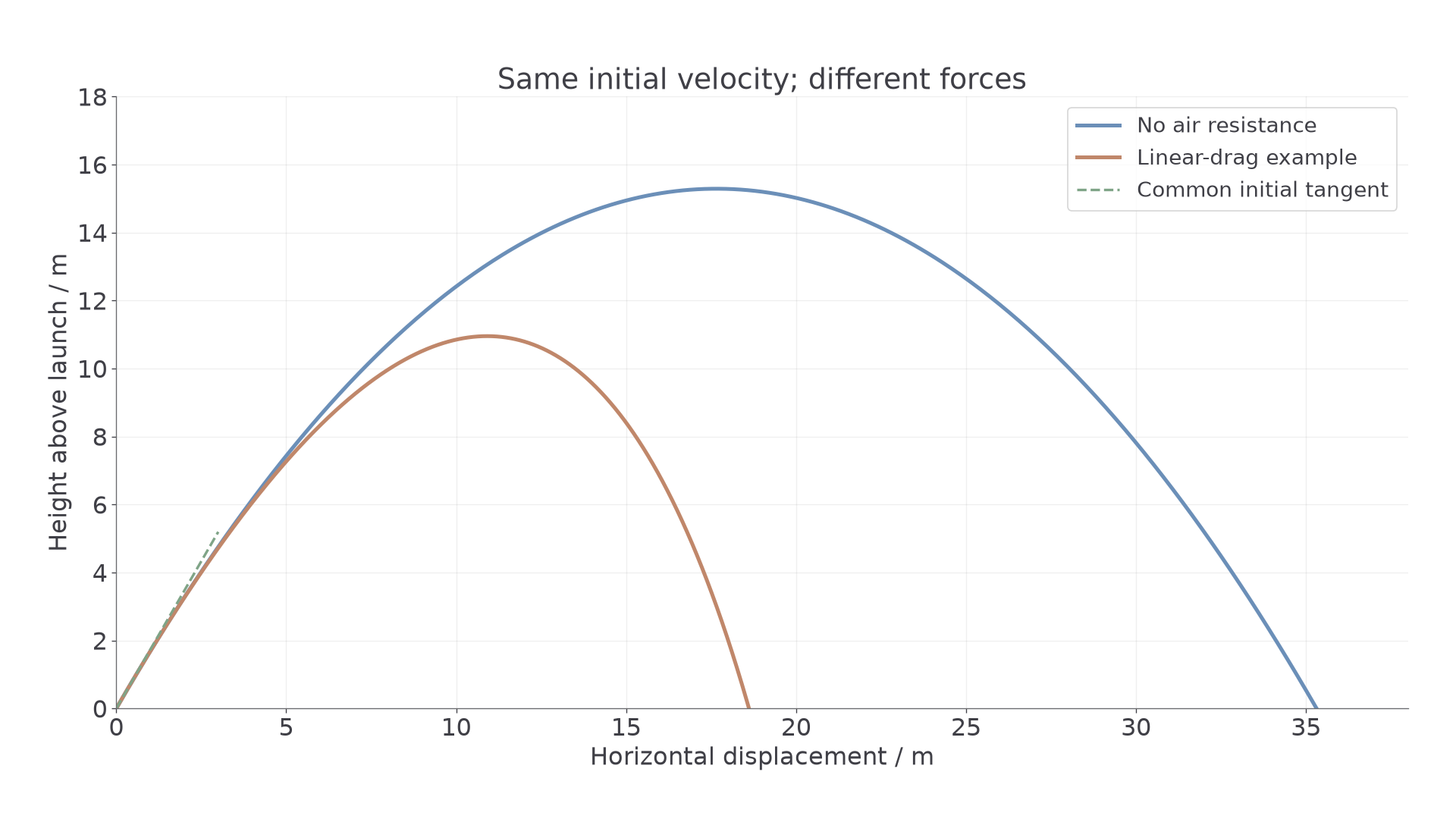
For otherwise identical upward launches landing at the same level, drag reduces the maximum height and range and makes the path asymmetric. The descent is steeper than the ascent at corresponding heights because horizontal speed has been lost. At the top, vertical velocity is zero but horizontal drag can still act. Vertical acceleration is not generally elsewhere, so do not use one constant vertical acceleration for the whole drag-affected path.
The graph is one explicit drag model, used to show qualitative effects; its mathematical drag law is not required here. Wind or lift changes the assumptions, so these comparisons are not universal statements about every flying object.