3.7.2.2 - Gravitational Field Strength
Gravitational field strength measures force per kilogram. Connect its vector definition to the inverse-square field outside a spherical planet, and decide when a uniform-field approximation is accurate enough.
Radial fields and the uniform-field approximation
A gravitational field line points along the force on a small test mass, not necessarily along the test mass’s velocity. Around an isolated spherically symmetric planet, the field is radial: inward towards the centre at every exterior point. Line separation increases outward, representing a weaker field.
[DIAGRAM: asset_name: 7.2.2 - Gravitational Field Strength - Diagram 1; asset_slug: 7.2.2 - Gravitational Field Strength - Diagram 1; recommended_method: retained_png; caption: Local uniform approximation and global radial field. Radial arrow lengths show direction only.; description: A small near-surface region can be treated as uniform; globally the field is radial. The radial arrows show direction only and are not drawn to a vector-magnitude scale.]
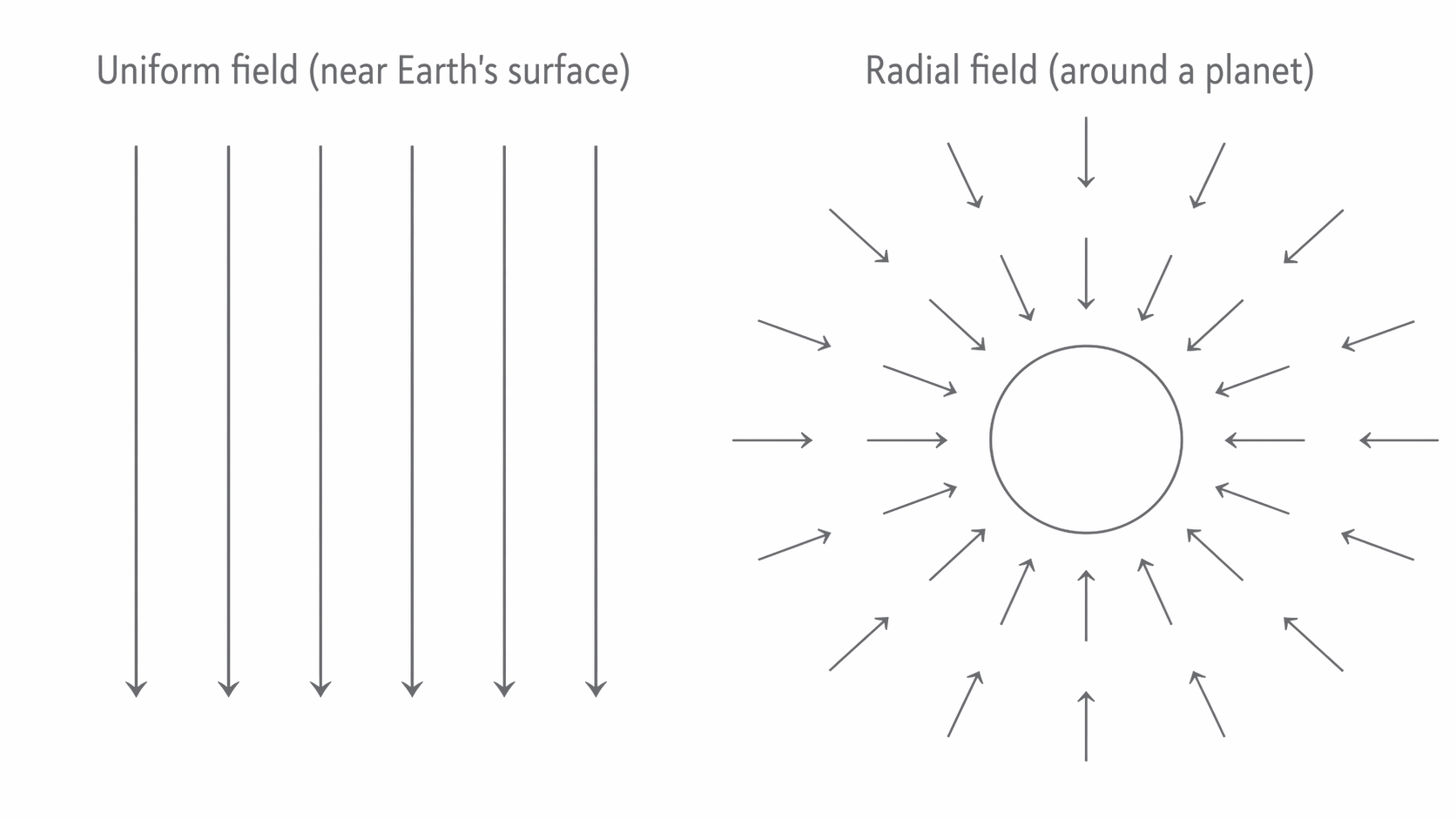
A uniform field has the same magnitude and direction throughout the region: its lines are parallel and equally spaced. Earth's field can be treated as uniform only over a region whose height and horizontal extent are small compared with Earth's radius. A small height change makes little difference to field strength; a small horizontal extent makes little difference to direction. Merely being at the same altitude does not give the same field direction on opposite sides of Earth.
For example, is only of Earth's radius of about . The inverse-square model predicts a fall in field strength of about over that height. This is negligible for many school calculations, although a sufficiently precise measurement can detect a change. “Uniform” is an approximation matched to the required accuracy.
Force per unit mass and free-fall acceleration
Gravitational field strength at a point is the gravitational force per unit mass on a small test mass placed there.
Definition of gravitational field strength
Its SI unit is . The test mass is small enough for its presence not to appreciably change the source arrangement. The field is a property of the sources and position, not of the chosen test mass.
At one point, a mass experiencing and a mass experiencing both measure . More mass means more force in the same field, not a stronger field.
If gravity is the only force, Newton’s second law gives . Consequently , and bodies released together have the same free-fall acceleration when air resistance is negligible. A resting supported object still has weight: its total acceleration is zero because its support force balances gravity.
Continue this lesson.
You’re previewing NovaLearn without an account. Create a free account to read the rest.
Create free account