3.10.5.2 - Image Detection and Enhancement
An X-ray image starts as a pattern of transmitted intensities. Follow how film, flat-panel detectors and image intensifiers turn that pattern into a visible image, and how a contrast medium changes the pattern before it reaches the detector.
Photographic detection and intensifying screens
Photographic film records exposure through changes in its silver-halide emulsion. Chemical development makes the latent image visible. More exposure produces a darker region of developed film, so strongly attenuating objects such as bone appear light. A digital display can imitate this convention but can also reverse its grey scale.
Film alone responds inefficiently to incident X-rays. An intensifying screen contains a phosphor which absorbs X-ray energy and emits many lower-energy visible photons by fluorescence. Film responds effectively to this light, so a useful image can be obtained with less X-ray exposure than with unaided film.
[DIAGRAM: asset_name: B.5.2 - Image Detection and Enhancement - Diagram 1; asset_slug: B.5.2 - Image Detection and Enhancement - Diagram 1; caption: Film receives visible light from intensifying screens on either side; description: Film receives visible light from intensifying screens on either side.]
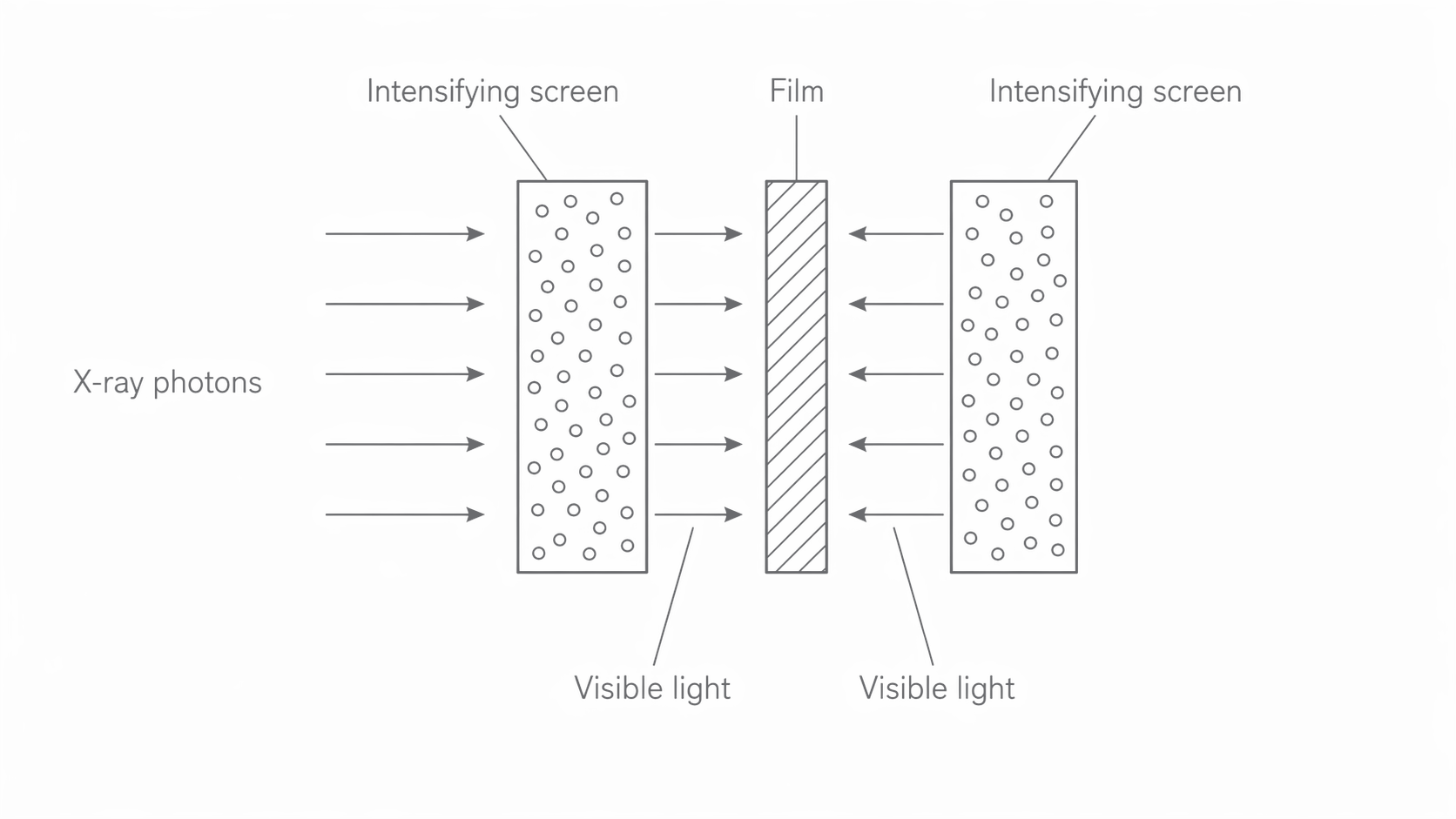
This is an exploded view: the screens and film are held in close contact in use. Some X-rays pass through the front screen and film to reach the rear screen. Light produced on either side exposes the film. One absorbed X-ray can supply the energy for many visible photons; the screen changes the form of the energy rather than creating energy.
Sensitivity and sharpness
The screen's greater sensitivity allows a shorter exposure at the same beam intensity, reducing dose and motion blur. However, visible light spreads sideways in a screen before reaching the film, which can blur fine detail. Good screen-film contact limits this spread. A thicker screen may absorb more X-rays but permit greater light spread: sensitivity and spatial resolution must be balanced.
Flat-panel detection and digital images
An indirect flat-panel detector replaces film and chemical development with a scintillator, photodiode pixels and electronic readout. AQA calls this a flat panel “FTP” detector; the transistor switches used for readout are commonly called TFTs.
- The scintillator absorbs X-rays and emits visible light. Greater absorbed X-ray energy gives greater total light output over the working range.
- Each photodiode pixel converts received light into an electrical charge. Different positions accumulate different charges, preserving the spatial pattern of transmitted intensity.
- Electronic scanning reads the pixel charges in a known order. The signals are digitised, and a computer assigns a displayed grey level to each location.
[DIAGRAM: asset_name: B.5.2 - Image Detection and Enhancement - Diagram 2; asset_slug: B.5.2 - Image Detection and Enhancement - Diagram 2; caption: Scintillator light is converted to pixel charge and electronically read out; description: Scintillator light is converted to pixel charge and electronically read out.]
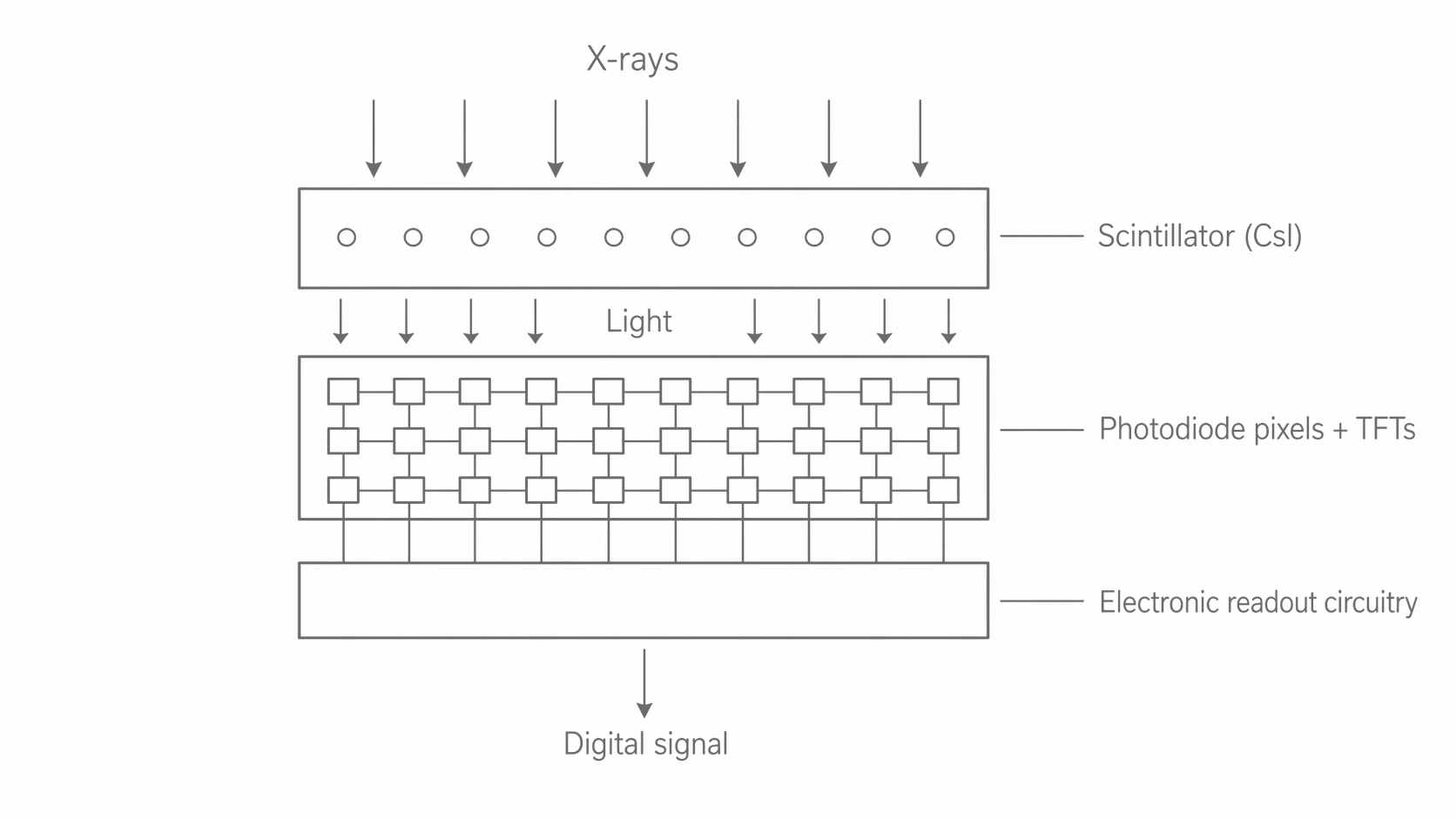
The electronic scan is a readout of the stationary detector's pixels, not a mechanical sweep of an X-ray tube across the patient. A camera using a CCD may record the visible output of another imaging system, but a CCD is not a replacement name for the photodiode-and-readout chain specified here.
What limits detail?
Smaller pixels sample smaller areas. For equal detector area and otherwise comparable systems, smaller pixels can distinguish finer features. Pixel number alone is not enough: a larger detector can have more pixels of the same size. Light spread within the scintillator, focal-spot blur, motion and noise also limit the final resolution. Enlarging an image on a screen does not recover detail that was never recorded.
Advantages over photographic detection
Electronic readout provides a rapid image without chemical processing. Digital files can be stored and transmitted, and brightness and contrast can be adjusted after acquisition. Efficient detection can allow a lower exposure for the required image quality. These are advantages rather than guarantees of a lower dose or finer spatial resolution than every film-screen system: exposure choice and detector design still matter. Processing can reveal recorded contrast, but cannot restore information lost to noise or blur.
Continue this lesson.
You’re previewing NovaLearn without an account. Create a free account to read the rest.
Create free account