3.11.1.6 - Work and Power
Torque transfers energy as an object turns. Derive work and power equations, distinguish motor work from kinetic-energy gain, and use free deceleration to estimate the resisting torque in a real machine.
Work done through an angle
A tangential force does work as its point of application moves around a circular arc.
At fixed radius , arc length is . For a constant tangential force,
Work by a constant torque
Use torque in , angular displacement in radians and work in joules.
The work is positive when torque and displacement have the same sense, negative when they oppose. One full revolution is , so a constant torque acting through five turns does .
[DIAGRAM: asset_name: C.1.6 - Work and Power - Diagram 1; asset_slug: C.1.6 - Work and Power - Diagram 1; caption: Work done is the signed area under a torque–angular-displacement graph; description: Work done is the signed area under a torque–angular-displacement graph.]
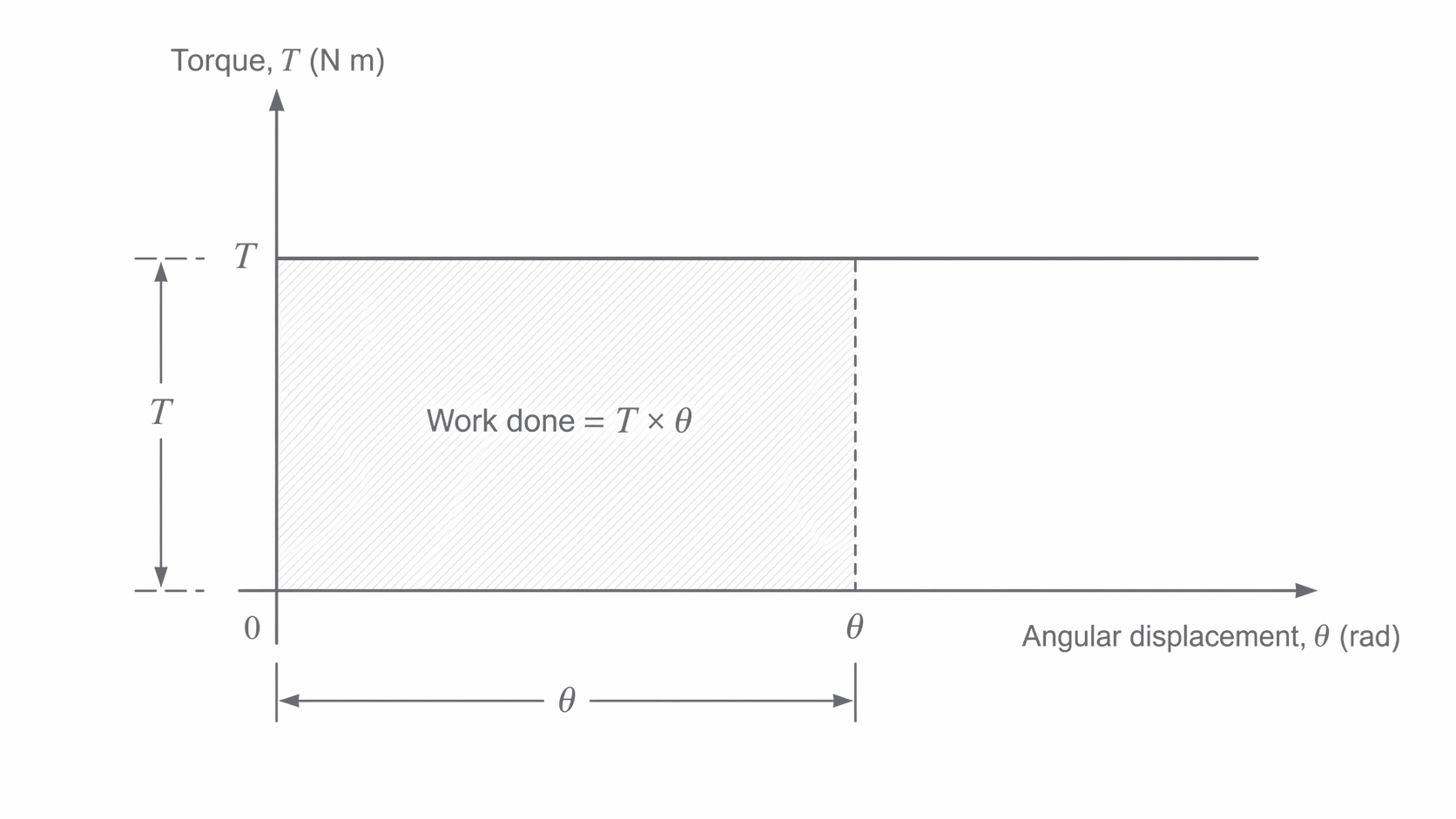
For a changing torque, find the area under its torque–angle graph. If torque increases linearly with angle from to , the area is . Linear variation with time does not by itself justify this torque–angle average.
The work of the net torque equals the change in rotational kinetic energy for fixed-axis rigid rotation. Work done by the motor alone can be greater because other torques do negative work.
Instantaneous and average power
Power is the rate of energy transfer, so a torque transfers energy faster when its point of application turns faster.
Over a small interval, . Dividing by and taking the instantaneous rate gives
Use watts, and . This relation applies to the torque and angular velocity at the same instant, even when they vary. Average power is total work divided by total time; for constant torque it is .
A shaft delivering at has , so . Using rpm directly would give the wrong torque.
At fixed mechanical power, : doubling speed halves torque. An ideal gear pair trades speed for torque while conserving power. Real gears have losses. A wheel can have zero net torque at steady speed while its shaft transmits a large non-zero power from motor to load.
Friction and energy transfer
Bearing friction and air resistance exert torques that oppose rotation and remove mechanical energy.
Take the positive sense to match the rotation. A frictional torque of magnitude does work through a positive angle. Its power on the wheel is negative; the positive rate of dissipation is . Energy goes mainly into internal energy of bearings and surroundings, with possible sound.
With no useful load and constant speed, the motor torque equals the resisting torque. Net torque is zero and kinetic energy stays constant, yet the motor must continuously replace the energy dissipated. Removing the motor torque makes the resistance the net torque and the wheel slows.
Lubrication and suitable bearings reduce unwanted losses. Brakes deliberately use friction to remove kinetic energy. The statement that friction dissipates energy here concerns sliding/bearing/drag losses; ideal static contact need not do negative work.
Continue this lesson.
You’re previewing NovaLearn without an account. Create a free account to read the rest.
Create free account