3.12.2.1 - Newton and Huygens
Newton and Huygens could both account for familiar reflection and refraction, yet their models made opposite predictions about light speed inside glass. Compare the physical reasoning and see why a successful prediction is a stronger test than the reputation of a scientist.
Newton's corpuscles
Newton pictured light as tiny, fast-moving corpuscles emitted by luminous objects. With no resultant force, a corpuscle continues in a straight line, so the model fitted rays and sharp shadows. These historical corpuscles are not Einstein's later photons.
Reflection as a change of velocity
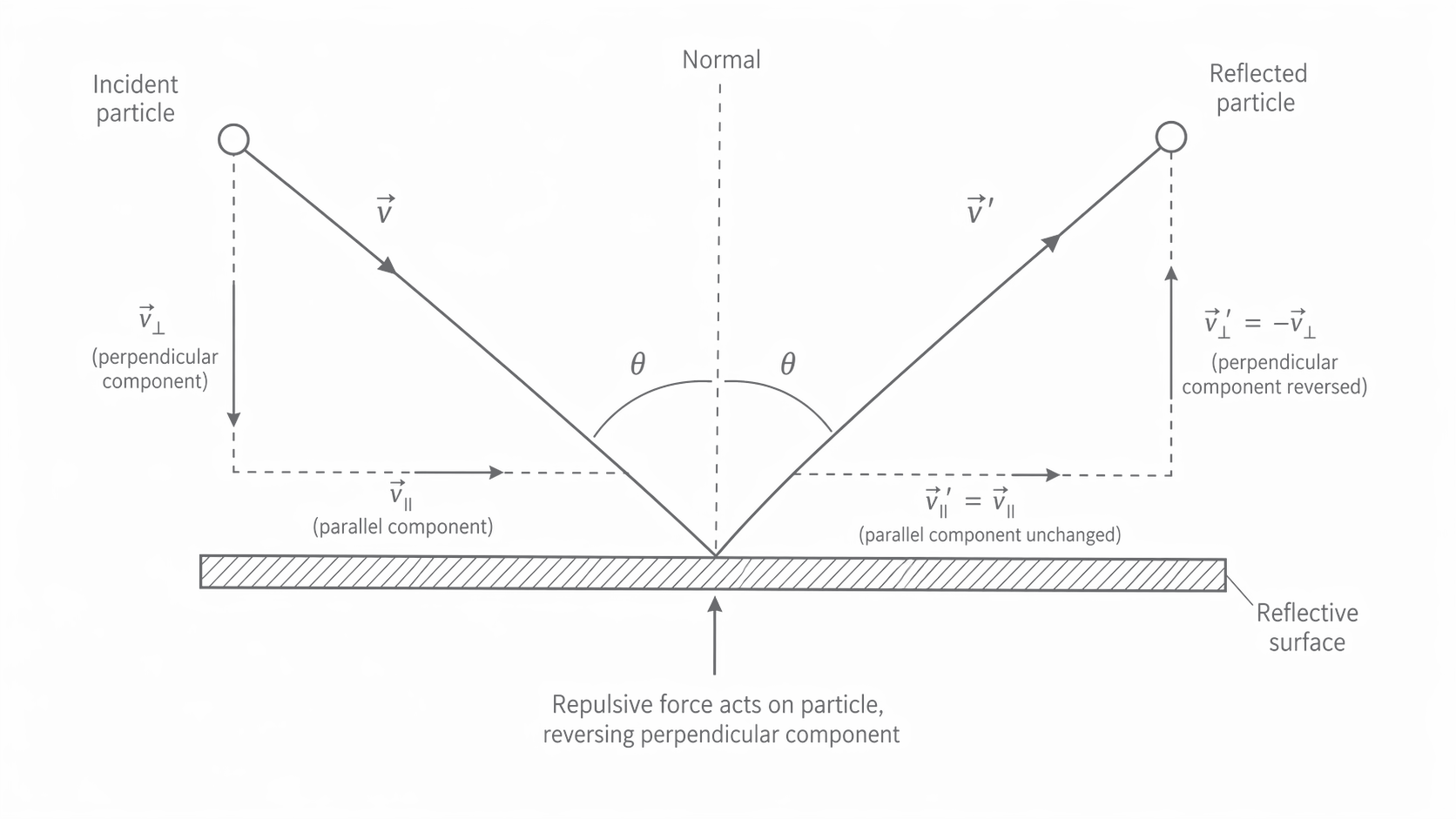
At a reflecting surface, Newton proposed a short-range repulsive force perpendicular to the surface. Resolve the incident velocity into components parallel and perpendicular to it. The parallel component is unchanged; the perpendicular component reverses with the same magnitude. The outgoing path is therefore symmetric about the normal: the angle of reflection equals the angle of incidence. Reversing both components would send the corpuscle back along its incident path and is not the general reflection rule.
[DIAGRAM: asset_name: D.2.1 - Newton's Corpuscular Theory of Light - Diagram 1; asset_slug: D.2.1 - Newton's Corpuscular Theory of Light - Diagram 1; caption: Newton’s model of reflection: the perpendicular velocity reverses; description: Scientific teaching diagram with geometry and labels checked against the owning explanation.]
Refraction as acceleration
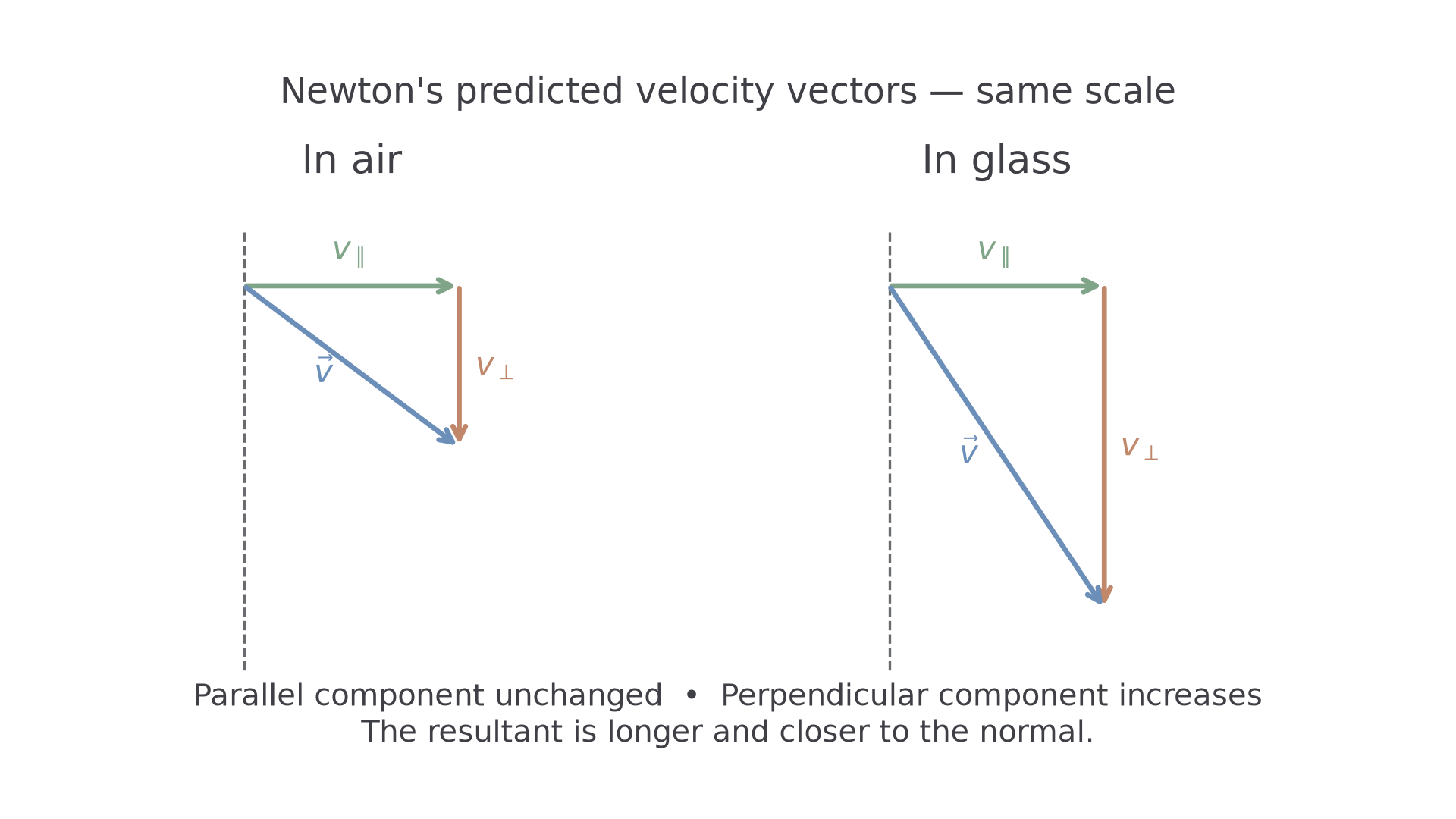
On entering an optically denser material such as glass, an attractive force towards that material was proposed instead. It increases the perpendicular component while leaving the parallel component unchanged. The resultant velocity lies closer to the normal and its magnitude is larger. Thus the model explains the direction of bending but predicts greater speed in glass than in air. A correct ray direction does not establish that the mechanism is correct.
[DIAGRAM: asset_name: D.2.1 - Newton's Corpuscular Theory of Light - Diagram 2; asset_slug: D.2.1 - Newton's Corpuscular Theory of Light - Diagram 2; caption: Newton’s refraction model predicts an increase in speed in glass; description: Scientific teaching diagram with geometry and labels checked against the owning explanation.]
Huygens' wavefronts
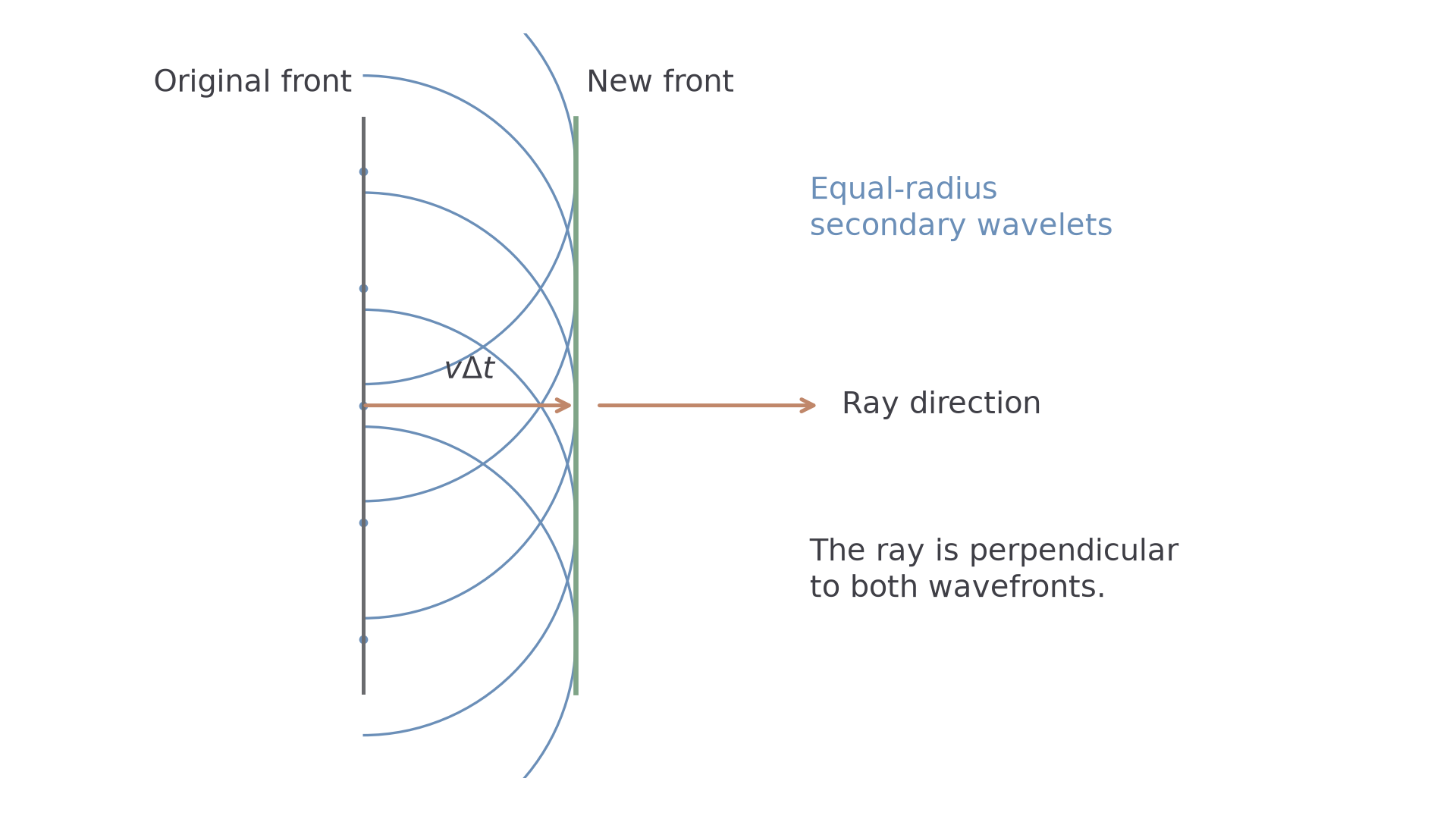
Huygens described light as a wave disturbance. A wavefront joins points at the same phase; a ray shows the direction of propagation and is perpendicular to the wavefront. Keeping these two lines distinct avoids a common refraction error.
In Huygens' construction, each point on a wavefront is treated as a source of secondary wavelets. In a uniform medium, their radius after a time is . The forward common tangent, or envelope, gives the new wavefront. The displacement between parallel wavefronts is measured perpendicular to them, along a ray.
[DIAGRAM: asset_name: D.2.1 - Newton's Corpuscular Theory of Light - Diagram 3; asset_slug: D.2.1 - Newton's Corpuscular Theory of Light - Diagram 3; caption: Equal-radius wavelets form a new wavefront perpendicular to the ray; description: Scientific teaching diagram with geometry and labels checked against the owning explanation.]
Continue this lesson.
You’re previewing NovaLearn without an account. Create a free account to read the rest.
Create free account