3.8.1.5 - Nuclear Radius
Nuclear radii are only a few femtometres. Use electrostatic energy to set an upper limit on nuclear size, interpret electron-diffraction evidence, and connect the measured radius law to the approximately constant density of nuclear matter.
Closest approach sets an upper limit
A positive alpha particle slows as it approaches a positive nucleus because electrostatic repulsion transfers kinetic energy to electric potential energy. For a head-on approach to a much heavier nucleus, the alpha particle momentarily stops at the turning point. This is a centre-to-centre separation, not the radius of either particle.
Take the electric potential energy to be zero at a very large separation. Neglect recoil of the target and assume the interaction is purely Coulombic outside the nucleus. Conservation of energy then gives
Head-on turning point
Here is the target proton number, is the elementary charge and is the minimum centre-to-centre separation. Use joules with SI charges and distances. This energy equation contains , whereas the Coulomb force equation contains .
[DIAGRAM: asset_name: 8.1.5 - Nuclear Radius - Diagram 1; asset_slug: 8.1.5 - Nuclear Radius - Diagram 1; caption: An alpha particle stops outside the nucleus at the head-on turning point; description: An alpha particle stops outside the nucleus at the head-on turning point.]
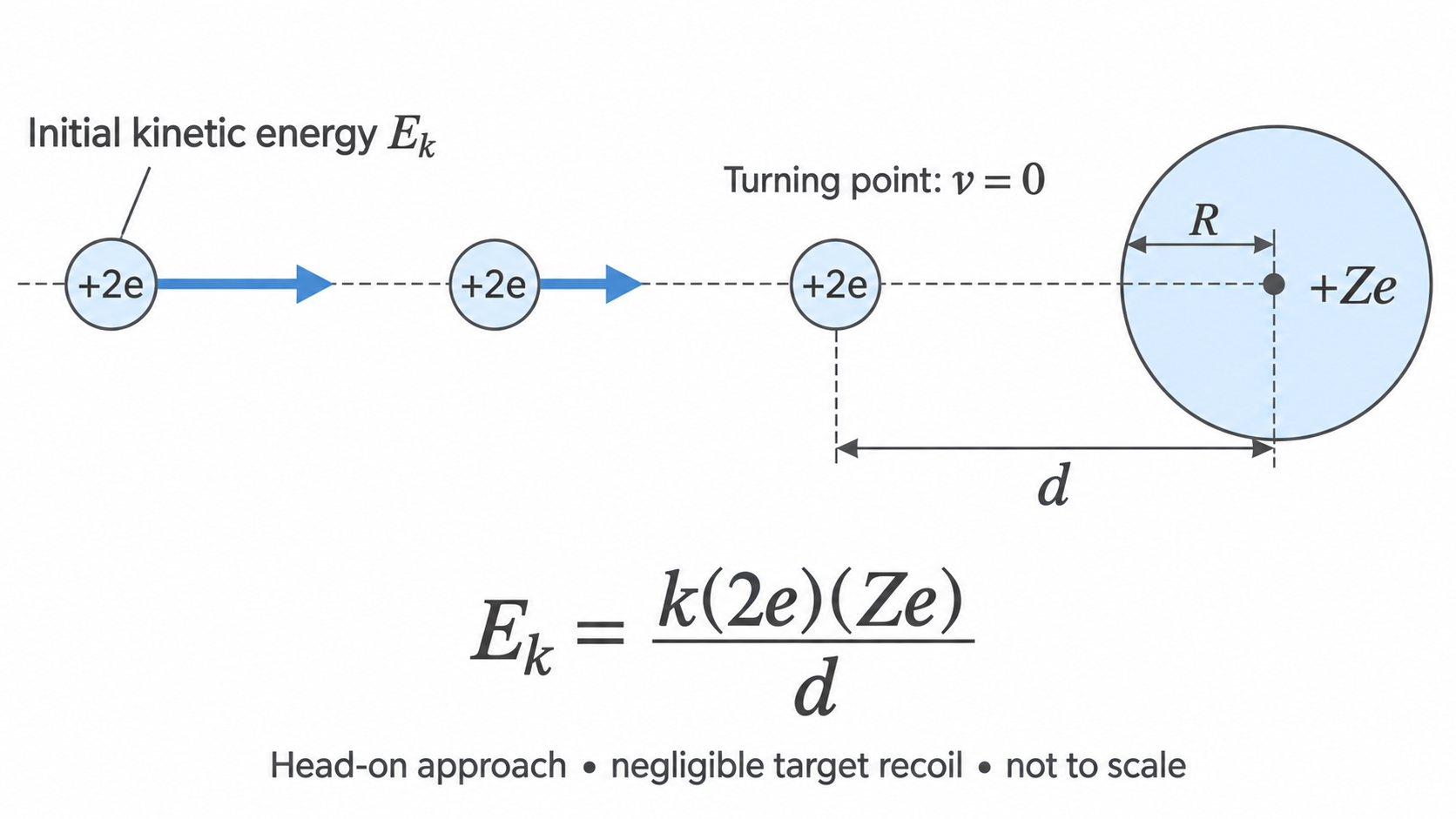
For an alpha particle with approaching a nucleus with , use , and . The energy is , so .
The alpha particle has turned around outside the nuclear surface: the result is an upper limit on nuclear radius. Doubling the incident energy halves this calculated distance, although the nucleus has not changed size. Recoil and the finite alpha-particle size also limit the estimate. At sufficiently close approach strong-interaction effects invalidate a purely Coulombic model; increasing energy indefinitely is not a way to measure the radius with this equation.
Electron diffraction probes nuclear charge
High-energy electrons have a de Broglie wavelength small enough to resolve a nucleus. A wavelength comparable with a few femtometres requires very large momentum. At hundreds of MeV the electron is highly relativistic, so and ; the non-relativistic expression is unsuitable at these energies.
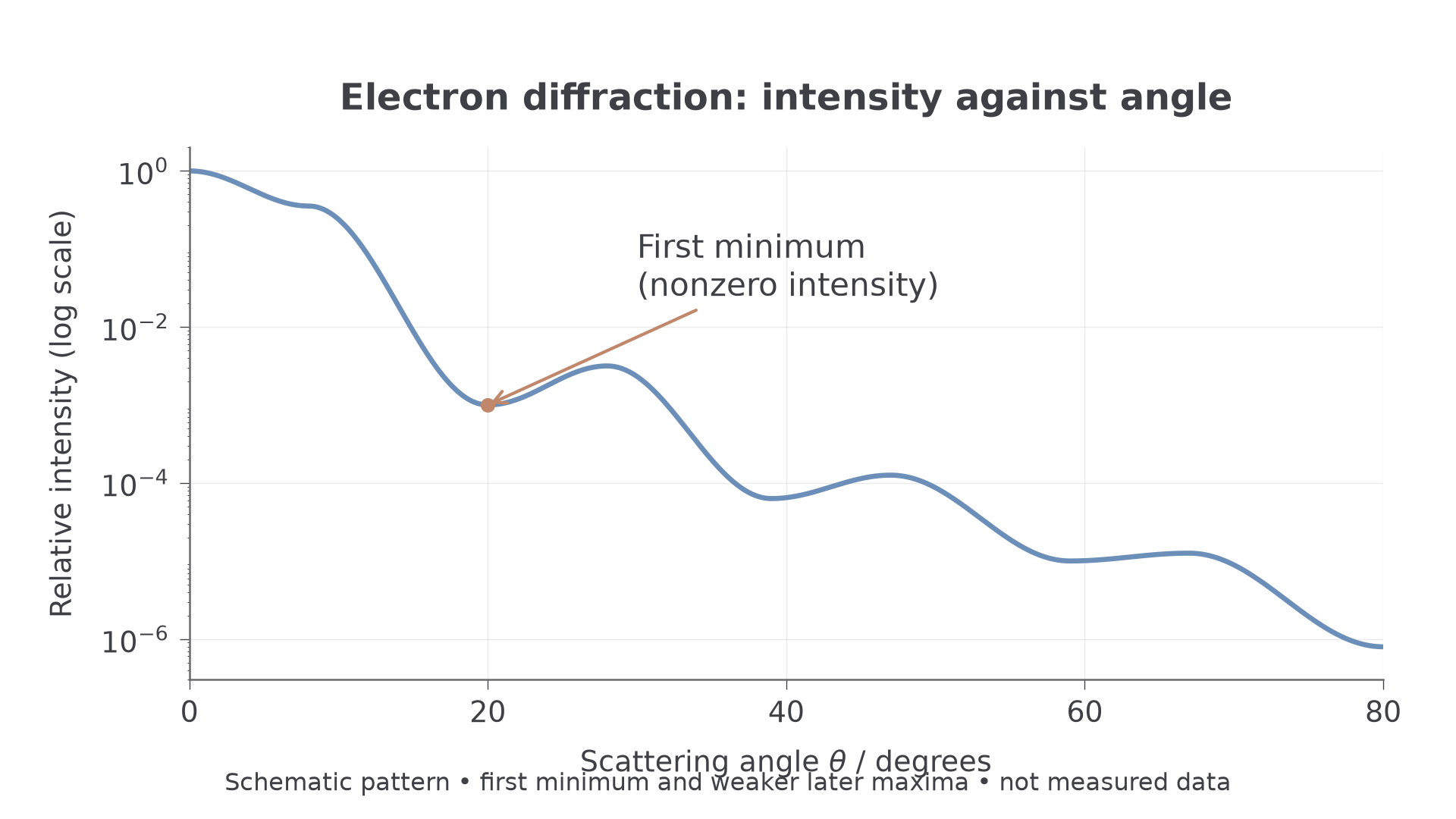
Electrons scatter electromagnetically from the nuclear charge distribution. They are leptons and do not experience the strong nuclear interaction. A detector measures scattered intensity at different angles to the incident beam. The finite size of the charge distribution produces a diffraction pattern: a large forward maximum, a first minimum at a nonzero angle, then weaker maxima and minima.
[DIAGRAM: asset_name: 8.1.5 - Nuclear Radius - Diagram 2; asset_slug: 8.1.5 - Nuclear Radius - Diagram 2; caption: Electron scattering has a forward maximum and a first diffraction minimum above zero; description: Electron scattering has a forward maximum and a first diffraction minimum above zero.]
Continue this lesson.
You’re previewing NovaLearn without an account. Create a free account to read the rest.
Create free account