3.4.1.5 - Newton's Laws of Motion
Choose a body or system, identify its external forces and use Newton's laws to explain its motion. Learn why interaction pairs differ from balanced forces, how to test the second law, and how the same force equations describe towing, lifts and terminal motion.
First and third laws
A moving object does not need a continuing resultant force to keep moving. Newton's first law states that an object remains at rest or moves with constant velocity unless a resultant force acts on it. Constant velocity means constant speed and direction. A car moving steadily on a straight road can have substantial driving and resistive forces: their vector sum is zero.
Newton's third law describes one interaction between two bodies. If A exerts a force on B, B simultaneously exerts an equal-magnitude force of the same interaction type in the opposite direction on A. This holds even when the bodies have different masses or accelerate. Their accelerations need not be equal because each depends on its own mass and resultant force.
For a book resting on a table, the upward force of the table on the book balances the Earth's downward gravitational force on the book. Both act on the book, so they are not a third-law pair. The partner of the table's contact force on the book is the book's contact force on the table. The partner of the book's weight is the book's gravitational force on the Earth.
[DIAGRAM: asset_name: 4.1.5 - Newton's Laws of Motion - Diagram 1; asset_slug: 4.1.5 - Newton's Laws of Motion - Diagram 1; caption: Balanced forces on one book and a contact pair on two bodies; description: Balanced forces on one book and a contact pair on two bodies.]
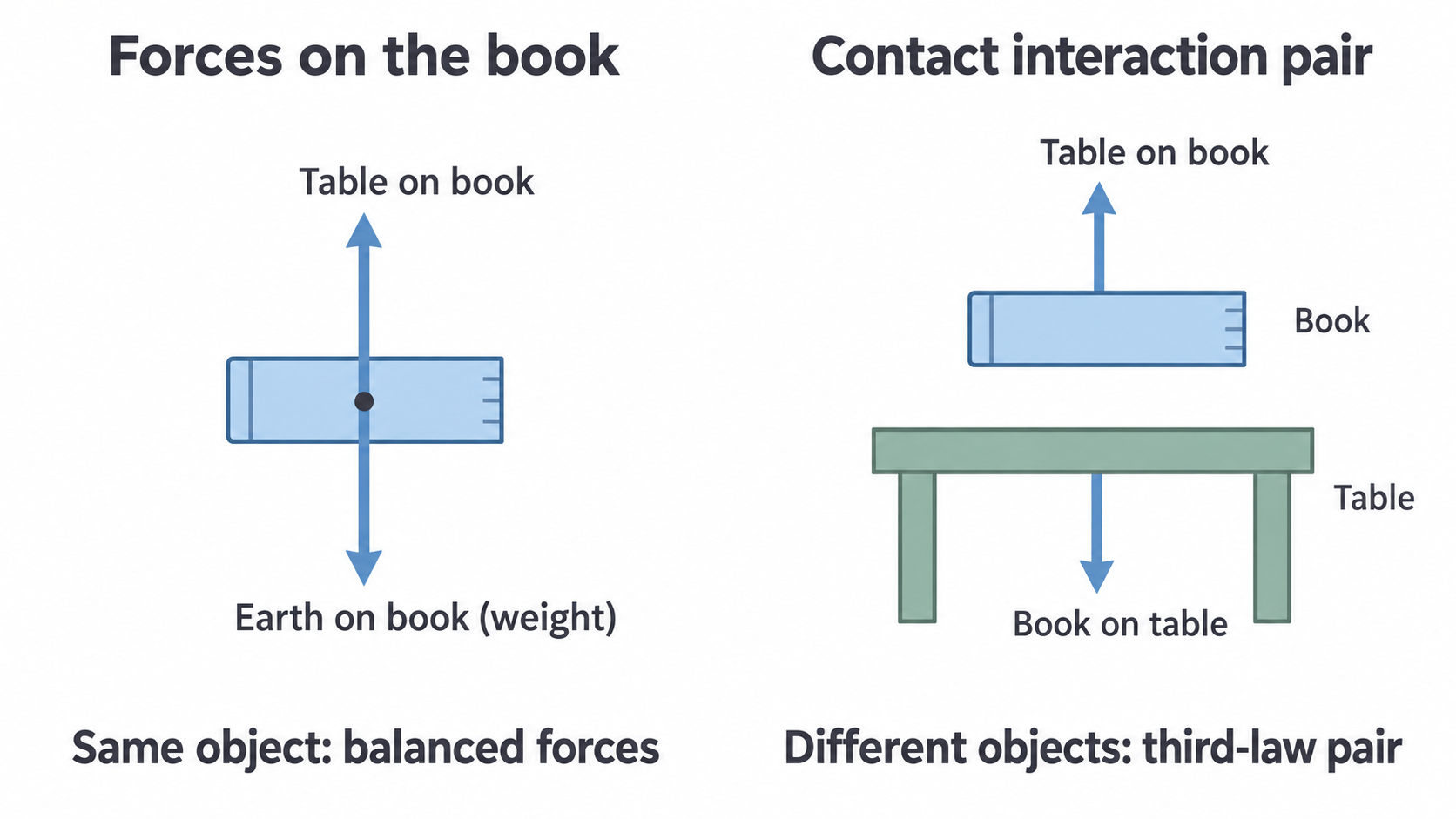
The right-hand objects are separated in the drawing only to identify the two contact forces. They are in contact in the real situation. Third-law forces cancel when adding forces on the combined system, but they do not cancel on either individual body. A swimmer pushes water backwards; the water's forward force acts on the swimmer. Resistance may balance it at steady speed or be smaller during forward acceleration.
Resultant force and experimental evidence
For a body of constant mass, Newton's second law connects its resultant external force with its acceleration:
The acceleration is in the direction of the resultant, not necessarily in the direction of velocity. A moving body slows when acceleration opposes velocity. One newton is the force that accelerates at . A force of opposed by on a trolley gives , not .
Testing the relationship
Use a trolley on a low-friction horizontal runway, pulled by a light string over a pulley by a hanging mass. Measure the mass of the whole accelerating system: trolley, added masses and hanger. A motion sensor records velocity against time; the gradient gives acceleration over a region before the hanger hits the floor. Alternatively, use two light gates to measure velocities and the time between them. Secure the pulley, catch falling masses and prevent the trolley running off the track.
To change the driving force while keeping total mass constant, transfer small masses from the trolley to the hanger. The driving external force on the combined system is the hanger's weight, , less resistance. The string tension is internal to that system and is not generally equal to , because the hanger accelerates. Minimise friction and pulley inertia or measure/account for their effects; otherwise calling the resultant is an approximation.
Plot acceleration against driving force. For negligible resistance and fixed total mass , : a straight line through the origin with gradient is expected. Constant resistance gives a negative acceleration-axis intercept if driving force rather than resultant force is plotted. Do not force a fitted line through the origin to conceal this.
[DIAGRAM: asset_name: 4.1.5 - Newton's Laws of Motion - Diagram 2; asset_slug: 4.1.5 - Newton's Laws of Motion - Diagram 2; caption: Acceleration against driving force for a constant total mass; description: Acceleration against driving force for a constant total mass.]
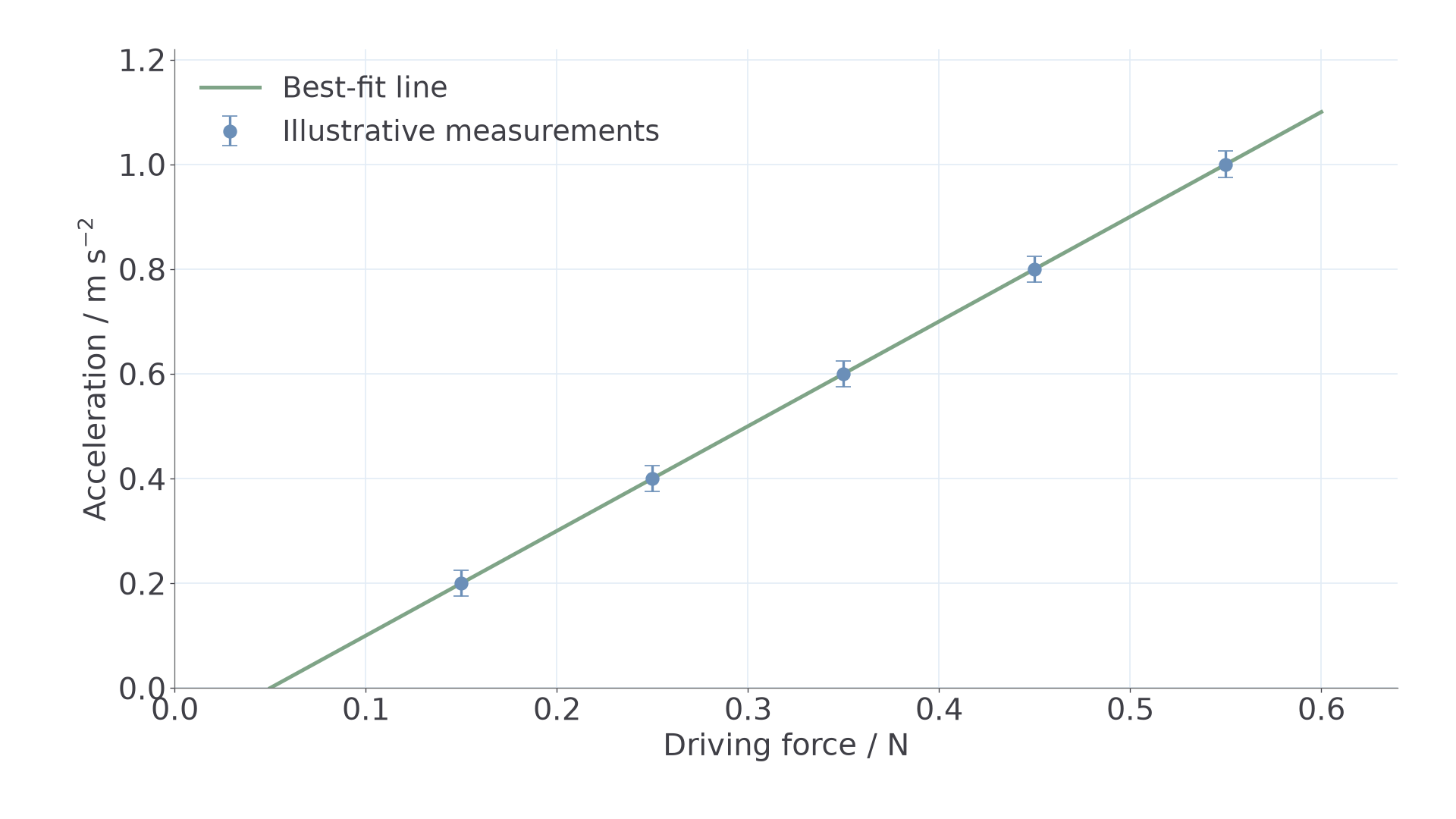
The illustrative data follow , with SI units. The gradient corresponds to ; the force-axis intercept estimates the approximately constant opposing force. Repeat each run, inspect scatter and use instrumental specifications as well as spread when estimating uncertainty. A small repeat range does not remove sensor calibration error. A best-fit gradient of and worst permissible gradient of give gradient uncertainty , or , approximately the fractional uncertainty in .
To test the mass relationship separately, keep driving force and resistance approximately constant and add mass to the trolley. Plot against ; direct proportionality is expected. Adding hanging masses without controlling total mass changes both variables and is not a clean test of .
Forces on a single body
A free-body diagram isolates one body and shows only forces acting on it. Identify the agent exerting each force: Earth supplies weight, a surface supplies normal contact and friction, a rope supplies tension. Do not add the force the chosen body exerts on another body, or add a separate arrow called “resultant” as if it were another interaction.
[DIAGRAM: asset_name: 4.1.5 - Newton's Laws of Motion - Diagram 3; asset_slug: 4.1.5 - Newton's Laws of Motion - Diagram 3; caption: Balanced forces on a car moving with constant velocity; description: Balanced forces on a car moving with constant velocity.]
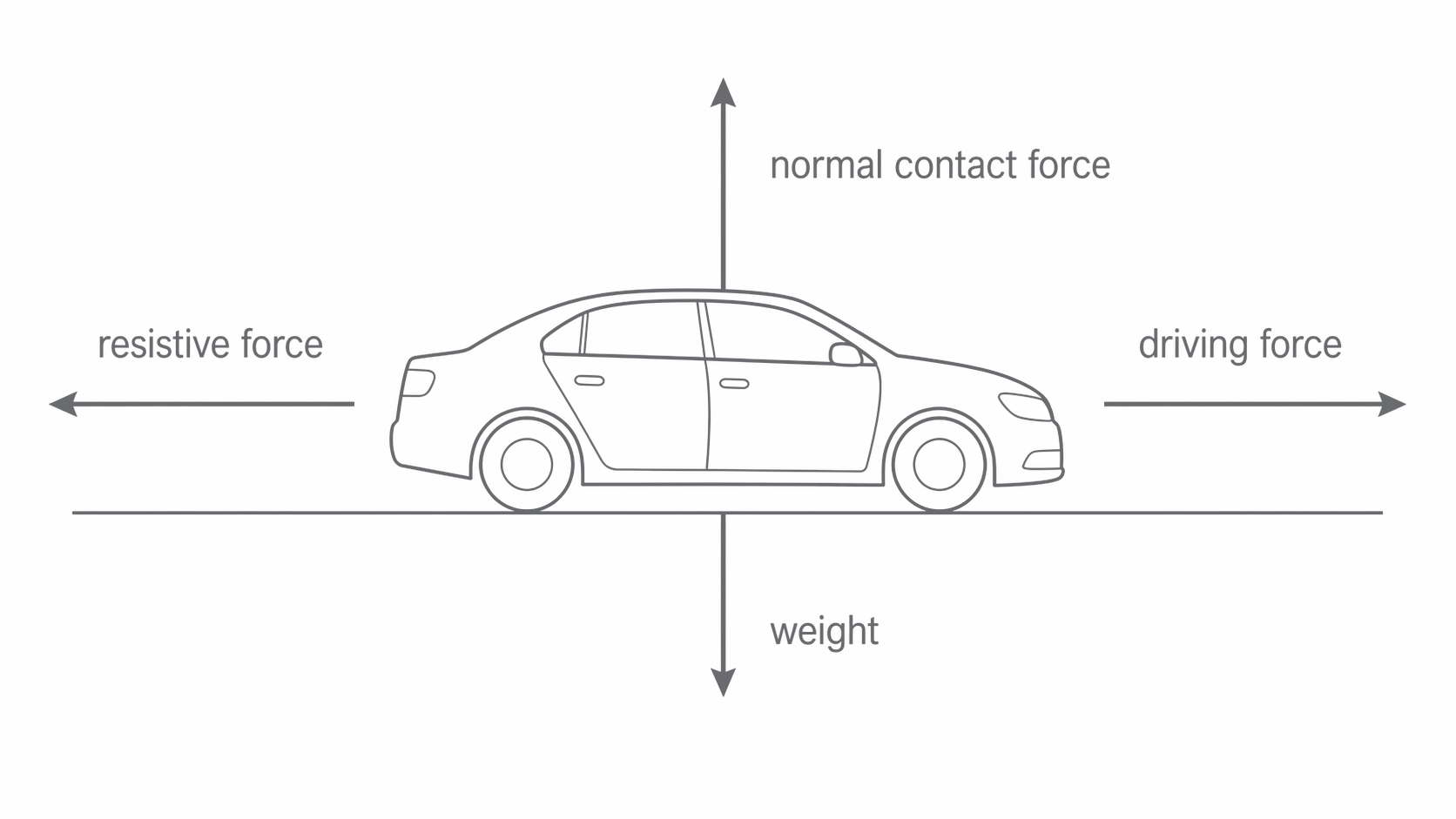
Here the upward normal contact force balances the weight, and the road's forward driving force balances resistance. The arrows describe straight-line constant velocity on a level road. Driving force on the car is supplied through tyre–road contact; the car pushes the road backwards. Friction opposes relative sliding or its tendency at contact, so friction is not always opposite to the body's overall motion.
Weight is , where is mass and near the Earth's surface. Mass measures inertia and does not change when the body moves to the Moon. Weight depends on gravitational field strength. The normal contact force is not automatically : on a slope or with an additional vertical pull, the perpendicular force equation must be used.
Resolving an angled pull
A box is pulled along a level floor by at above horizontal. Resistance is , and there is no vertical acceleration. Horizontal and vertical equations are separate:
Thus horizontally and . The pull reduces the normal force. A negative calculated normal force would mean the assumed continued contact is impossible, so the model would need changing.
Lifts, connected bodies and terminal motion
Choosing the system boundary determines which forces enter Newton's second law. For a person in a lift, take upward as positive: . The scales measure , not . A lift moving down but slowing has upward acceleration, so . A lift moving up but slowing has downward acceleration, so . Motion direction alone does not decide the scale reading.
For example, a person descending and slowing at has . The force pair between person and floor remains equal and opposite throughout.
A car towing a trailer
A car tows a trailer with a light horizontal tow bar. Driving force is ; resistances on car and trailer are and . For the combined system, tow-bar forces cancel internally:
For the trailer alone, , giving . Using all as the force on the trailer would put a force on the wrong body. A taut inextensible connection makes their accelerations equal in this model.
Approaching terminal speed
For a falling body, take downward as positive and neglect buoyancy: , where drag increases with speed. Initially drag is small and acceleration is close to . As speed rises, drag rises and the downward resultant decreases, so the speed still increases but more slowly. At terminal speed, , acceleration is zero and the body continues falling. Forces have not disappeared. If a parachute suddenly increases drag above weight, acceleration is upward while velocity is still downward; the body slows toward a lower terminal speed.