3.2.2.2 - Collisions of Electrons with Atoms
A collision can leave an atom excited or can remove an electron completely. Tracking where the incident electron’s energy goes explains the thresholds for these processes and the production of visible light in a fluorescent tube.
The electronvolt and acceleration
An electronvolt, , is a unit of energy: the energy gained by an electron accelerated through a potential difference of . It is convenient for atomic processes because their energies are small in joules.
Energy gained through a potential difference
Here is the magnitude of the accelerating potential difference and is the magnitude of electron charge.
Multiply by to convert eV to joules; divide by this factor to convert joules to eV. For example, , while . The unit eV is not a voltage, and it can describe the energy of a photon or any particle, not only an electron.
An electron accelerated from rest without energy losses through gains . If it collides with gas atoms while accelerating, some electrical energy becomes the atoms’ internal energy, so its final kinetic energy can be smaller than . For non-relativistic motion, gives the maximum speed reached with no losses:
Excitation by electron collision
Excitation raises an atom to a higher allowed energy state while its electrons remain bound. A colliding electron can transfer energy to a bound electron, but the atom’s internal energy can increase only by one of its allowed energy gaps.
If the first excitation energy is , a incident electron cannot cause that excitation. A incident electron can: it transfers and retains , neglecting recoil. The incident electron does not need exactly the excitation energy. It needs at least that energy; the amount transferred must equal an allowed gap. Below the first threshold, a collision may change the electron’s direction, but there is no internal excitation and its kinetic energy is approximately unchanged when atomic recoil is negligible.
[DIAGRAM: asset_name: 2.2.2 - Collisions of Electrons with Atoms - Diagram 2; asset_slug: 2.2.2 - Collisions of Electrons with Atoms - Diagram 2; recommended_method: retained_png; caption: Collision excitation raises the bound electron to a higher level. A later downward transition emits a photon. these are two different stages.; description: Collision excitation raises the bound electron to a higher level. A later downward transition emits a photon. these are two different stages.]
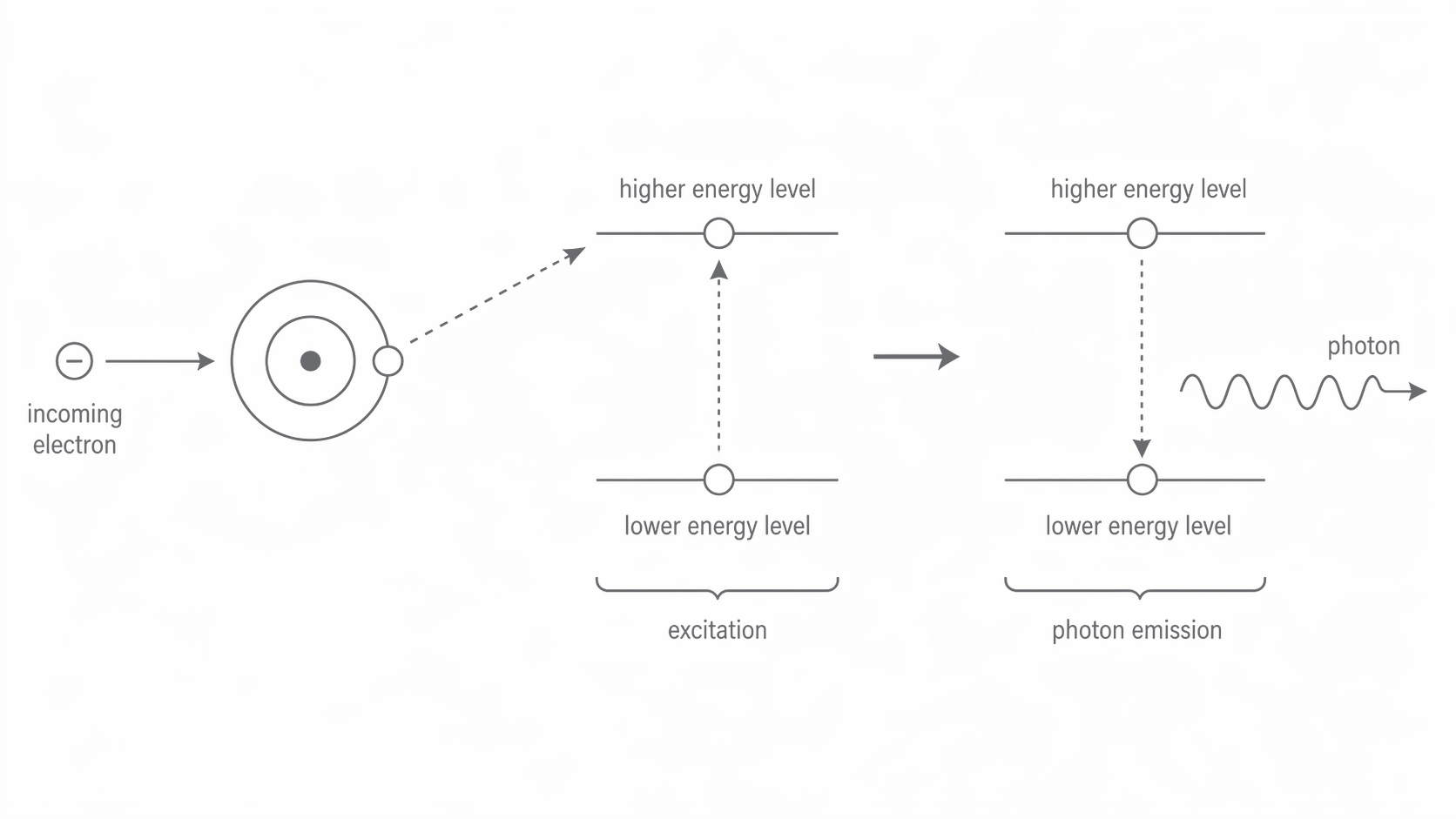
An excited atom can subsequently lose energy by emitting a photon as a bound electron moves to a lower level. The photon energy equals the difference between those levels. The incident free electron and the bound atomic electron have distinct roles: the first supplies collision energy, and the second changes the atom’s energy state.
Ionisation and the escape threshold
Ionisation by electron impact removes an electron completely from an atom. A neutral atom becomes a positive ion, and two free electrons can leave the collision: the original incident electron and the newly freed electron.
The ionisation energy is the minimum energy required to remove an electron completely from the specified initial atomic state. Unless stated otherwise, use a ground-state atom. If the incident kinetic energy is less than this threshold, it cannot cause ionisation. Having enough energy makes ionisation possible, but does not mean every collision ionises the atom.
For mercury with ground-state ionisation energy , an electron with can leave up to shared between the two outgoing electrons. It is wrong to assign automatically to each electron. Some energy can also go to the recoiling ion; neglect it only when the question permits that approximation.
Excitation leaves an electron bound and transfers an allowed discrete gap. Ionisation removes it and requires at least the binding energy; excess energy may be shared continuously as outgoing kinetic energy. Both are inelastic collisions when incident kinetic energy becomes internal energy. Total energy is conserved even though the particles’ total kinetic energy decreases.
Energy accounting in collisions
An energy balance must include every outgoing particle and the change in the atom. For excitation with negligible recoil,
For ionisation with negligible recoil,
All terms must use the same energy unit. Working in eV often makes the subtraction simpler; convert to joules only when needed.
Reconstructing an accelerating potential difference
An electron loses in an excitation and retains . Its initial kinetic energy was . If it started from rest and had no earlier losses, it was accelerated through .
Accounting for two outgoing electrons
Suppose an incident electron has , the ionisation energy is , and the scattered incident electron leaves with . The freed electron has
The balance checks: . A negative result would mean the assumed event or supplied interpretation is impossible.
From electron collisions to visible light
A fluorescent tube transfers electrical energy first to moving electrons, then to atoms, and finally to radiation. A potential difference accelerates free electrons through low-pressure mercury vapour. Collisions can ionise mercury atoms, creating more free electrons and helping sustain the discharge. Other inelastic collisions excite mercury atoms.
When an excited mercury atom later de-excites, it emits radiation, predominantly ultraviolet in the useful operating process. Excitation absorbs energy; de-excitation releases it. These must not be described as the same event. The ultraviolet photons reach the phosphor coating on the inside of the glass. The coating absorbs the UV, becomes excited and emits lower-energy visible photons as it relaxes. A suitable mixture of phosphors produces a broad range of visible wavelengths that appears white. Not all absorbed energy becomes visible radiation; some is transferred thermally.
[DIAGRAM: asset_name: 2.2.2 - Collisions of Electrons with Atoms - Diagram 3; asset_slug: 2.2.2 - Collisions of Electrons with Atoms - Diagram 3; recommended_method: retained_png; caption: The energy-transfer sequence separates upward excitation, downward de-excitation with UV emission, and absorption followed by visible emission in the phosphor coating.; description: The energy-transfer sequence separates upward excitation, downward de-excitation with UV emission, and absorption followed by visible emission in the phosphor coating.]
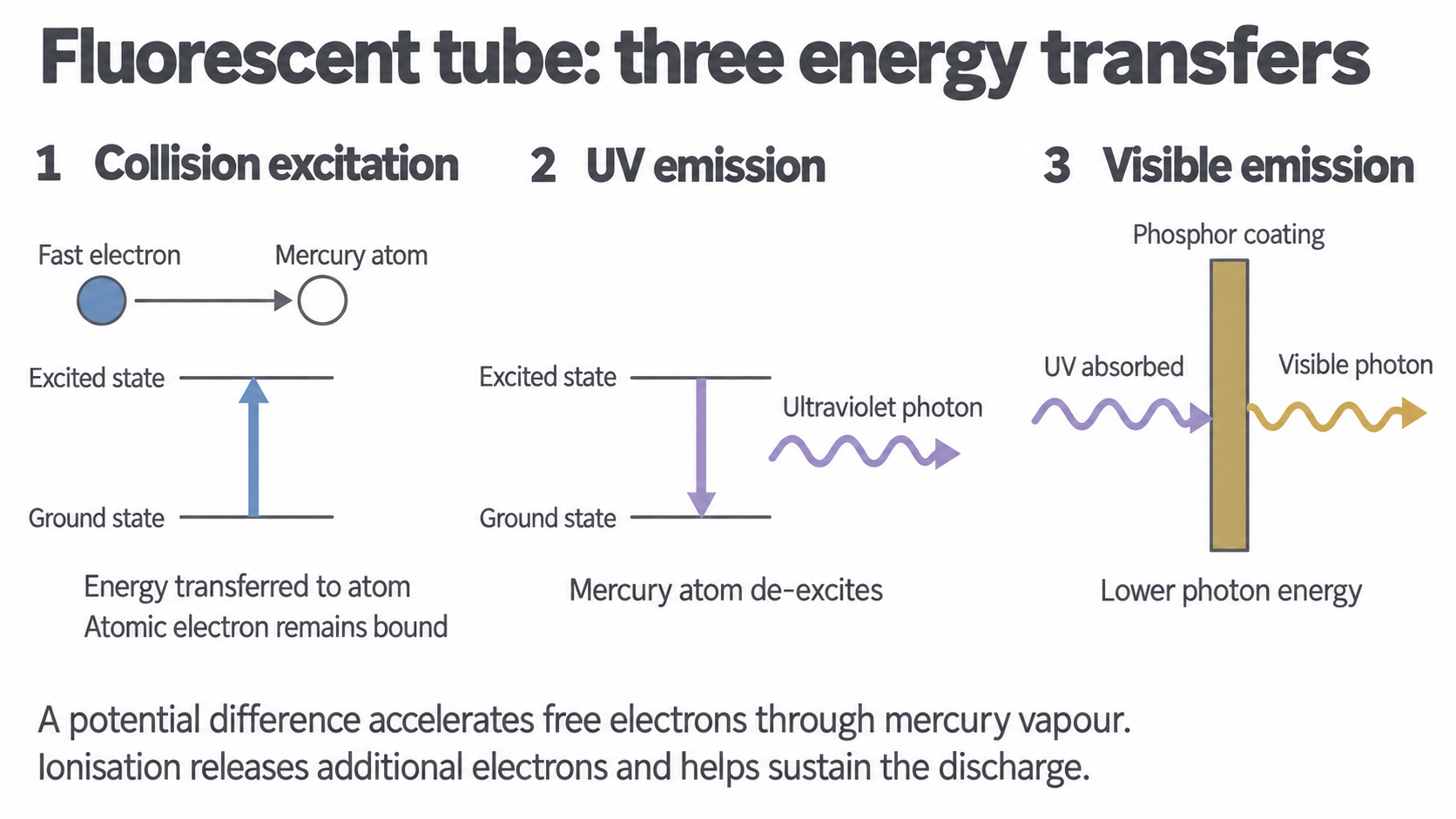
The electrons repeatedly lose kinetic energy in inelastic collisions, so their average speed is lower than the no-collision maximum calculated from . A gas that emits mainly UV can still be useful for visible lighting if a suitable coating absorbs that UV. A narrow visible emission line from the gas alone would not give white light.