3.6.1.3 - Simple Harmonic Systems
Derive the periods of spring and pendulum oscillators from their restoring forces, track their energy, and identify where ideal SHM stops being a useful approximation.
The mass-spring system
A spring oscillator is simple harmonic when its resultant restoring force is proportional to displacement from equilibrium. For a horizontal mass on a frictionless surface with one ideal spring, . Hence , so and
Here is the moving mass and is the effective stiffness in . For two springs pulling a mass back towards equilibrium, use their combined restoring stiffness, not one spring's stiffness unless it represents the combination.
For a vertical spring, displacement is measured downwards from the loaded equilibrium position, not from the spring's natural length. At equilibrium its extension satisfies . At an additional displacement ,
[DIAGRAM: asset_name: 6.1.3 - Simple Harmonic Systems - Diagram 1; asset_slug: 6.1.3 - Simple Harmonic Systems - Diagram 1; caption: Static extension and extra displacement have different reference levels; description: Static extension and extra displacement have different reference levels]
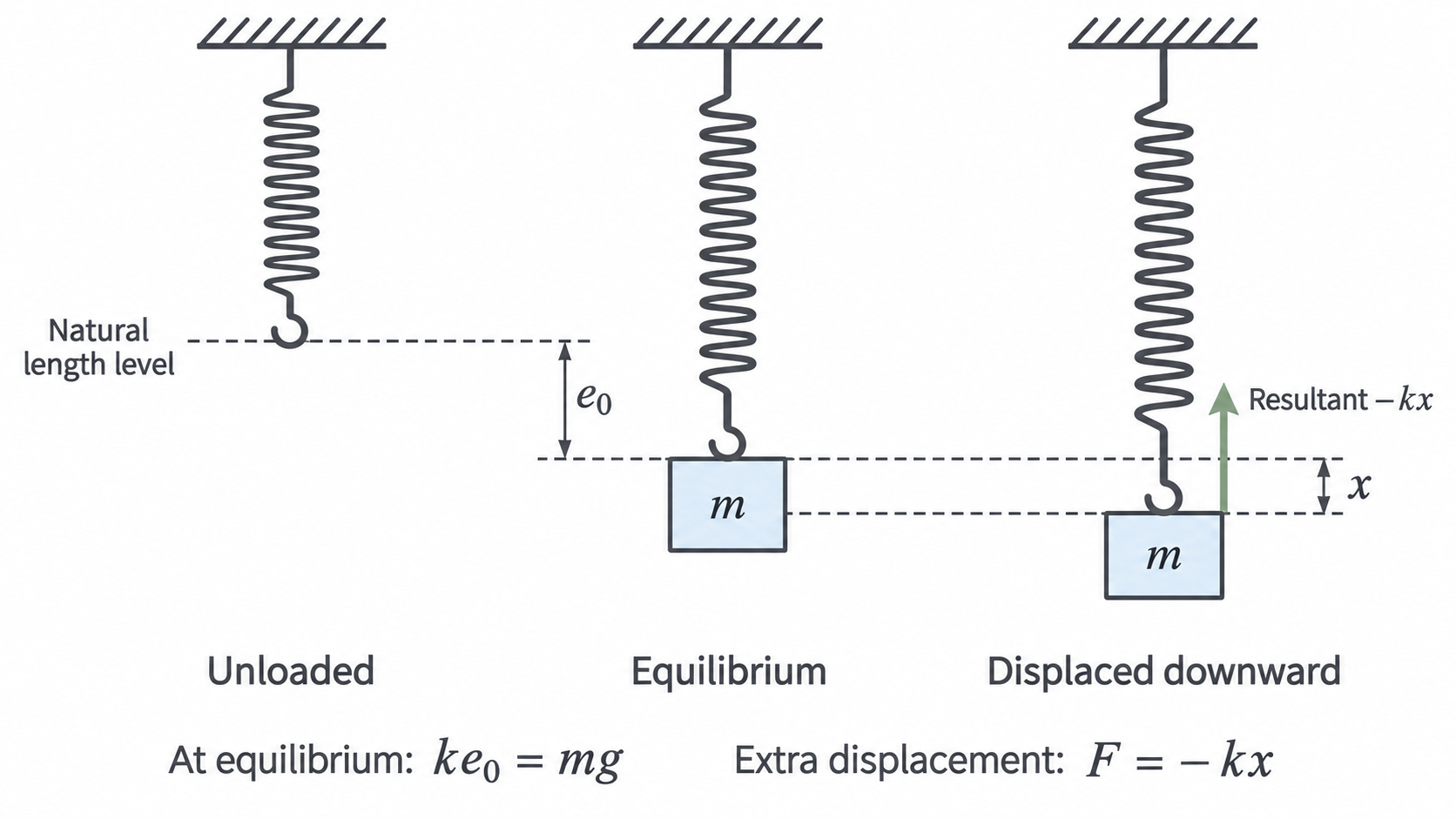
Gravity sets the equilibrium extension but cancels from the restoring equation. The same ideal mass and spring therefore have the same period on Earth and the Moon. Increasing mass fourfold doubles the period; increasing stiffness fourfold halves it.
Assume negligible spring mass, small damping, a rigid support and Hooke's law throughout the motion. A light vertical spring must remain taut; very large upward displacements can violate this assumption. If the spring has appreciable mass, its effective moving mass must also be considered.
A load extends a spring by . With , , and .
The simple pendulum
A simple pendulum models a compact bob on a light, inextensible string with a fixed pivot. Its length runs from the pivot to the bob's centre of mass. Let positive arc displacement correspond to a positive angle from vertical.
The real forces are tension along the string and weight vertically down. Only the tangential component of weight changes motion along the arc:
[DIAGRAM: asset_name: 6.1.3 - Simple Harmonic Systems - Diagram 2; asset_slug: 6.1.3 - Simple Harmonic Systems - Diagram 2; caption: Resolve weight along and perpendicular to the pendulum arc; description: Resolve weight along and perpendicular to the pendulum arc]
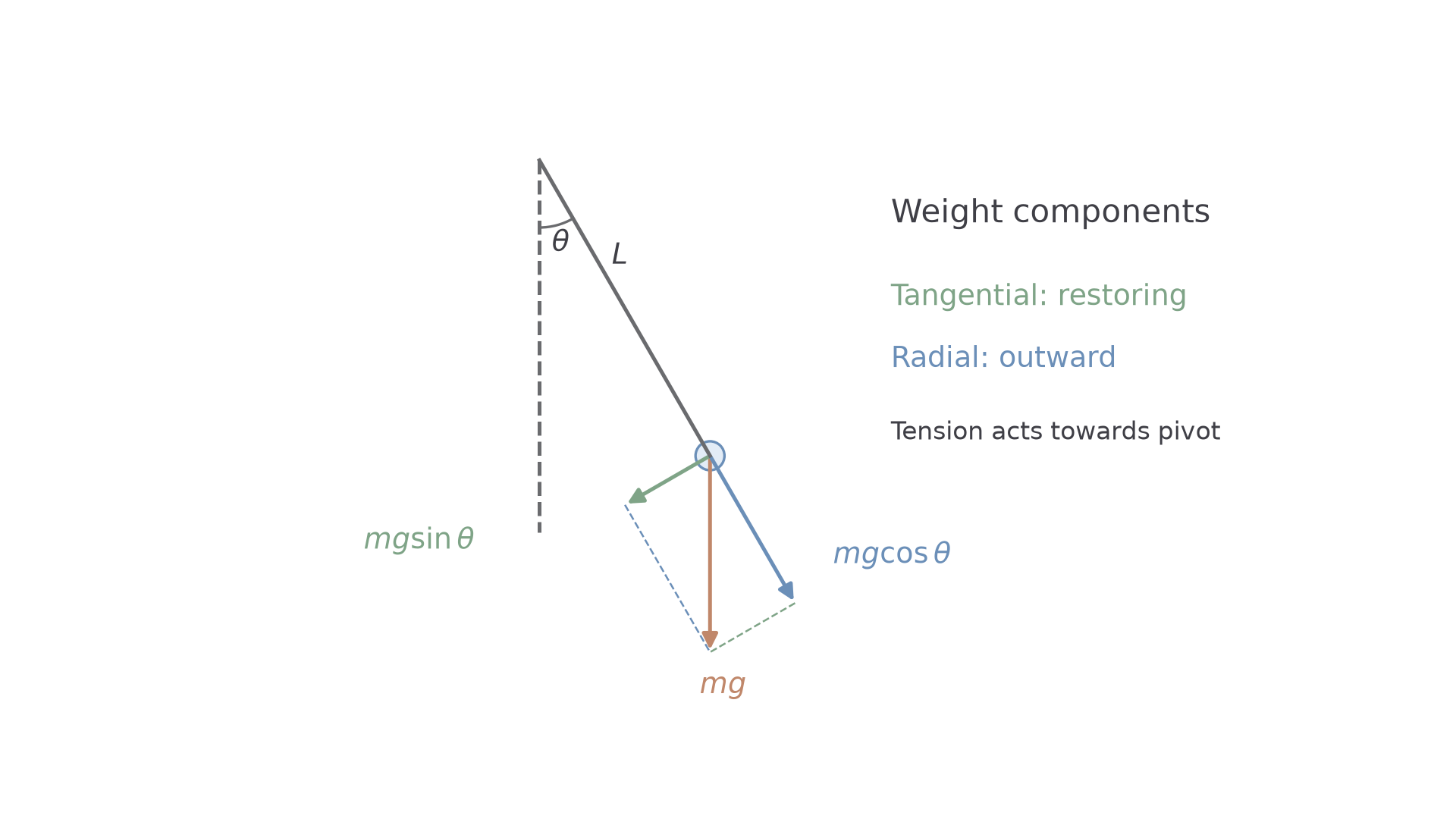
The outward radial weight component is ; tension acts inward. They are not generally equal because a moving bob also needs radial acceleration. The SHM equation here describes the tangential acceleration, not that radial component.
Arc length is exactly when is in radians. For small angles, , giving
Mass cancels because both the restoring force and inertia are proportional to bob mass. Increasing length fourfold doubles the period; weaker gravity makes the period longer. The period is approximately independent of amplitude only while the small-angle approximation is adequate. There is no sharp physical boundary at ; an initial angle of about is a useful practical choice. At larger amplitudes the actual period is longer than this approximation predicts.
For and , . At the equilibrium crossing, tangential acceleration is zero, but radial acceleration is not: the bob is turning along a curved path.
Energy against displacement and time
In an ideal oscillator, kinetic and potential energy exchange while total mechanical energy remains constant. For a horizontal spring whose extension is ,
For a vertical spring, is the change in the combined elastic-plus-gravitational potential energy measured from its minimum at equilibrium. It is not the spring's absolute elastic energy, which depends on . The same SHM energy pattern applies to a small-angle pendulum with and arc displacement in place of .
Continue this lesson.
You’re previewing NovaLearn without an account. Create a free account to read the rest.
Create free account