3.12.3.5 - Mass and Energy
Separate rest energy, total energy and kinetic energy before calculating at relativistic speeds. The AQA mass-versus-speed convention and Bertozzi's independent measurements show why increasing energy drives a massive particle towards, but never to, the vacuum speed of light.
Rest energy and changes of system mass
An object has rest energy even when its centre of mass is stationary. Its rest mass and rest energy are related by
Rest energy
This is an equivalence of mass and energy, with supplying the conversion between kilograms and joules. It does not mean that every object's entire rest energy is available in an ordinary reaction.
If a stationary system loses energy to its surroundings, its mass decreases by , where the deltas here denote positive amounts lost. Energy retained as internal energy contributes to the mass of the system. Heating therefore increases a sealed system's rest mass slightly; choosing a frame in which the whole system moves faster is a different change and does not change its rest mass.
For example, energy leaving a stationary system corresponds to a mass loss . The energy and mass account must refer to the same system. A reaction's lower product rest masses can supply kinetic energy and radiation; total energy is conserved when all products and transfers are included.
AQA's relativistic-mass convention
The current AQA specification uses , , and graphs of mass against speed. In this convention is relativistic mass, defined by total energy divided by ; is the rest mass.
Relativistic mass
For the same unchanged particle, rest mass is invariant: observers in relative motion agree on . They can disagree about its energy and therefore about in the AQA convention. Many modern accounts use “mass” to mean invariant rest mass throughout; the physical predictions are the same once the notation is identified. Do not say the particle's rest mass increases just because it is accelerated.
At , , so . At , : a proton with has in this convention, while its rest mass stays .
Avoid inserting this speed-dependent mass into as though all classical dynamics remained unchanged. The energy equations give the required conclusions directly.
Separating total and kinetic energy
The total energy of a free massive particle is its rest energy plus its kinetic energy, all referred to the same inertial frame.
Total and kinetic energy
The subtraction matters: at rest, , so but . Calling the kinetic energy would wrongly give a stationary particle a non-zero kinetic energy.
An electron at
With , . Here , giving
The classical calculation gives . Its percentage underestimate is measured relative to the relativistic value:
At , the approximation yields . Classical mechanics is an excellent low-speed approximation, with accuracy determined by the measurement precision required.
If kinetic energy is given instead, first find , then . For example, gives , not 3, and .
Reading the graphs and the speed limit
Graphs distinguish the non-zero rest energy from the zero kinetic energy at rest and show how rapidly relativistic effects grow near . Normalised axes allow the same curves to represent particles with different rest masses.
[DIAGRAM: asset_name: D.3.5 - Mass and Energy - Diagram 1; asset_slug: D.3.5 - Mass and Energy - Diagram 1; recommended_method: matplotlib; caption: Relativistic mass rises from its rest value as speed increases; description: Exact graph of relativistic mass ratio m/m0 against speed ratio v/c, with rest-mass reference at 1 and vertical asymptote at v/c=1.]
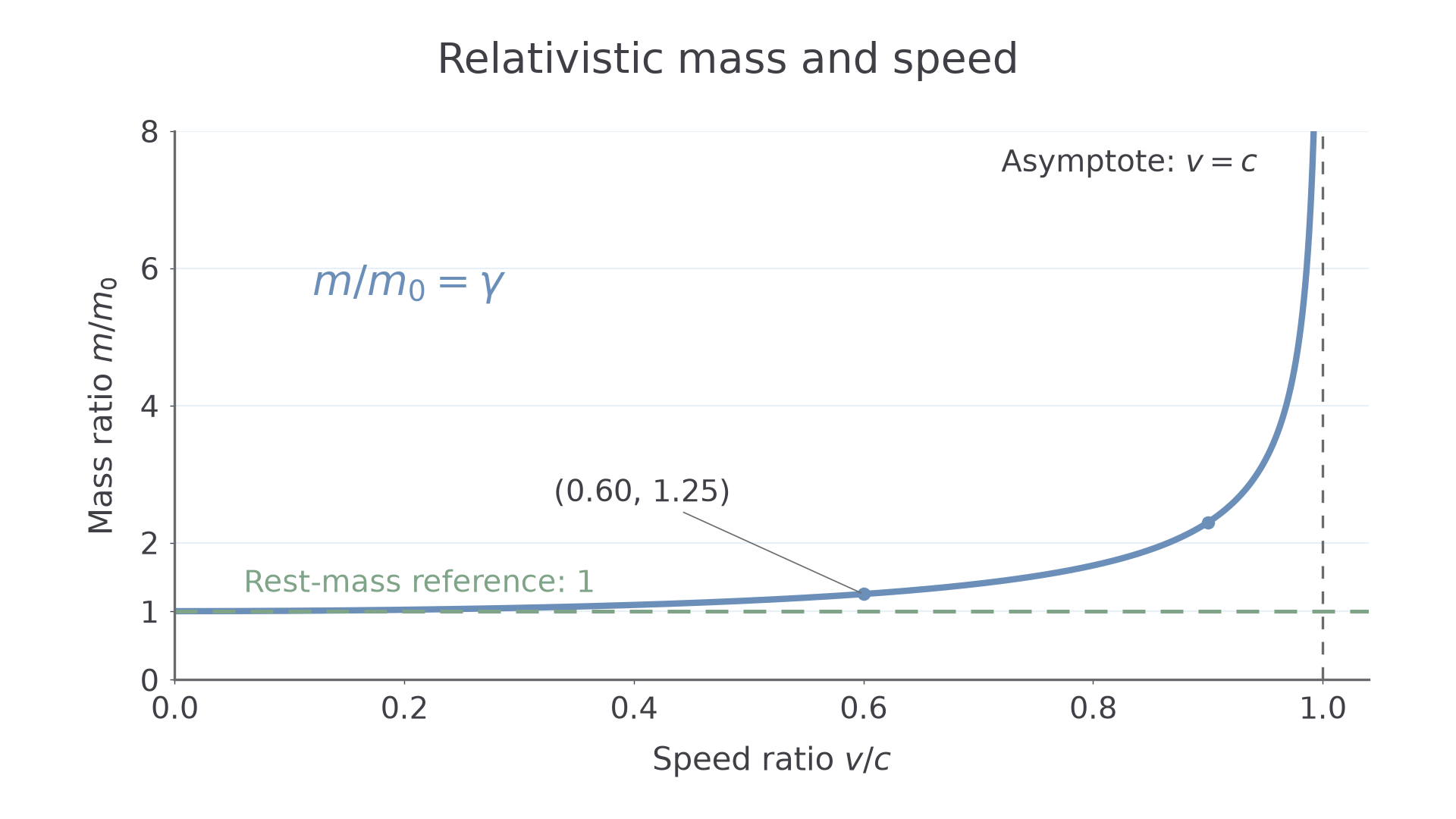
Relativistic mass starts at , remains close to 1 at low speed and rises without bound as . The dashed horizontal line represents invariant rest mass.
Continue this lesson.
You’re previewing NovaLearn without an account. Create a free account to read the rest.
Create free account