3.6.1.2 - Simple Harmonic Motion
Connect the restoring acceleration of an oscillator to its displacement, speed and time graphs. Keep signed quantities separate from magnitudes and use the starting position to choose the phase.
The restoring acceleration condition
An oscillation is repeated motion about an equilibrium position. It is simple harmonic only when acceleration is proportional to displacement from equilibrium and directed oppositely to it:
The constant is positive. Thus positive gives negative , and negative gives positive . Merely pointing towards equilibrium is insufficient: the magnitude must also grow in direct proportion to .
Displacement is signed. Amplitude is the greatest magnitude of displacement, so the turning points are and , a total separation . The period ends when both position and direction repeat; there are two equilibrium crossings per period. Frequency is , and angular frequency is , in .
[DIAGRAM: asset_name: 6.1.2 - Simple Harmonic Motion - Diagram 1; asset_slug: 6.1.2 - Simple Harmonic Motion - Diagram 1; caption: Displacement is measured from equilibrium and acceleration points back towards it; description: Displacement is measured from equilibrium and acceleration points back towards it]
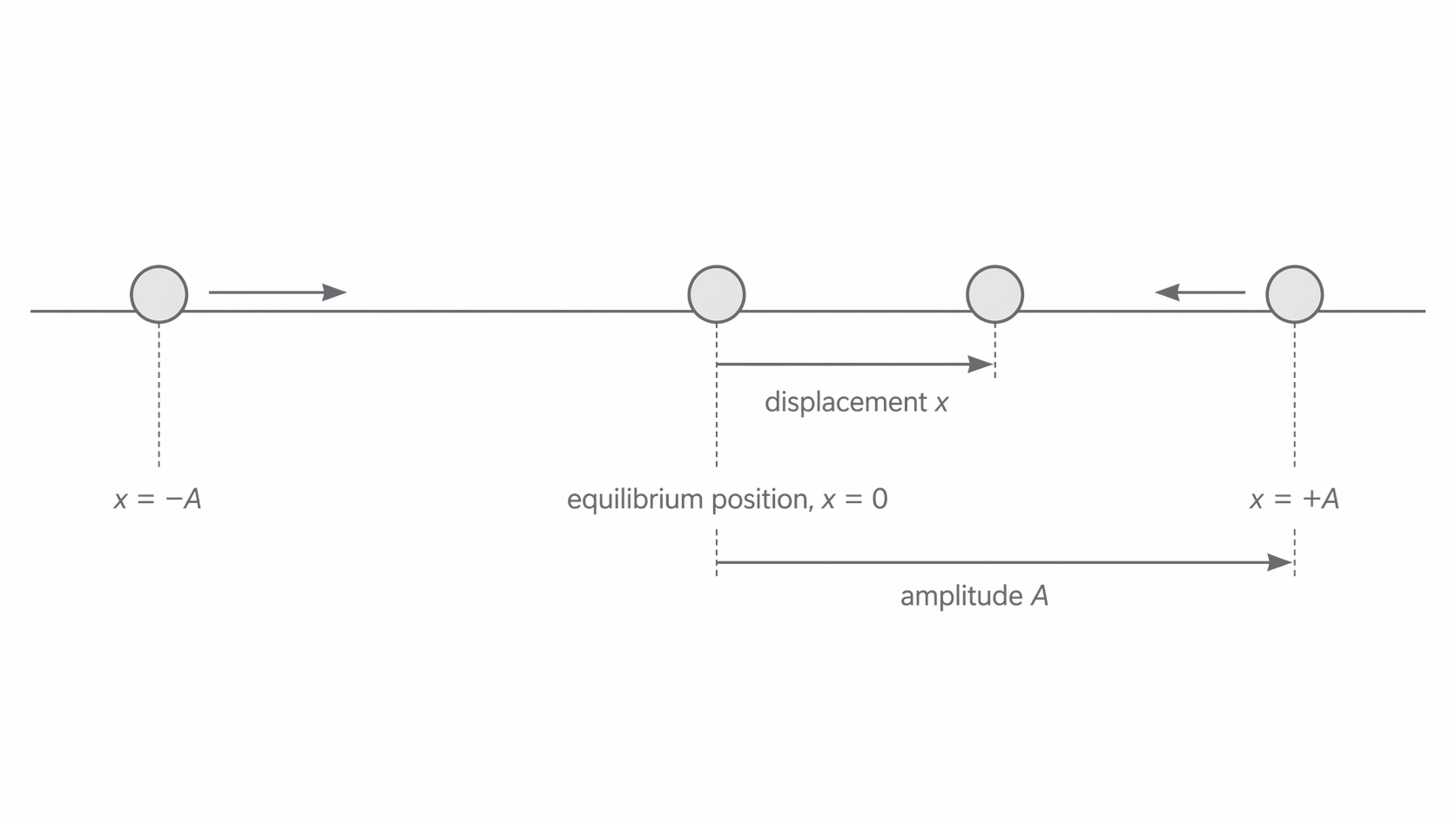
The restoring acceleration does not always oppose velocity. Returning towards equilibrium, the object speeds up because velocity and acceleration have the same sign. Moving away, it slows down because they have opposite signs. At equilibrium acceleration is zero but velocity need not be zero.
Displacement and the choice of time zero
Choose when an ideal oscillator is released from its positive turning point. Its displacement is
The phase is in radians. At , the displacement is respectively . If timing begins at equilibrium moving positively, use . A change of time origin changes phase, not the physical period or amplitude.
For , and release from , at the phase is . Hence . Use radian mode. The positive displacement does not mean positive velocity: the mass is already moving back towards equilibrium.
Speed and the sign of velocity
The speed is largest at equilibrium and zero at either turning point. The velocity-displacement relation is
Here denotes maximum speed. At any interior displacement the object passes twice per cycle, once in each direction; choose the sign from the stated motion. Do not infer it from the sign of .
An oscillator has , , and . Then , the speed is , and the maximum speed is . If it is returning towards equilibrium, its velocity is .
This equation relates velocity to position, not time. A velocity-position plot has two branches forming an ellipse; a speed-position plot has only the upper branch. Neither is the sinusoidal velocity-time curve.
Continue this lesson.
You’re previewing NovaLearn without an account. Create a free account to read the rest.
Create free account