RP07 - Simple Harmonic Motion
Investigate how period depends on pendulum length and hanging mass. Measure complete cycles, test the predicted relationships and use gradients with realistic uncertainties to determine g and spring stiffness.
Models to test experimentally
Required practical 7 investigates both a simple pendulum and a mass-spring system. The aim is to test a relationship across a range of settings, not simply obtain one plausible value.
For a vertical spring obeying Hooke's law, let be displacement below its loaded equilibrium. If the static extension is , then and . Thus acceleration is proportional and opposite to displacement and
For a pendulum with arc displacement , the tangential acceleration is at small angles in radians. Therefore
The spring period depends on total moving mass and stiffness; the small-angle pendulum period depends on pivot-to-centre length and gravity, not bob mass. Negligible spring mass, light damping, a fixed support and small pendulum angle are modelling assumptions to check, not guarantees from a straight graph.
A straight -versus- line compatible with the origin supports ; its gradient has units . For a spring use versus , giving in . In both cases the desired constant equals divided by the relevant gradient.
Set up and time complete oscillations
A rigid support and a well-defined equilibrium reference make repeated timings comparable. Clamp the stand securely, secure the bob and masses, keep feet clear and place a tray or cushion under the spring without obstructing its motion. Check the spring's safe loading range before adding masses.
Pendulum measurements
Clamp a light string between wooden blocks to define a fixed pivot. Measure length from that pivot to the centre of the bob, using a metre rule and a set square to transfer the centre level. Alternatively measure to the top of the bob and add its measured radius. Read the scale square-on; interpolate between graduations where appropriate. Record the length and the uncertainty from both endpoints and judgement of the centre.
[DIAGRAM: asset_name: RP 07 - Investigation into Simple Harmonic Motion - Diagram 1; asset_slug: RP 07 - Investigation into Simple Harmonic Motion - Diagram 1; caption: Pendulum length runs from the pivot to the bob centre; description: Pendulum length runs from the pivot to the bob centre]
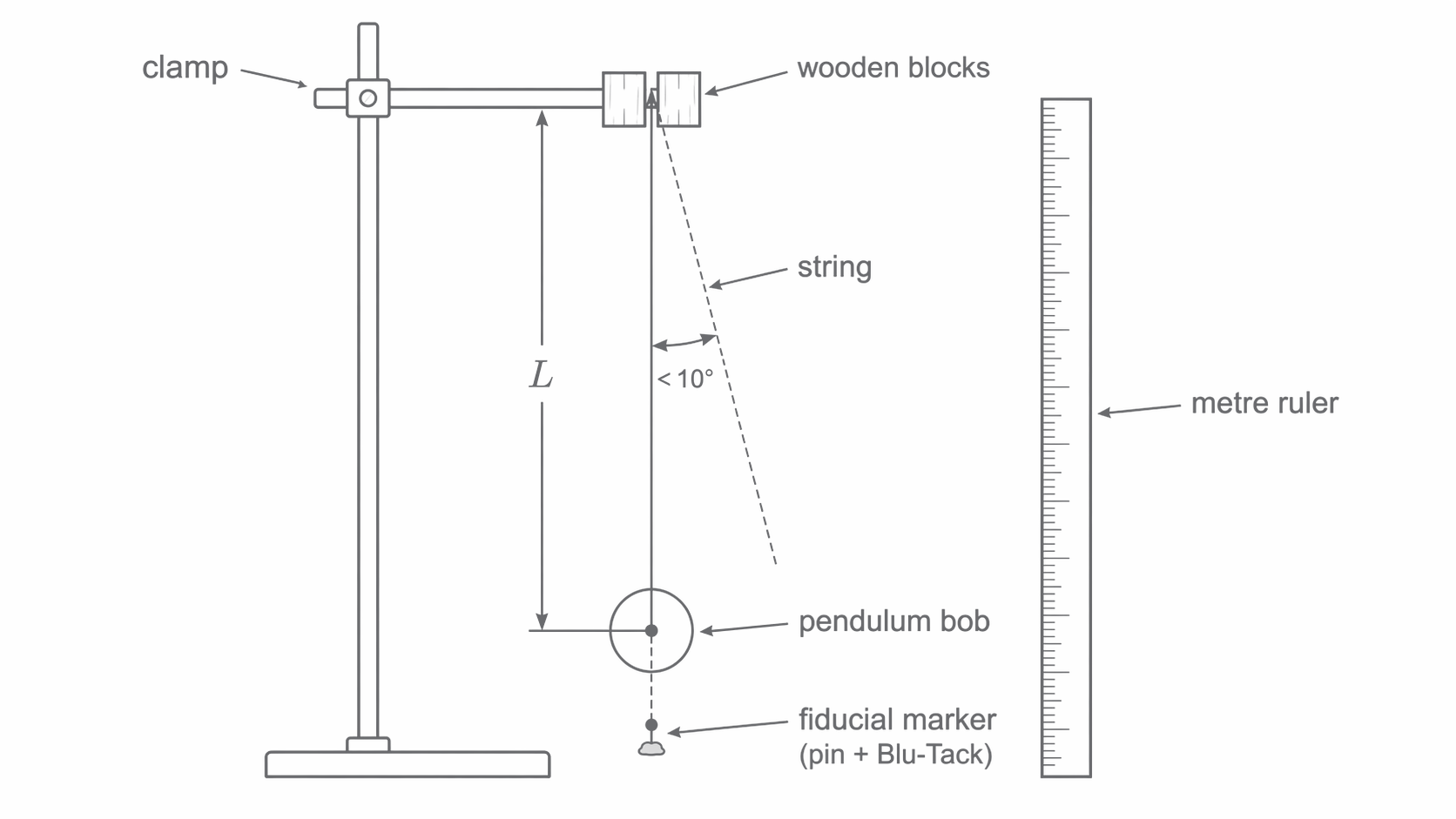
Set a small initial angle, for example about , using a protractor. Release without pushing and check the swing stays in one vertical plane. Use a fixed fiducial marker just below equilibrium, clear of the bob's path. The fast equilibrium crossing gives a sharper timing event than the turning point. Count zero at the first crossing, then count ten complete cycles, always using crossings in the same direction. Repeat the total time three times, calculate the mean and divide by ten. Record raw repeats before averaging.
Change length over a useful range, for example seven settings from to , while keeping the bob and small initial angle consistent. A preliminary run checks that the longest pendulum fits safely and the shortest period can be timed adequately.
Spring measurements
Use a balance to check the total hanging mass, including the hanger. Allow the spring to settle, place a fiducial marker alongside the hanger at equilibrium, pull down a few centimetres and release without sideways motion. Time ten complete vertical cycles in the same direction and repeat. Add known masses within the linear range and move the marker to the new equilibrium each time.
[DIAGRAM: asset_name: RP 07 - Investigation into Simple Harmonic Motion - Diagram 2; asset_slug: RP 07 - Investigation into Simple Harmonic Motion - Diagram 2; caption: Spring apparatus with an equilibrium timing marker clear of the moving hanger; description: Spring apparatus with an equilibrium timing marker clear of the moving hanger]
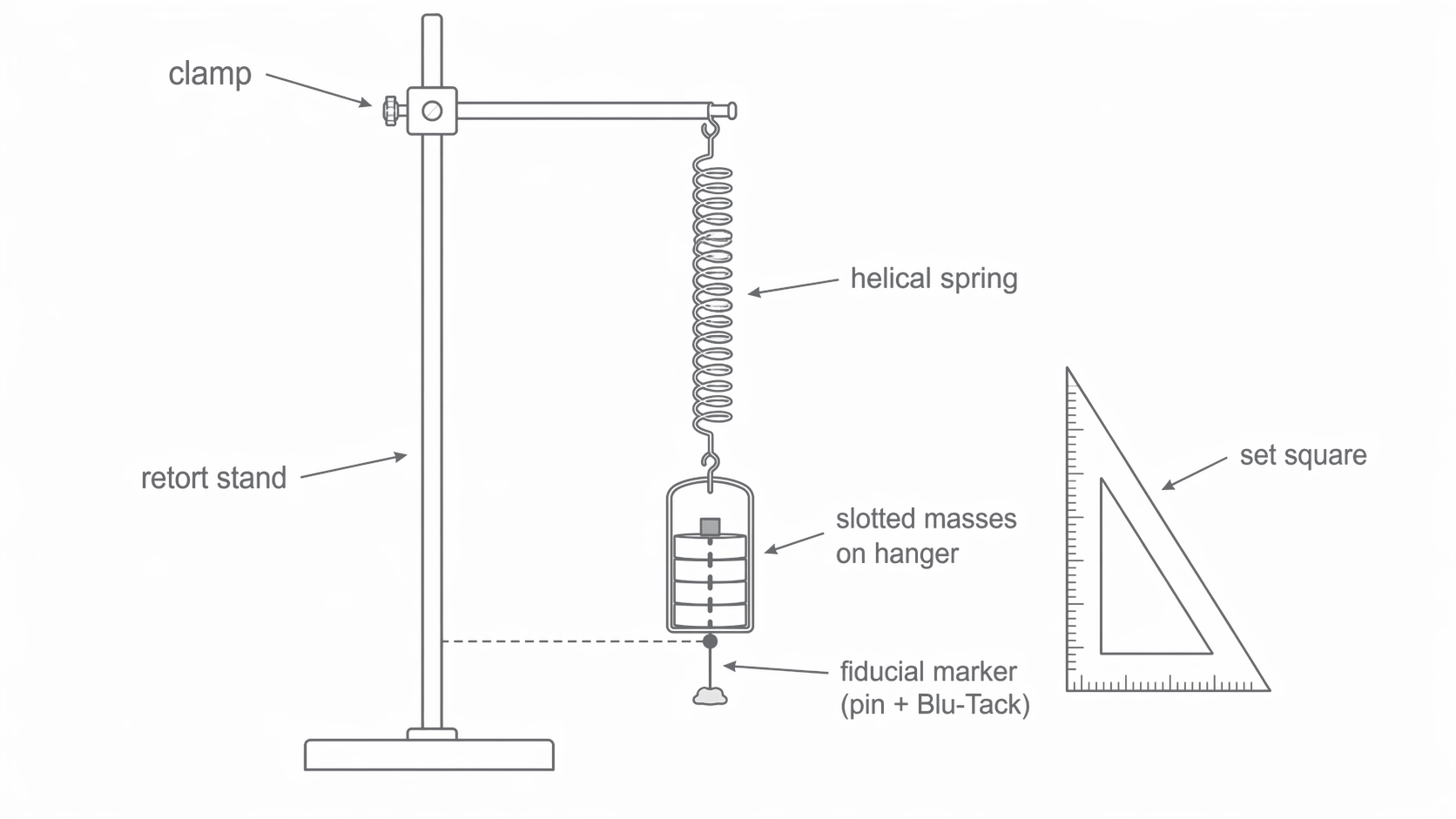
The sketches are schematic. Keep markers alongside or immediately below a safe unobstructed path; they must not touch the moving object. Use the same spring and check for permanent extension after unloading. Timing nine cycles but dividing by ten makes too small, not too large.
Electronic timing
A calibrated position sensor with a data logger removes manual start/stop reaction delay but still has resolution, sampling and calibration uncertainties. Choose enough samples per cycle to resolve the trace, measure between well-separated equal-phase peaks and divide by the number of cycles between them. A calibrated motion transducer can also feed an oscilloscope: four divisions per cycle at gives . At , a two-division peak-to-peak signal is ; displacement needs the sensor's volts-per-metre calibration, and amplitude is half the peak-to-peak displacement. A signal generator and vibration transducer can extend the apparatus to driven oscillations, with drive frequency and amplitude controlled separately.
Control variables and test assumptions
Change one intended independent variable at a time. For the pendulum length investigation, keep the same bob, pivot and small initial angle; a change of bob size can change the centre-of-mass position even though the ideal period is independent of mass. For the spring investigation vary total hanging mass, hold stiffness fixed and keep amplitude small enough for Hooke's law and a taut spring.
Repeat readings reveal spread and possible anomalies. Investigate a discrepant timing by repeating that setting and checking counting, lateral motion and slipping clamps; do not remove a point merely because it is inconvenient. A mean reduces random variation but does not correct a ruler offset or a consistently wrong cycle count.
To test amplitude independence, keep or fixed and vary initial amplitude, repeating the same timing procedure. Small changes consistent with timing uncertainty support the ideal model. Large-angle pendulum oscillations should give longer periods. To test pendulum mass independence, keep length to the bob centre fixed while changing bob mass; keep shape similar to control air resistance.
If heavy loading permanently stretches a spring, the spring has changed. Stop, use a suitable load range and repeat with a spring whose force-extension behaviour is stable. Do not assume old data before and after permanent extension belong to one unchanged stiffness. The limit of proportionality and the elastic limit describe different things: a spring may depart from a linear force-extension law before permanent deformation occurs.
Record apparatus resolution, settings, unusual motion and method changes alongside the data. This is preparation for practical work; written answers alone do not demonstrate the teacher-observed skills required for the practical endorsement.
Continue this lesson.
You’re previewing NovaLearn without an account. Create a free account to read the rest.
Create free account