3.9.2.2 - Absolute Magnitude and Distance
Absolute magnitude compares stars at a fixed distance. Use the geometry of parallax to understand the parsec, then combine independent distance measurements with the magnitude scale to infer and check intrinsic stellar brightness.
Units of astronomical distance
A light year is the distance light travels in a vacuum in one year, not a period of time. Multiplying by gives
An astronomical unit, AU, is approximately the mean Earth–Sun distance: . The parsec, pc, is the distance at which a transverse baseline of 1 AU subtends an angle of one arcsecond. One arcsecond is of a degree.
Thus . To convert light years into parsecs, divide by 3.26: . Multiplying instead would give a larger numerical distance in the larger unit, a useful warning that the conversion is reversed.
Parallax and the parsec
A nearby star appears to shift against distant background stars as Earth orbits the Sun. This apparent shift is stellar parallax; it is caused by the changing observing position, not the star making an annual journey across the sky.
Observations six months apart use opposite sides of Earth's orbit. In the ideal geometry shown, the full angular shift is . The parallax angle uses the half-baseline from the Sun to Earth, 1 AU.
[DIAGRAM: asset_name: A.2.2 - Absolute Magnitude, M - Diagram 1; asset_slug: A.2.2 - Absolute Magnitude, M - Diagram 1; caption: Parallax uses the 1 AU half-baseline and half the six-month angular shift; description: The angle theta at the star lies between the star–Sun line and one star–Earth line. Distances and angle are exaggerated, not to scale.]
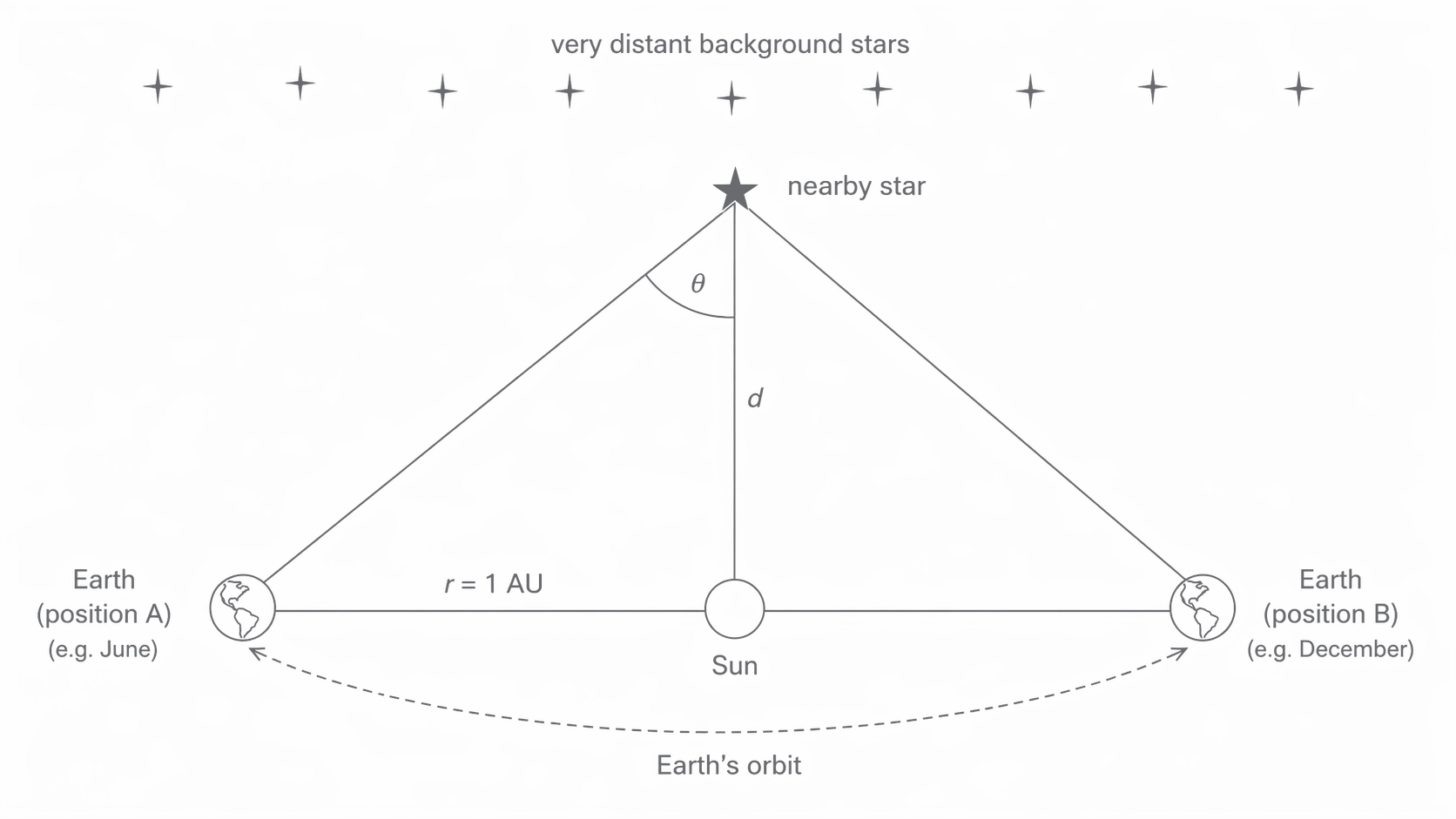
From the right triangle, . For a very small angle in radians, , so . Since one arcsecond is , a 1 AU baseline gives : one parsec, within rounding.
Parallax distance
Do not insert degrees or radians into this particular unit form. A parallax of arcseconds gives , whereas a full six-month shift of arcseconds gives arcseconds and .
At larger distances the angle becomes smaller. A fixed angular measurement uncertainty is then a larger fraction of the signal, making the distance less precise. An observed displacement can also include a star's own motion, so repeated measurements distinguish the annual parallax from that motion.
Absolute magnitude removes the distance effect
Absolute magnitude is the apparent magnitude a star would have if placed at a distance of 10 parsecs from Earth. This is a notional comparison: the star is not physically moved.
Fixing distance removes its effect on the received intensity. A lower absolute magnitude therefore means greater intrinsic luminosity in the specified wavelength band. Comparing total luminosities requires total, or bolometric, magnitudes; ordinary visible magnitudes refer to visible light. The magnitude–distance relation works when the same band is used for and , with absorption negligible or corrected.
Continue this lesson.
You’re previewing NovaLearn without an account. Create a free account to read the rest.
Create free account