3.13.6.1 - Principles of Communication Systems
A real-time communication system delivers information as it is produced, with a short delay. Follow a signal from its source, through a transmission medium, to an output, and explain why each stage is needed.
Following the signal
A communication system transfers information from a source to a destination. A block diagram shows the function of each stage and arrows show the direction of signal flow; it does not show the circuitry inside each block.
The general system has the sequence below. Follow the top row to the right and the lower row back to the left. The output amplifier is a separate stage after information has been recovered.
[DIAGRAM: asset_name: E.6.1 - Principles of Communication Systems - Diagram 1; asset_slug: E.6.1 - Principles of Communication Systems - Diagram 1; caption: Signal flow through a real-time communication system; description: Signal flow through a real-time communication system]
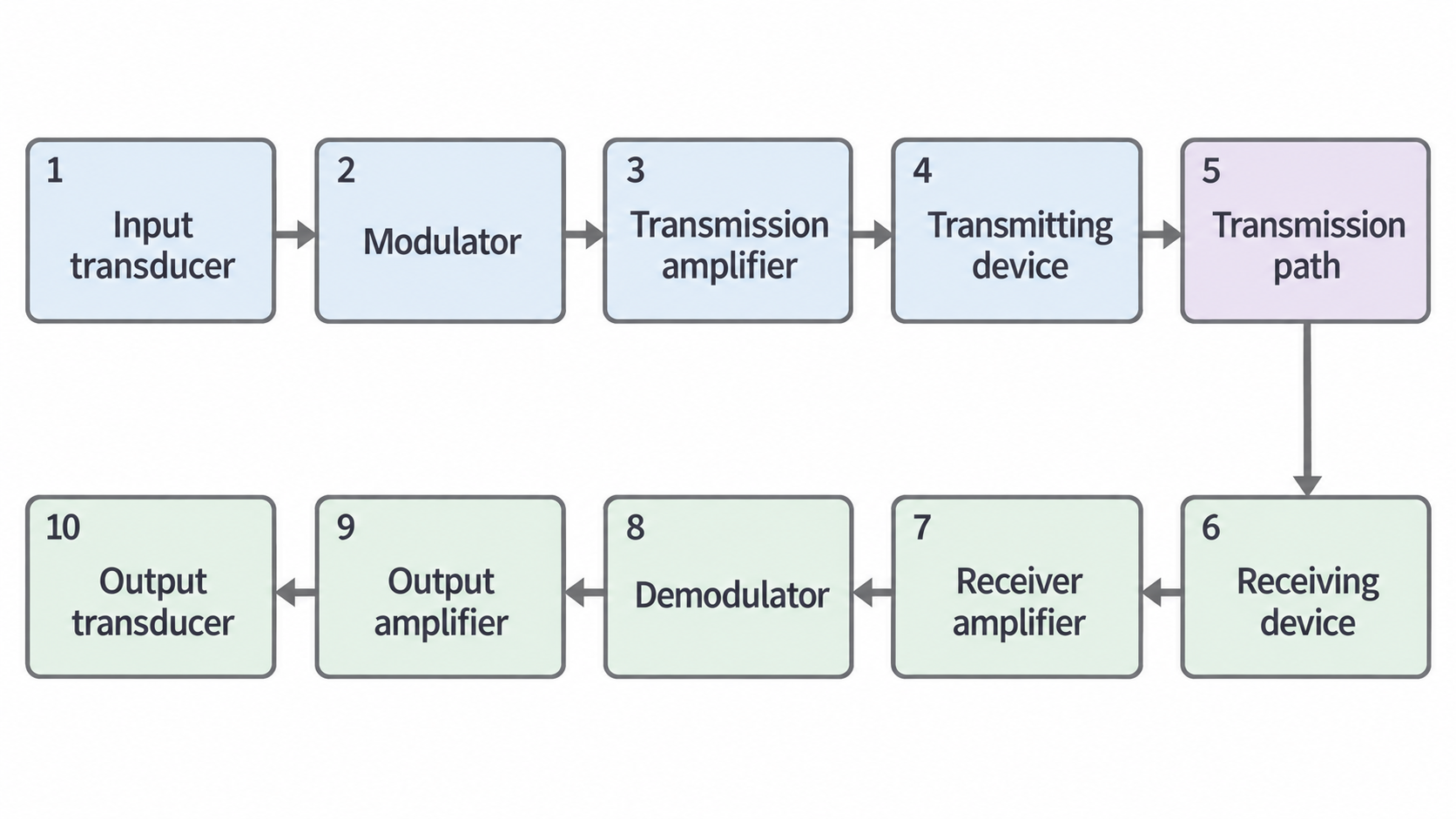
- Input transducer → modulator → transmission amplifier → transmitting device.
- Transmission path.
- Receiving device → receiver amplifier → demodulator → output amplifier → output transducer.
The message is preserved while its physical form changes. Sound from a microphone becomes an electrical information signal; a radio link carries it in an electromagnetic wave; a loudspeaker converts the recovered electrical signal back to sound. Real time does not mean zero travel time.
Preparing and transmitting the message
A microphone produces a small electrical signal whose variations represent the original sound. It is an input transducer: a device converting the physical input into an electrical signal.
The modulator varies a property of a carrier wave in accordance with this information. The carrier is chosen to suit the transmission path. This is different from merely making the microphone signal larger.
The transmission amplifier raises the modulated signal's amplitude or power to a level suitable for transmission. The signal will weaken along the path, so launching sufficient power helps it remain detectable. The transmitting device launches the prepared signal: an aerial radiates radio waves; a laser diode or LED emits light into a fibre.
| Stage | Input and useful change |
|---|---|
| Input transducer | Physical information → electrical information signal |
| Modulator | Information varies a property of the carrier |
| Transmission amplifier | Prepared signal → higher signal amplitude/power |
| Transmitting device | Electrical signal → transmitted wave in the chosen medium |
Continue this lesson.
You’re previewing NovaLearn without an account. Create a free account to read the rest.
Create free account