3.12.2.5 - Wave–particle duality
Electrons carry charge and arrive in localised interactions, yet a beam can produce diffraction. Use de Broglie’s relation to connect that wave evidence to momentum and to predict how an accelerating voltage changes the pattern.
de Broglie's proposal
De Broglie proposed that matter has a wave aspect, extending the dual behaviour already found for light. A moving particle with momentum has an associated de Broglie wavelength
For a non-relativistic particle, , giving . Momentum must be in for in to give wavelength in metres. The general relation uses momentum; replacing it with is only a low-speed approximation.
Greater momentum means shorter wavelength. Doubling momentum halves wavelength; it does not double it. A object moving at has wavelength , far too small for ordinary structures to reveal diffraction. Electrons have much smaller momentum and can have wavelengths on atomic scales.
Wave–particle duality means that the behaviour observed depends on the experiment: electrons show diffraction and interference, while their charge, momentum transfer and localised detections have particle-like aspects. An electron does not physically turn into a classical water wave between detections. The associated wavelength predicts patterns of outcomes.
From accelerating voltage to wavelength
An electron accelerated from rest through a potential difference of magnitude gains kinetic energy , where . This energy is in joules when is in volts. In the non-relativistic approximation,
Combining energy conservation with the de Broglie relation gives
This assumes negligible initial kinetic energy and no significant energy loss during acceleration. It is appropriate when the kinetic energy is small compared with the electron rest energy. At large TEM voltages, relativistic corrections become important; the formula is not universally exact.
Worked example and inverse decision
Using , electrons accelerated through gain . Their momentum is , so . Use the square root of the full product , and retain intermediate precision.
The equation also tells us how to choose a voltage for a target wavelength. Squaring and rearranging gives . Thus : multiplying voltage by four halves wavelength. The electron speed and momentum each double; they do not increase by four.
Why graphite produces rings
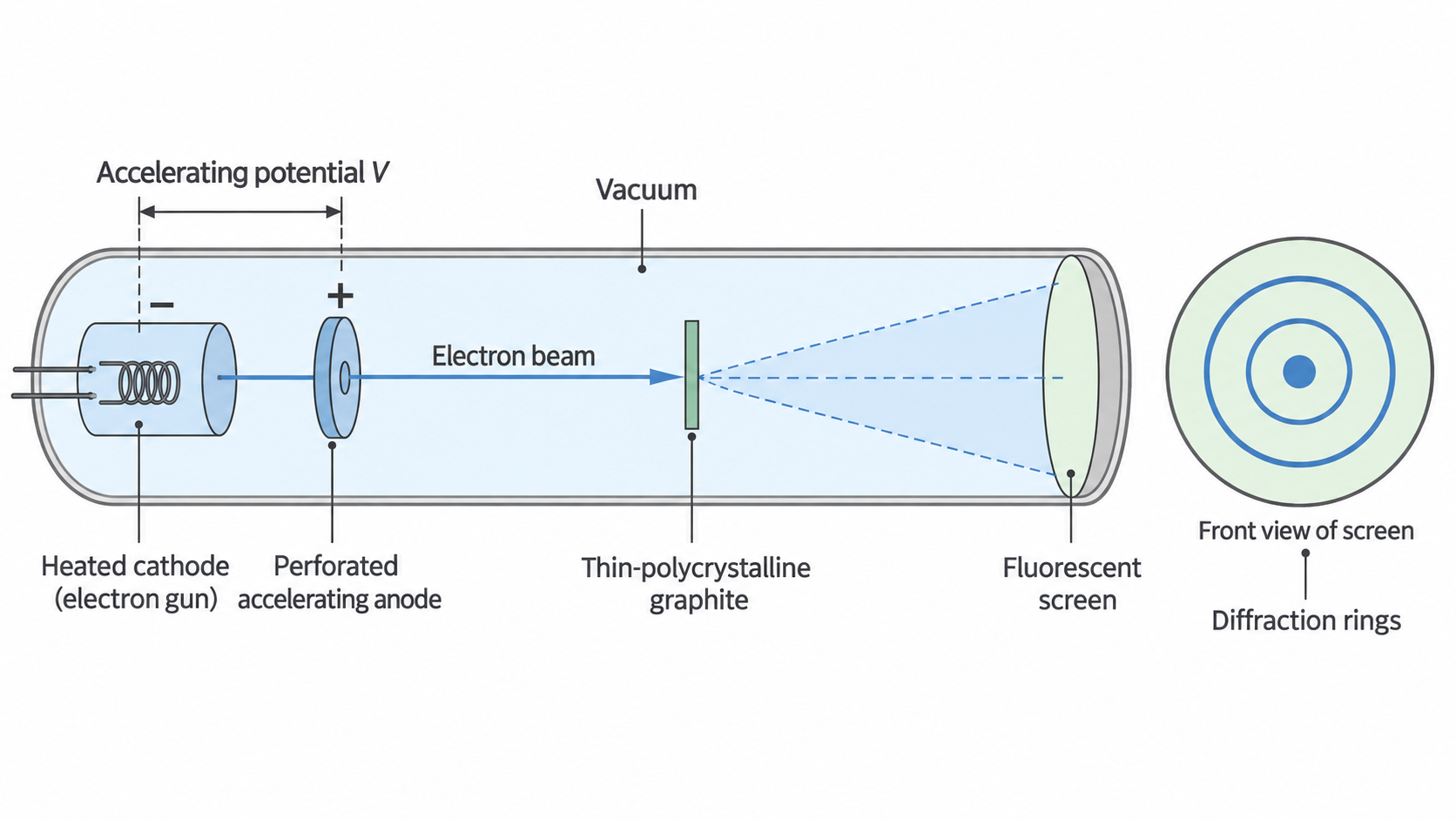
A diffraction tube accelerates electrons towards a thin polycrystalline graphite target in a vacuum. The electron gun's cathode is negative relative to the accelerating anode. A fluorescent screen shows where the transmitted electrons arrive. The vacuum reduces collisions with gas molecules; the target must be thin enough for useful transmission.
[DIAGRAM: asset_name: D.2.5 - Wave–Particle Duality - Diagram 1; asset_slug: D.2.5 - Wave–Particle Duality - Diagram 1; caption: Electrons accelerate towards the anode and diffract at a thin graphite target; description: Scientific teaching diagram with geometry and labels checked against the owning explanation.]
Continue this lesson.
You’re previewing NovaLearn without an account. Create a free account to read the rest.
Create free account