3.10.4.2 - Fibre Optics and Endoscopy
Optical fibres guide visible light into and out of the body. Trace the complete optical path through a flexible fibre endoscope, explain which information each bundle must preserve, and relate fibre design to image quality.
Guiding light by total internal reflection
An optical fibre confines light so that it can follow a flexible path. In a clad fibre, the light-carrying core has a higher refractive index than the surrounding cladding. Light repeatedly meets the core–cladding interface from inside the core.
Two conditions are needed for total internal reflection: light must be incident from the higher-index medium towards the lower-index medium, and the angle of incidence must exceed the critical angle. Angles are measured from the normal, perpendicular to the boundary, not from the fibre axis or the boundary itself.
At the critical angle , the refracted ray would travel along the boundary, so its angle to the normal is . Snell's law gives
where is the core index and is the lower cladding index. For , no propagating refracted ray carries light into the cladding in this ray model. The reflected angle equals the incident angle.
[DIAGRAM: asset_name: B.4.2 - Fibre Optics and Endoscopy - Diagram 1; asset_slug: B.4.2 - Fibre Optics and Endoscopy - Diagram 1; caption: Light reflects inside the higher-index core. Incidence and reflection angles are measured from the normal.; description: Continuous equal-angle ray path and enlarged normal at core–cladding interface.]
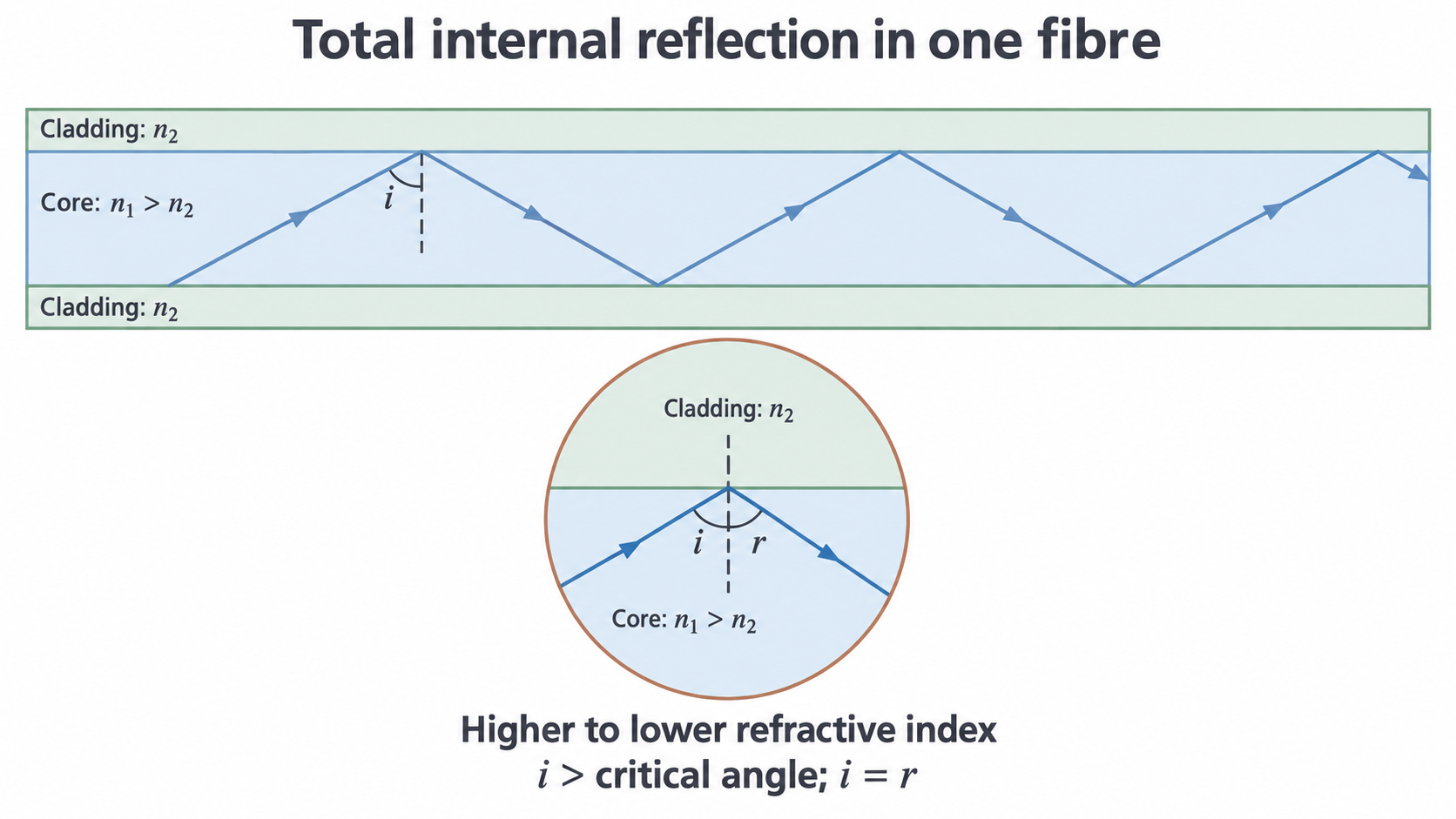
For example, and give . A ray incident at to the normal is totally internally reflected; one at is partly transmitted into the cladding. Bending a fibre too tightly can reduce incidence below the critical angle at its outer boundary, causing light loss.
Cladding provides a controlled lower-index boundary and optically isolates neighbouring cores. Without it, light can cross between touching fibres. It also protects the core surface, although an outer coating provides further mechanical protection. Whether each individual fibre must preserve its own signal depends on the bundle's job, which is the next distinction.
Preserving an image or delivering illumination
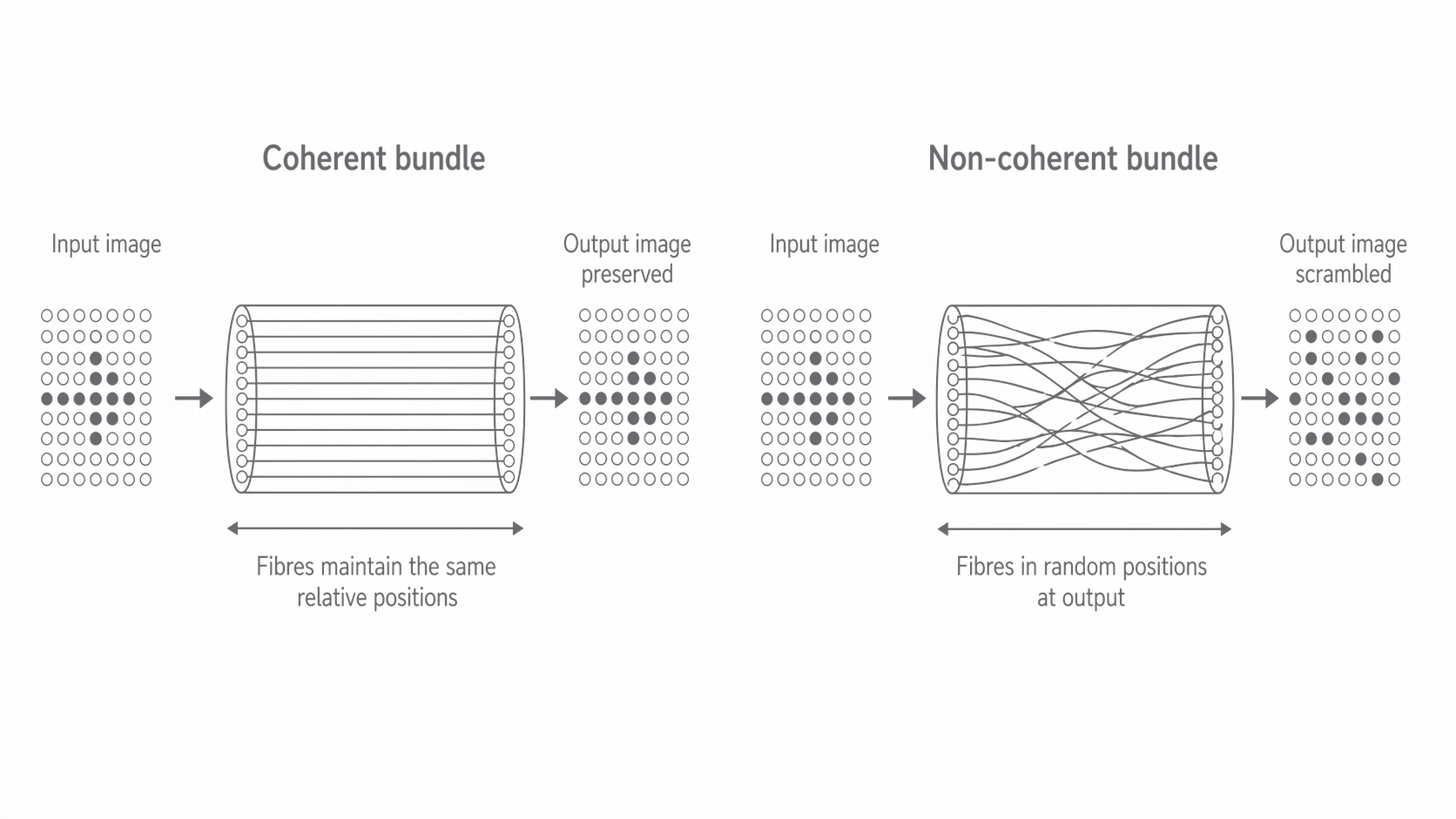
A bundle contains many fibres, each carrying light from one small area of its input face. An image is a spatial pattern, so reproducing it requires keeping those areas in the correct relative order.
In a coherent bundle, corresponding fibres occupy the same relative positions at both ends. A bright point at the top left of the input remains at the top left of the output. The middle of the bundle can bend: coherence here means preserved spatial ordering at the ends, not identical optical phase as in coherent laser light.
In a non-coherent bundle, the relative positions are not preserved. The same light may emerge, but in a scrambled pattern. It is suitable for illumination because delivering light to a surface does not require transmitting a recognisable input image. Such a bundle is simpler to assemble because individual positions need not be tracked.
[DIAGRAM: asset_name: B.4.2 - Fibre Optics and Endoscopy - Diagram 2; asset_slug: B.4.2 - Fibre Optics and Endoscopy - Diagram 2; caption: A coherent bundle preserves the pattern of bright fibres. A non-coherent bundle scrambles that pattern.; description: Qualitative comparison of relative fibre positions at input and output.]
Why cladding matters differently in the two bundles
The coherent image bundle needs individual optical isolation. If light leaks from one core into a neighbour, a bright input point can illuminate the wrong output point, reducing contrast and destroying detail even if the fibres remain in the correct physical order. Lower-index cladding prevents this mixing.
For the non-coherent illumination bundle, transfer of light between neighbouring fibres does not destroy information the instrument needs: no image is being carried. Individual cladding is therefore not essential for preserving its function. An actual illumination bundle may still be clad for construction or transmission reasons; do not turn 'not required for an image' into 'must never have cladding'.
The optical path through a flexible endoscope
A flexible fibre endoscope carries light to an internal surface and returns an image to an observer outside the body. The distal end is the tip inside the body; the proximal end is near the observer.
Follow the path in order:
- An external lamp sends light along a non-coherent illumination bundle to the distal tip. Reflection within the fibres guides it around the flexible tube.
- Light leaving the tip illuminates the tissue. Some light is reflected from that surface towards the optical system.
- An objective lens at the distal tip forms an image of the surface on the input face of the coherent bundle.
- Each isolated fibre carries one small element of that image by total internal reflection. The bundle preserves the elements' relative positions.
- An eyepiece magnifies the output image for viewing, or a camera displays it on a screen.
Continue this lesson.
You’re previewing NovaLearn without an account. Create a free account to read the rest.
Create free account